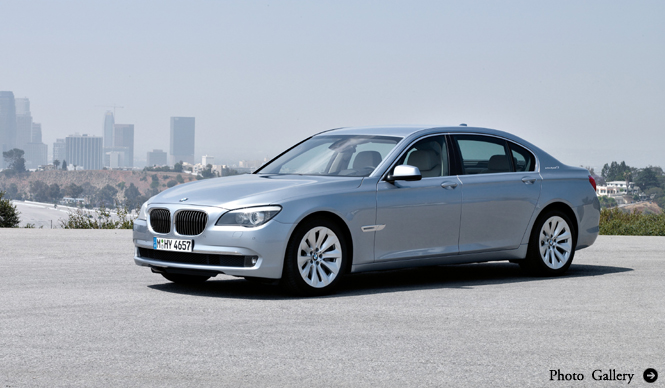
BMW ACTIVE HYBRID 7 | A Worthy Rival to the Lexus LS600h
BMW ACTIVE HYBRID 7 | A Worthy Rival to the Lexus LS600h
A Worthy Rival to the Lexus LS600h
BMWhas announced the introduction of a hybrid model, the "ActiveHybrid 7," to its 7 Series lineup.
By Giraffe
4.4-Liter V8 Twin-Turbo Plus Electric Motor
The system powering the BMW ActiveHybrid 7 is known as a mild hybrid, where a motor integrated between the engine and torque converter assists the engine during driving.
The engine is a 4.4-liter V8 twin-turbo, paired with a motor producing a maximum output of 15 kW (20 hp) and a peak torque of 210 Nm (21.4 kgm). It utilizes a lithium-ion battery. This setup delivers a combined system output of 465 ps and 71.4 kgm of torque, achieving 0-100 km/h in 4.9 seconds with an 8-speed automatic transmission.
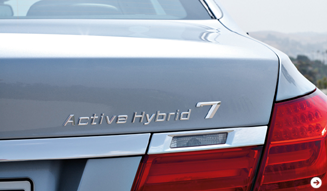
Approximately 15% Improvement in Fuel Economy
Furthermore, the adoption of regenerative braking and an idling stop function contributes to enhanced fuel efficiency. Even when the engine is off, the "ActiveHybrid 7" maintains air conditioning, allowing for cabin cooling before a summer drive without starting the engine.
The fuel economy is rated at approximately 10.6 km/l, representing about a 15% improvement compared to the 750i.
This new model will be available in two variants: the standard wheelbase "ActiveHybrid 7" and the long-wheelbase "ActiveHybrid 7L." It is scheduled for its official debut at the Frankfurt Motor Show in September, followed by a market launch in the US, its primary target market, around the spring of 2010.
BRAND HISTORY
Instantly recognizable by its "kidney grille" and quad round headlights, BMW's distinctive front fascia is a hallmark of the brand. While consistently popular in the Japanese import car market, surprisingly few may know the meaning behind its name.
Bayerische Motoren Werke. Literally translated, it means "Bavarian Engine Works." Its predecessor, Rapp Motorenwerke, was an aircraft engine manufacturer founded in 1913 in Bavaria, Germany, by Karl Friedrich Rapp. Rapp partnered with fellow Bavarian aircraft manufacturer Otto-Flugzeugwerke to achieve business success. In 1916, the company was renamed Bayerische Motoren Werke GmbH. Two years later, it reorganized as a stock corporation and registered its propeller logo, inspired by the blue sky and white clouds of Bavaria.
BMW continued to enhance its presence through innovative technology, but the defeat in World War I forced the cessation of aircraft engine production. Consequently, BMW channeled its expertise into motorcycles, unveiling the shaft-driven "BMW R32" in 1923, which garnered significant attention. Not content with this, the company acquired Dixi, a licensee of the Austin Seven. This acquisition provided a foothold in the automotive business, leading to the launch of the "BMW 3/15 PS" in 1929, marking the start of its history as an automobile manufacturer.
Incidentally, Otto-Flugzeugwerke, which had a close relationship with BMW, was founded by Gustav Otto, the son of Nikolaus August Otto, who established the theory of the internal combustion engine. This historical connection likely explains BMW's continued focus on internal combustion engines.