BMW and Daimler Research Wireless Charging Together | BMW & Daimler
BMW & Daimler | Daimler & BMW
BMW and Daimler Jointly Research Wireless Charging
With the expansion of EV and plug-in hybrid models, Daimler and BMW have announced they will jointly research and unify specifications for wireless charging facilities, which allow charging simply by parking, as an alternative to current plug-in chargers.
Text by HORIGUCHI Yoshihiro (OPENERS)
A Powerful Partnership to Aid the Spread of EVs and PHEVs
German manufacturers are rapidly expanding their lineups of EVs and plug-in hybrids. A key inconvenience for users, compared to gasoline cars, is the charging process. Currently, all manufacturers use cables, requiring users to plug and unplug at the start and end of charging. Furthermore, when charging outdoors, one might be exposed to wind and rain during the operation, or soil their clothes and hands with dust from the cable.
Consequently, all manufacturers are researching wireless charging systems that "automatically charge simply by parking in a designated spot." We have previously reported on initiatives byVolvoandToyota, but now BMW, which has just released the pure EV "i3" and the plug-in hybrid sports car "i8", and Daimler, which is a leader in city commuters with the "Smart EV" and is about to launch the "S 500 Plug-in Hybrid", have announced they will jointly research and work towards unifying specifications between the two companies.
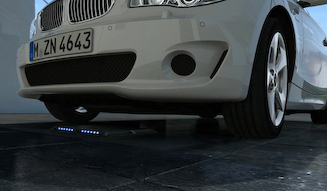
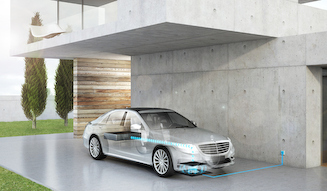
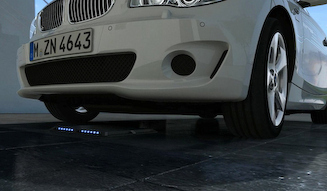
The prototype specifications currently involve an electromagnetic induction method, where power is exchanged between a lightweight coil mounted on the vehicle and a coil embedded in the ground of the parking space. The transmittable power is 3.6kW, which is reportedly capable of fully charging the i8 in under two hours. The plan is to increase this to 7kW to accommodate larger capacity batteries in the future. For safety, the space between the floor coil and the vehicle coil is constantly monitored, and the system is equipped with a function to immediately stop charging if foreign objects are detected.
The realization of contactless chargers, which will likely accelerate the adoption of EVs and plug-in hybrids, appears to be gaining momentum through the collaborative efforts of these two German automakers.