The All-New Lexus IS Has Finally Arrived | Lexus
Lexus IS | The New Lexus IS
The All-New Lexus IS is Finally Here
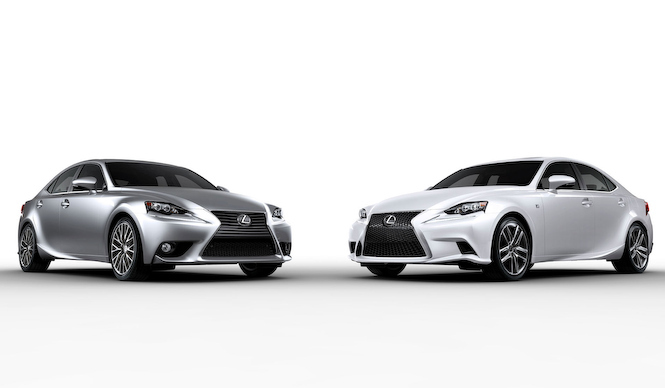
With a full model change and the long-awaited spindle grille, the new IS is a model that leads Lexus's sports image, emphasizing the "joy of driving." As previewed, it has been released today.
Text by SUZUKI Fumihiko (OPENERS)
IS Finally Goes on Sale
The second-generation Lexus ISwhich OPENERS has also featured, has finally gone on sale. For a test drive impression of it, we have the one fromYasuhisa Shimashita, and although it was before full-scale production, we also have one from a model produced on the same line as the production modelYasuhiko Kawamura, which OPENERS has already published, so please refer to them.
Here, we will first introduce the lineup of the IS, which has been officially announced this time.
The model lineup is broadly divided into three types based on powertrain differences. All of them are familiar from the LexusGSand the ToyotaCrown.
Specifically, the "IS 250" (4.2 million yen, "version L" 4.8 million yen, "F SPORT" 4.8 million yen) equipped with a 2.5-liter V6 engine (maximum output 158kW (215ps)/6,400rpm, maximum torque 260Nm/3,800rpm); the "IS 300h" (4.8 million yen, "version L" 5.38 million yen, "F SPORT" 5.38 million yen), which is the first hybrid model for the IS, combining a 2.5-liter inline 4-cylinder engine (maximum output 131kW (178ps)/6,000rpm, maximum torque 221Nm/4,200-4,800rpm) with an electric motor (output 105kW (143ps), torque 300Nm); and the top-of-the-line "IS 350" (5.2 million yen, "version L" 5.75 million yen, "F SPORT" 5.95 million yen) equipped with a 3.5-liter V6 engine (maximum output 234kW (318ps)/6,400rpm, maximum torque 380Nm/4,800rpm). These are the three types.
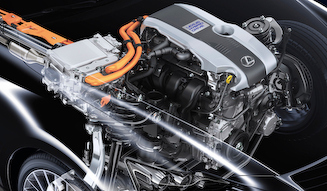
The transmission is a 6-speed automatic for the "IS 250," an electronically controlled continuously variable transmission for the "IS 300h," and an 8-speed automatic for the "IS 350."
Design Directly From the LF-CC
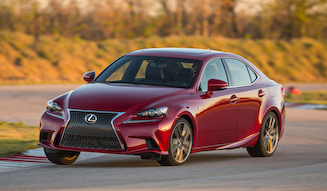
The exterior features sharp lines, elaborate for a production model, as if the concept modelParis Motor Show, which debuted at theLF-CC, has been made into a 4-door. The L-shaped LED clearance lamps, independent of the headlamps, are also as seen on the concept model.
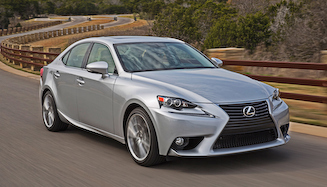
The New Lexus IS
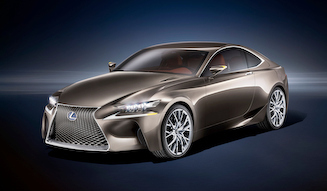
Concept Model LF-CC
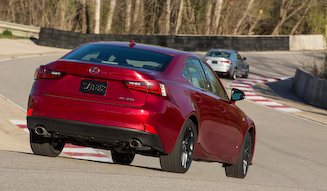
Additionally, although it's a minor detail, the wheel arches above the rear tires feature a treatment called arch hemming, a first for Lexus. Normally, the panel bends in an L-shape towards the tire, but here it is bent in a V-shape. This process increases production steps but provides the benefit of allowing the tires to be positioned further outward. In fact, the new IS has its tires 5mm wider than the previous model. This results in a wider track and, combined with the lowest front height for a Lexus, emphasizes a sporty styling.
The interior features Lexus's signature horizontal layout. The meter panel for the standard model has a two-dial LCD screen, which changes its display according to the driving mode for the hybrid model. For the F SPORT model, this becomes a large, movable ring meter, similar to the "LFA." It also adopts the LFA's control system, including changing the display with the steering switches.
The driving position has been made sportier by lowering the hip point by 20mm and tilting the steering wheel angle by 3 degrees.
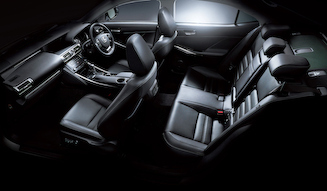
The body dimensions are 4,665mm in length, 1,810mm in width, and 1,430mm in height, with a wheelbase of 2,800mm. Compared to the previous model, the height remains the same, but the length has increased by 80mm, the width by 15mm, and the wheelbase by 70mm. As a result, the rear seat space has been expanded, which is also a feature of the new IS. Furthermore, in the hybrid model, by placing the battery under the trunk floor, the luggage capacity is 450 liters, nearly equivalent to the gasoline model's 480 liters.
Regarding driving performance, the body rigidity has been increased. While the front is based on the previous IS, the cabin and rear are based on the GS. In addition to adopting laser screw welding, which improves body rigidity more than spot welding, material optimization has been carried out and refined.
The suspension has been specially tuned, and features like "NAVI-AI AVS," which instantly changes damper damping force as needed, and "LDH (Lexus Dynamic Handling System)," which includes rear-wheel steering, are exclusive to the F SPORT model.
Lexus's First Safety Features
Finally, regarding safety features. The millimetre-wave radar-based Pre-Collision Safety System warns the driver if there is a possibility of collision with a preceding vehicle or obstacle. It assists braking or applies automatic braking to decelerate rapidly.
Lane Departure Alert is a feature that warns of lane departure by judging road lines with a camera, a first for Lexus. Blind Spot Monitor indicates vehicles in the rear blind spot with an indicator on the door mirror. Automatic High Beam automatically switches to high beams when the ambient light is insufficient for low beams, and returns to low beams when there is a preceding or oncoming vehicle or when the light is sufficient.
In terms of passive safety, in addition to airbags, a high-strength cabin, and an impact-absorbing body, the Pop-Up Hood, which lifts the engine hood upon collision detection to mitigate impact to the pedestrian's head, is also adopted for the first time by Lexus.
Chief Engineer Junichi Furuyama described the feeling he got during a test drive as "the car (IS) provoking me, saying 'you can push it harder, you can still go further,' making my heart race." OPENERS plans to cover this new IS further, so please look forward to it.

Lexus IS 350 | Lexus IS 350
Body Size | Length 4,665 x Width 1,810 x Height 1,430mm
Wheelbase | 2,800 mm
Tread Front/Rear | 1,535/1,550 mm (1,540mm rear only for F SPORT)
Minimum Ground Clearance | 135 mm
Minimum Turning Radius | 5.2 meters
Trunk Capacity | 480 liters
Weight | 1,630 kg (1,640 kg for F SPORT)
Engine | 3,456 cc V6 Direct Injection DOHC
Maximum Output | 234kW (318ps) / 6,400 rpm
Maximum Torque | 380Nm (38.7kgm) / 4,800 rpm
Transmission | 8-speed automatic (8-Speed SPDS)
Drivetrain | FR
Tires Front/Rear | 225/40R18 / 255/35R18
Fuel Economy (JC08 mode) | 10.0 km/ℓ
Price | 5.2 million yen ("version L" 5.75 million yen, "F SPORT" 5.95 million yen)
Lexus IS 300h | Lexus IS 300h
Body Size | Length 4,665 x Width 1,810 x Height 1,430mm
Wheelbase | 2,800 mm
Tread Front/Rear | 1,535/1,550 mm (1,540mm rear only for F SPORT)
Minimum Ground Clearance | 135 mm
Minimum Turning Radius | 5.2 meters
Trunk Capacity | 450 liters
Weight | 1,670 kg
Engine | 2,493 cc Inline 4-cylinder Direct Injection DOHC (Atkinson cycle)
Engine Maximum Output | 131kW (178ps) / 6,000 rpm
Engine Maximum Torque | 221Nm (22.5kgm) / 4,200-4,800 rpm
Motor Maximum Output | 105kW (143ps)
Motor Maximum Torque | 300Nm (30.6kgm)
System Maximum Output | 162kW (220ps)
Transmission | Electronically controlled continuously variable transmission
Battery | Nickel-metal hydride
Drivetrain | FR
Tires Front/Rear | 225/40R18 / 255/35R18
Fuel Economy (JC08 mode) | 23.2 km/ℓ
Price | 4.8 million yen ("version L" 5.38 million yen, "F SPORT" 5.38 million yen)
Lexus IS 250 | Lexus IS 250
Body Size | Length 4,665 x Width 1,810 x Height 1,430mm
Wheelbase | 2,800 mm
Tread Front/Rear | 1,535/1,550 mm (1,540mm rear only for F SPORT)
Minimum Ground Clearance | 135 mm
Minimum Turning Radius | 5.2 meters
Trunk Capacity | 480 liters
Weight | 1,580 kg
Engine | 2,499 cc V6 Direct Injection DOHC
Maximum Output | 158kW (215ps) / 6,400 rpm
Maximum Torque | 260Nm (26.5kgm) / 3,800 rpm
Transmission | 6-speed automatic (6 Super ECT)
Drivetrain | FR
Tires Front/Rear | 225/40R18 / 255/35R18
Fuel Economy (JC08 mode) | 11.6 km/ℓ
Price | 4.2 million yen ("version L" 4.8 million yen, "F SPORT" 4.8 million yen)