Audi Announces its First Mass-Produced EV, the "e-tron" | Audi
Audi e-tron
Audi Announces its First Mass-Produced EV, the "e-tron"
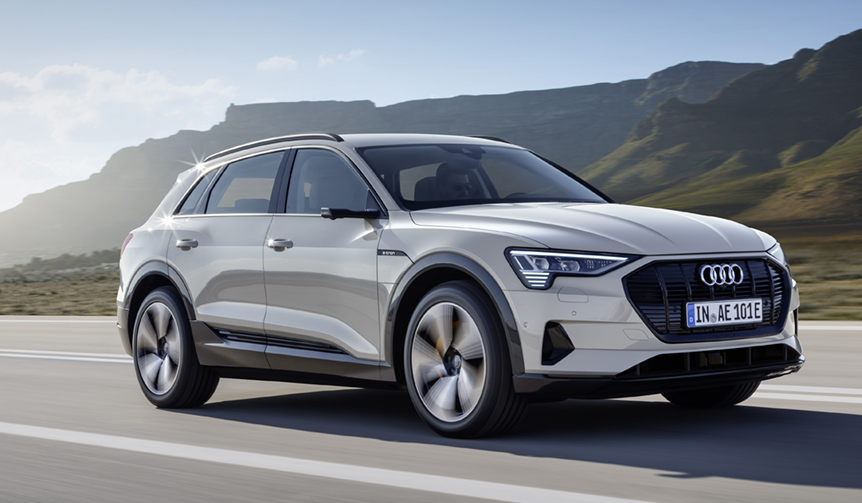
On September 18, Audi unveiled the "Audi e-tron," the brand's first mass-produced electric vehicle (EV). It offers the sportiness and practicality of a full-size SUV, high performance and agile handling thanks to two electric motors and an electric all-wheel-drive system, a range of over 400 km, and a wide variety of charging options, allowing owners to enjoy electric driving without any compromises.
Text by HARA Akira
408 PS and 664 Nm of Torque from Electric All-Wheel Drive
The two electric motors in the Audi e-tron, Audi's first mass-produced EV, deliver a system output of up to 408 PS (300 kW) and 664 Nm of torque in boost mode. Audi claims a 0-100 km/h acceleration time of 5.7 seconds and a top speed of 200 km/h (electronically limited). The instantaneous delivery of maximum torque enables quiet yet powerful acceleration.
The drive system is a new generation of quattro, an electric all-wheel-drive system that instantaneously and continuously varies the drive torque between the front and rear axles. By placing the drive components and battery system low in the center of the vehicle, it achieves a center of gravity height comparable to a sedan and an ideal weight distribution of 50:50 front to rear. Combined with a ride height adjustment function that can vary by up to 76 mm, it delivers powerful performance on any terrain.
Highly Efficient Recuperation System
The impressive range of over 400 km on a single charge is primarily due to an innovative recuperation system. Recuperation energy contributes up to 30 percent to the vehicle's range. Recuperation occurs in two ways: during coasting when the driver lifts their foot off the accelerator, and during braking when the brake pedal is pressed. In both cases, the electric motors function as generators, converting kinetic energy into electrical energy.
Specifically, for decelerations up to 0.3 G, which accounts for 90 percent of braking scenarios, only the electric motors perform recuperation. Only during sudden braking exceeding 0.3 G do the conventional wheel brakes engage. For example, when braking from 100 km/h, the e-tron can recuperate up to 300 Nm and 220 kW of electrical power, which corresponds to 70 percent of the input kinetic energy.
The electro-hydraulic brake control system instantly determines whether to use electric motor braking, conventional brakes, or a combination of both on each axle for recuperation. The seamless transition between electric and hydraulic braking ensures consistent braking force without the driver noticing.
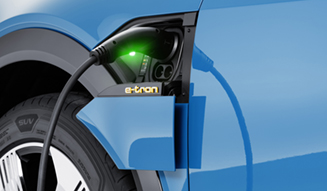
The high-voltage battery, with an energy capacity of up to 95 kWh, can be rapidly charged in approximately 30 minutes using a DC charger with a maximum output of 150 kW. It also supports AC charging up to 11 kW, with an optional 22 kW capability. The mobile charging system for home use can be connected to a 230V domestic outlet or a 400V three-phase outlet. When combined with a home energy management system, charging can be scheduled during off-peak hours or utilize power generated by a home solar installation.
Audi e-tron
Audi Announces its First Mass-Produced EV, the "e-tron" (Part 2)
Exterior and Interior Visualizing Electrification, Plus Top-Tier Assistance Systems
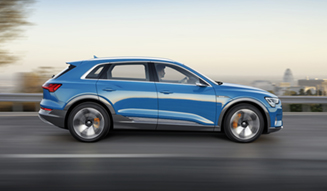
The e-tron is a full-size SUV with dimensions of 4,901 mm in length, 1,935 mm in width, and 1,616 mm in height. Its long wheelbase of 2,928 mm provides comfortable space for five occupants and a luggage capacity of 660 liters.
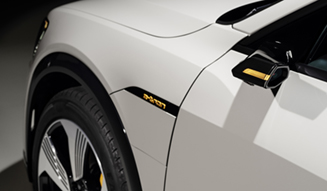
The exterior features a platinum gray, octagonal singleframe grille signifying its electric nature, and struts in place of exhaust pipes. The e-tron logo on the charging flap and the optional brake calipers are highlighted in orange, symbolizing high voltage.
The optional virtual exterior mirrors incorporate small cameras at the end of slender stalks, displaying images on high-contrast OLED displays inside the vehicle. This contributes to a reduced drag coefficient, achieving a class-leading 0.27 for the SUV segment and reportedly increasing range by approximately 40 km per charge.
The interior comes standard with the latest Audi Virtual Cockpit. Nearly all traditional switches have been replaced by displays, which can also be operated via voice control. The center tunnel console features an open structure on both sides, allowing the driver to rest their hand on the seemingly floating console and operate the integrated shift switch with their thumb and index finger.
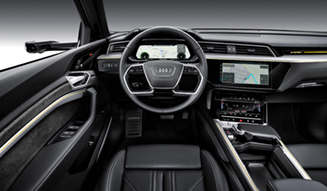
The e-tron utilizes efficiency assist, leveraging up to five radar sensors, six cameras, twelve ultrasonic sensors, one laser sensor, navigation data, and "Car-to-X" information. This system provides predictive hints and automatic recuperation functions displayed on the Virtual Cockpit to support economical driving. When combined with the adaptive cruise assist, it can also predictively decelerate and accelerate the vehicle.
The navigation system's e-tron route planner intelligently suggests destinations based on previously driven routes and charging stations. It also considers the battery's charge status and traffic information to estimate arrival times, including charging duration.
Production takes place at Audi's CO2-neutral factory in Brussels, with deliveries to European customers scheduled for the latter half of 2018. The base price in Germany is set at 79,900 euros (approximately 10.46 million yen).
Contact Information
Audi Communication Center
0120-598106