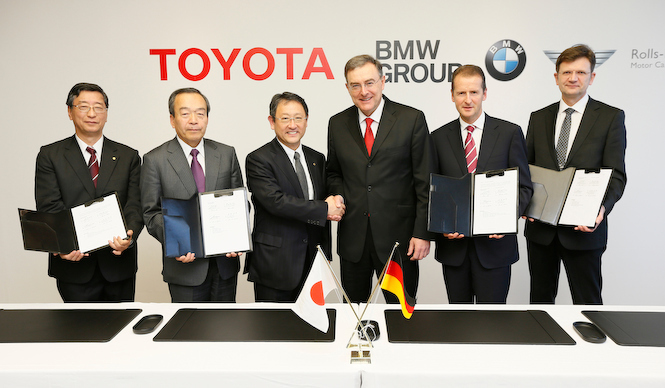
BMW and Toyota Sign Collaboration Agreement | BMW & Toyota
BMW & TOYOTA | Toyota & BMW
BMW and Toyota Sign Cooperation Agreement
Speaking of BMW and Toyota, their relationship began in December 2011 with an agreement to build a mid-to-long-term cooperative framework for next-generation environmentally friendly vehicles and technologies. Last March,Announce Joint Research on Next-Generation Lithium-Ion Battery Technologyin June,a joint announcement exploring cooperation including fuel cells and sports car developmentwas made. Today, they announced the formal signing of a cooperation agreement covering four areas: "Joint research on lithium-air batteries," "Development of fuel cell systems," "Joint development of lightweight technologies," and "Feasibility of sharing a mid-size sports car platform."
Text by SUZUKI Fumihiko (OPENERS)
Cooperation in Four Areas
Lithium-air batteries, which boast performance far exceeding that of lithium-ion batteries – increasingly the standard for plug-in hybrids – are considered a "dream battery." As the name suggests, they generate electricity through a chemical reaction between lithium and air. However, commercialization has yet to be realized, and various challenges must be overcome. The two companies will tackle this technology together.
Beyond next-generation batteries lies the development of fuel cell systems. In pursuit of a future zero-emission society, this initiative involves not only the fuel cell systems themselves, including hydrogen tanks and motors, but also the joint development of social infrastructure and standardization. Based on the results of this research, Toyota intends to launch a new FCV (fuel cell vehicle) to the market by 2020.
The two companies will also collaborate on the joint development of platforms utilizing cutting-edge materials such as reinforced resins. The outcomes of this effort are expected to be reflected in the platform development of both companies. BMW has experience in this area, having adopted a carbon structure for its soon-to-be-released compact mass-production model,the "i3."Further developments are anticipated.
Furthermore, the development of sports cars utilizing the results of these research efforts is also within the scope of their cooperation. This is still in its very early stages, with both companies investigating their respective technologies and markets. A feasibility study is planned for 2013. If deemed highly feasible, they will then explore how to proceed with cooperation.
None of these initiatives represent a superficial collaboration based on existing assets. Instead, they signify substantial joint investment for the future. Both companies emphasized the importance of sharing a common vision and having a trustworthy partner, as these endeavors involve disclosing core aspects of their automotive manufacturing processes and will require considerable time to yield results. BMW appears to believe that this is a pivotal moment for the transformation of personal mobility, and that decisive action now will shape the future. Their expectations for cooperation with Toyota are therefore significant.