Evolving to its Third Generation! The Mercedes-Benz CLS Arrives | Mercedes-Benz
Mercedes-Benz CLS | Mercedes-Benz CLS
Evolving to its Third Generation! The Mercedes-Benz CLS Arrives | Mercedes-Benz
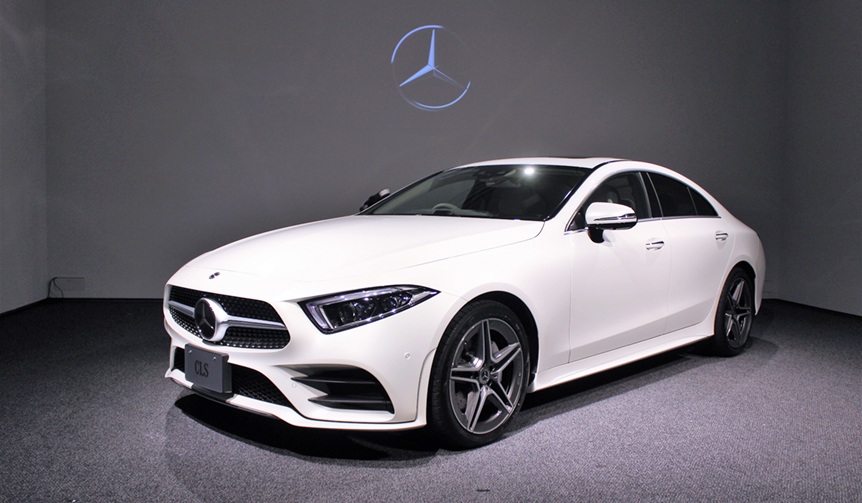
Mercedes-Benz Japan has announced the third-generation CLS. It will be available in two grades: the "CLS 220 d Sports" equipped with a 2-liter inline-4 diesel engine, and the "CLS 450 4MATIC Sports" equipped with a 3-liter inline-6 turbo and ISG, with prices starting from 7.99 million yen.
Text & Photographs by Shunichi Uchida
Inspired by the Oceanic Whitetip Shark
First, I'd like to discuss the design, which is a core value of the new CLS. The overall proportions haven't changed drastically from previous CLS models. However, the character lines, press lines, and the "reverse slant" of the front are significant new features.
This is the first time a new design language has been embodied, based on Mercedes-Benz's fundamental design philosophy of "Sensual Purity," but taking that philosophy a step further.
Robert Lesnik, Head of Exterior Design at Daimler AG, reflects on the past CLS models as follows.
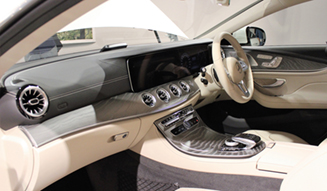
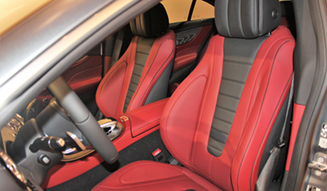
"The first generation, which debuted in 2004, had a low cabin, typical Mercedes proportions for a rear-wheel-drive vehicle, short overhangs, and a long dash-to-axle distance. Its body featured sharp angles in various places, creating an overall edgy design. Then, the second generation, launched in 2011, shared the same overall proportions and wheelbase as the first. However, the major difference was the addition of numerous character and press lines, replacing the edges. In retrospect, there were too many lines."
Therefore, the new CLS returns to its roots with the first generation. While the proportions remain largely unchanged, a "side bone" has been added to the side of the body instead of sharp edges. This creates a solid, well-defined skeletal structure.
When asked about this design, Lesnik mentioned it was inspired by the oceanic whitetip shark. "Although smaller than a great white shark, it has agile movements, and its very shape symbolizes speed. Adding the side bone makes the car sleeker."
Mercedes-Benz CLS | Mercedes-Benz CLS
Evolving to its Third Generation! The Mercedes-Benz CLS Arrives | Mercedes-Benz
Proportions, Not Lines
Mercedes-Benz has consistently adhered to its design philosophy of "Sensual Purity." With the CLS, it has evolved to "2.0." "It's become cleaner and smoother. We've designed it so that people appreciate the 'proportions themselves' rather than just the lines, incorporating very sharp graphics. This is a form we've adopted for the first time at Mercedes, a philosophy that is very modern and will be applied to future models," says Lesnik.
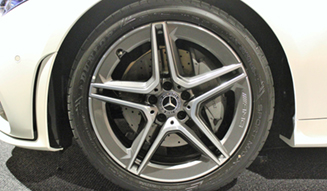
Additionally, the aerodynamically designed wheels, first introduced on the new CLS, and the air curtains located in front of the front wheels are important design features that will be carried over to future models.
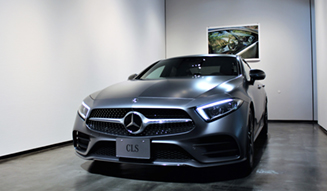
The CLS 220 d Sports is powered by a 2.0-liter inline-4 BlueTEC engine, also found in the "E-Class," producing a maximum output of 194 hp and a maximum torque of 400 Nm.
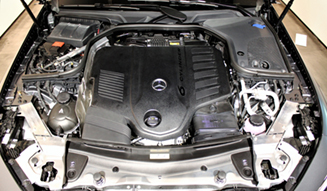
The CLS 450 4MATIC Sports features a powertrain that simultaneously achieves efficiency, comfort, and high performance by incorporating new technologies such as the inline-6 engine, designated M256, an Integrated Starter Generator (ISG), and a 48V electrical system.
The M256 engine alone produces a maximum output of 367 hp and a maximum torque of 500 Nm. Components such as the air conditioner and water pump, which were previously driven by the engine's rotation, are now electric. This eliminates the need for a belt drive system at the front of the engine, resulting in a more compact engine.
Mercedes-Benz CLS | Mercedes-Benz CLS
Evolving to its Third Generation! The Mercedes-Benz CLS Arrives | Mercedes-Benz
Intentionally Not Stopping the Engine
The ISG is an electric motor, positioned between the engine and transmission, producing a maximum output of 16 kW and a maximum torque of 250 Nm. It also functions as an alternator and starter. This electric motor and the 48V electrical system generate electricity through regenerative braking, similar to conventional hybrid vehicles, and charge a lithium-ion battery with a capacity of approximately 1 kWh. When the engine is at low RPMs, this power is used to provide motive force assistance, achieving high efficiency and powerful acceleration.
Furthermore, by using a higher-output electric motor for the starter, vibrations during engine startup are suppressed, and the comfort of restarting the engine during start-stop operation is improved.
Additionally, since engine stops lasting less than two seconds increase fuel consumption compared to not stopping the engine at all, a function has been implemented that intentionally avoids stopping the engine if it is predicted that the engine will not stop for more than two seconds, based on the driver's driving data and information from radar sensors.
The safety and driver assistance systems are the latest, equivalent to those in the "S-Class." These include DISTRONIC Active Distance Assist, which not only maintains distance from the vehicle ahead but also monitors surrounding traffic and provides steering assistance; ACTIVE LANE CHANGE ASSIST for changing lanes on highways; and REMOTE PARKING ASSIST, which enables automatic parking via remote control using a smartphone from outside the vehicle.
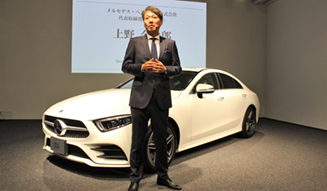
Kintaro Ueno, President of Mercedes-Benz Japan, stated, "The CLS debuted in 2004 as a model that created a new category: the four-door coupe, by merging the elegant and emotional styling of a coupe with the comfort and practicality of a four-door sedan. Since then, this segment has become incredibly popular, and it's no exaggeration to say that four-door coupes are now an established, mainstream segment. The CLS's unique styling has been loved by many customers, with approximately 380,000 units sold worldwide." He expressed great expectations for the third generation.