Lamborghini's super SUV, the Urus, unveiled for the first time in Japan | Lamborghini
Lamborghini Urus | Lamborghini
Lamborghini's Super SUV, the Urus, Unveiled for the First Time in Japan
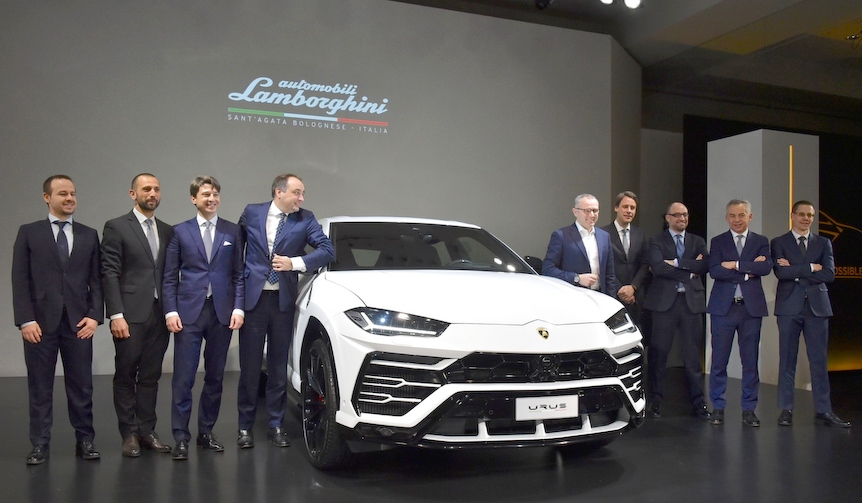
On February 6, Lamborghini unveiled its new high-performance SUV,Urusat an event for the press in Tokyo. The Urus is the company's third model, following theAventadorandHuracanand has been developed as a super SUV that infuses Lamborghini's DNA of design, performance, driving, and emotion into the most versatile vehicle, the SUV. The name 'Urus' is said to come from the aurochs, a large wild bull also known as the urus, which has a very similar appearance to the Spanish fighting bulls that are a tradition for Lamborghini.
Text by HARA Akira
0-100 km/h in 3.6 Seconds, Top Speed of 305 km/h: The Super SUV
The unveiled Urus boasts a gleaming white body, symbolizing the dawn of a new era for Lamborghini.
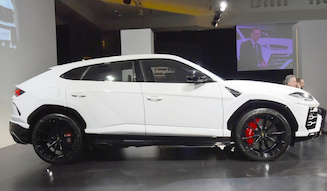
Its exterior, which follows the Lamborghini tradition of super sports cars with two-thirds body and one-third window, features a raised hood, the diagonal hood line from the Countach, familiar Y-shaped headlights, large air intakes forming a hexagonal theme, powerful character lines on the sides, and a gently sloped rear window, all of which are striking.
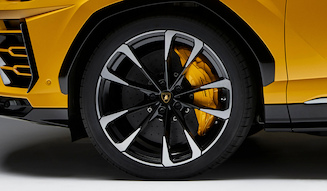
Massive 23-inch wheels are fitted at the four corners of the body, supporting the high ground clearance. Inside them are carbon-ceramic brakes with a front diameter of 440mm, the largest for a production model, emphasizing its high-performance SUV credentials.
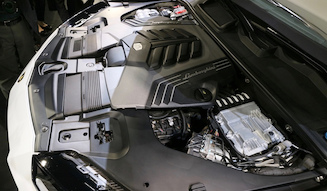
Maurizio Reggiani, the board member in charge of Lamborghini's research and development, who took the stage first, explained, "The Urus is an all-around sports car with a visionary concept that allows you to enjoy the same high performance as other Lamborghini vehicles, while also offering convenience and versatility." At its heart lies a 4.0-liter V8 twin-turbo engine mounted at the front.
Lamborghini's first turbo engine, producing a maximum output of 650 hp at 6,000 rpm and a peak torque of 850 Nm between 2,250-4,500 rpm, is the optimal choice for an SUV model expected to be driven in all conditions. With a dry weight under 2,200 kg and a power-to-weight ratio of 3.38 kg/hp, it achieves performance worthy of a super sports car: 0-100 km/h in 3.6 seconds, 0-200 km/h in 12.8 seconds, a top speed of 305 km/h, and braking from 100 km/h in 33.7 meters.
Furthermore, elements supporting the super SUV's driving dynamics include "4WD + Torque Vectoring" for optimized driving dynamics and "4WS" with rear steering that moves +/- 3.0 degrees, providing agility at low speeds and stability at high speeds. The Tamburo drive mode selector on the center console allows for control of these and other vehicle dynamics systems according to the driving scenario.
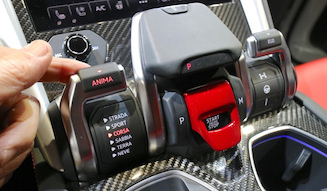
Specifically, by pulling the ANIMA lever located to the left of the shift lever, drivers can select between STRADA (standard), SPORT (sport), and CORSA (track) modes, as well as NEVE (snow) mode, which is newly available for the Urus. TERRA (off-road) and SABBIA (desert) modes can also be selected as options.
The lever on the right is the EGO mode, which allows the driver to customize settings from a comfortable ride to a sporty and aggressive drive according to their preferences. This is made possible by Lamborghini's first electromechanical active roll stabilization system and adaptive air suspension.
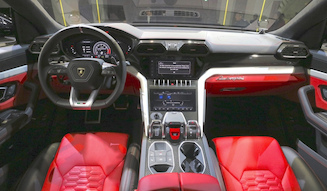
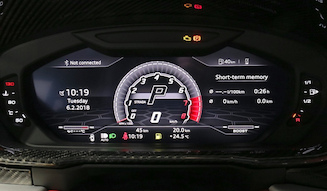
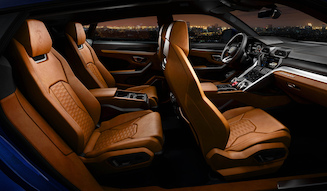
The interior, on the other hand, features a cohesive design characteristic of Lamborghini vehicles, with hexagonal air vents, door handles, cup holders, and airbag modules, as well as a dashboard angled towards the driver. The Tamburo selector emphasizes its status as a new SUV model.
The model on display was equipped with red leather seats, creating a sporty contrast with the black and silver parts, as well as carbon fiber accents.
The rear seats are surprisingly spacious, offering ample legroom thanks to the long wheelbase, as well as generous headroom. The comfortable cabin even features monitors mounted on the back of the front seats. The trunk space is also ample, with a capacity of 616 liters. This can be expanded to 1,596 liters by folding down the bench seat.
In terms of safety, the addition of advanced driver-assistance systems (ADAS) is also newsworthy, achieving Level 2 (SAE standard) support systems, equivalent to new models in the Volkswagen Group. The PreCognition system for collision prevention/mitigation and adaptive cruise control for traffic jams are standard, with traffic jam assist and a top-view camera available as options.
Lamborghini Urus | Lamborghini
Lamborghini's Super SUV, the Urus, Unveiled for the First Time in Japan (2)
An All-Around Sports Car in the Shape of an SUV
Stefano Domenicali, CEO, who flew in for this event, explained the new SUV's versatility: "The Urus is a car that can be used daily, carrying four or five people, including family and friends. It can also carry golf bags. And it can handle everything from the circuit to the highway, from urban areas to rough terrain. In other words, it is a completely new product that did not exist in the market before."
He added that this would allow them to welcome many new families into the Lamborghini user base. Analysis of Urus sales shows that 65% of buyers are new customers who have switched from luxury cars or high-end SUVs from other manufacturers.
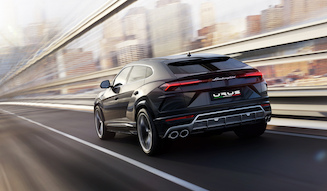
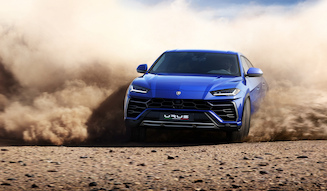
For Lamborghini, for whom Japan is the second-largest market, the launch of the new Urus is perfectly timed. There is also an analysis suggesting that the Urus's value proposition aligns perfectly with Japanese consumers who appreciate art, style, technology, and "Made in Italy."
Furthermore, by launching the Urus, Lamborghini has set its production target for 2019 at approximately double the previous figure, to 7,500 units. To accommodate this, the production facility in Sant'Agata Bolognese, Italy, has been expanded to twice its original size, to 160,000 square meters, and 500 new employees have been hired.
"This is the best moment for Lamborghini. Both the employees and I are highly motivated, we are developing young talent, and our global reputation is improving. A good example of this is our social media follower count, which has now reached 11.5 million," he emphasized. "If any employee isn't motivated by this, I'll tell them to go work for another company," he said with a laugh. He also added, "Now is the time we have reached a new starting point."
The future plan is to introduce a hybrid model at an appropriate time once sales of the new Urus stabilize. Deliveries of the Urus are scheduled to begin in Spring 2018, with prices in Japan starting at 25.74 million yen.

Lamborghini Urus | Lamborghini
Body | Length 5,112 x Width 2,016 x Height 1,638 mm
Wheelbase | 3,003 mm
Tread Front/Rear | 1,695 / 1,710 mm
Vehicle Weight | 2,200 kg
Engine | 3,996cc V8 Twin-Scroll Twin-Turbo
Max Output | 478 kW (650 ps) / 6,000 rpm
Max Torque | 850 Nm / 6,800 rpm
Transmission | 8-speed AT
Drivetrain | 4WD
Suspension Front/Rear | Multi-link (Adaptive Air)
Tires Front | 285/45R21
Tires Rear | 315/40R21
Brakes Front | Carbon-ceramic disc φ440 x 40 mm
Brakes Rear | Carbon-ceramic disc φ370 x 30 mm
Top Speed | 305 km/h
0-100 km/h Acceleration | 3.6 seconds
0-200 km/h Acceleration | 12.8 seconds
100-0 km/h Braking | 33.7 meters
Fuel Economy (EC Value) | 12.7 L/100 km (approx. 7.9 km/L)
CO2 Emissions | 290 g/km
Minimum Ground Clearance | 150 - 248 mm
Minimum Turning Radius | 5.9 meters
Trunk Capacity | 616 - 1,596 liters
Price (incl. tax) | 27,799,200 yen