All-New Audi Q5 Arrives in Japan | Audi
Audi Q5 | The Audi Q5
Audi SQ5 | Audi SQ5
All-New Audi Q5 Arrives in Japan
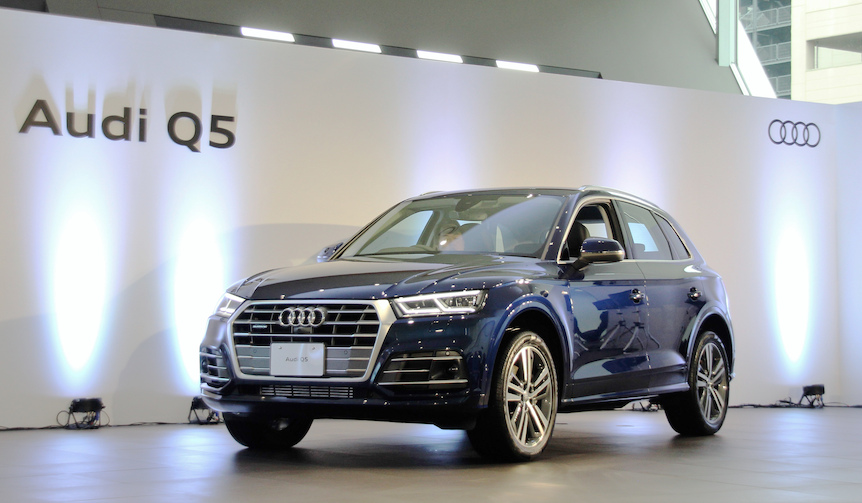
Audi Japan will begin sales of the fully redesigned mid-size SUV, theQ5, and its sporty version, theSQ5, on October 2nd. The Q5 is priced at 6.57 million yen, and the SQ5 at 8.87 million yen.
Text & Photographs by UCHIDA Shunichi
Three Grades, Two Engines
The "Q5" is arguably the cornerstone of Audi's SUV lineup. The models introduced in Japan are three in number: the "Q5 2.0TFSI quattro," its air suspension-equipped variant, and the high-performance "SQ5."
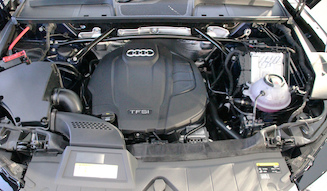
The Q5 is powered by a 2.0-liter four-cylinder turbo engine producing 252 ps and 370 Nm of torque, an increase of 22 ps and 20 Nm over the previous generation. Despite this, thanks to a lighter body, the JC08 mode fuel economy has improved by 11 percent to 13.9 km/ℓ.
Audi Q5
Audi Q5
The transmission is a 7-speed S tronic, which has also been made lighter and more efficient. The lower gears are optimized for acceleration, while the higher gears are set to reduce engine speed and improve fuel economy.
The SQ5 is equipped with a 3.0-liter V6 turbo engine. The turbocharger has been changed from a supercharger to a twin-scroll type, producing 354 ps and 500 Nm of torque. While achieving a 0-100 km/h acceleration of 5.4 seconds, the adoption of Audi's unique B cycle combustion process results in a JC08 mode fuel economy of 11.9 km/ℓ, a 10 percent improvement over the previous generation.
Engine power is transmitted to all four wheels via an 8-speed Tiptronic transmission.
Audi Q5 | The Audi Q5
Audi SQ5 | Audi SQ5
All-New Audi Q5 Arrives in Japan (2)
Quattro System Significantly Evolved
Both the Q5 and SQ5 feature Audi's advanced quattro all-wheel-drive system. The Q5 utilizes a new quattro system that reduces unnecessary drive resistance and improves efficiency in real-world driving, rather than the self-locking center differential type. This system optimally distributes torque to all four tires based on driving conditions. For example, on flat straight roads with low load, the multi-plate clutch before the center differential disengages, driving only the front wheels. Conversely, when driving sportily on winding roads, or during acceleration and on slippery surfaces, the clutch engages predictively, instantly transmitting power to the rear axle and ensuring stable driving performance.
Furthermore, during front-wheel drive, not only the center differential but also the dog clutches on the rear axle are disengaged, allowing the propeller shaft to rotate freely, further reducing driving resistance. As a result, this contributes to a fuel economy improvement of 0.3 liters per 100 km.
Audi SQ5
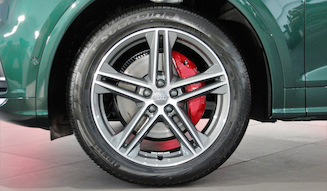
Audi SQ5
An newly developed adaptive air suspension is available for serious off-road driving. Through Audi drive select, seven settings can be selected from comfort to dynamic. In lift and off-road modes, the vehicle height increases by 45 mm compared to standard, ensuring ample ground clearance.
The SQ5's quattro system uses the traditional self-locking center differential type. Under normal driving conditions, engine power is distributed 40% to the front and 60% to the rear. Combined with the standard sport suspension with damping control, it offers a more sporty handling experience. Additionally, dynamic steering, which variably controls the ratio based on driving speed and steering angle, is available as an option.
Audi Q5 | The Audi Q5
Audi SQ5 | Audi SQ5
All-New Audi Q5 Arrives in Japan (3)
Interior and Luggage Space Expanded
One of the key points of this full model change is weight reduction.
While the Q5's dimensions have increased to 4,680 mm in length (+50 mm vs. previous), 1,900 mm in width (same), 1,665 mm in height (+5 mm), and a wheelbase of 2,825 mm (+15 mm), it has achieved a 60 kg weight reduction. This is due to the use of aluminum for the hood and rear tailgate. However, the use of hot-formed steel in the safety cell, where strength is crucial, has also increased body rigidity.
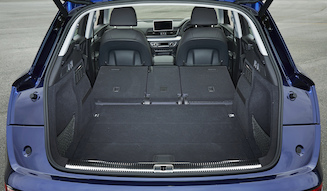
Audi Q5
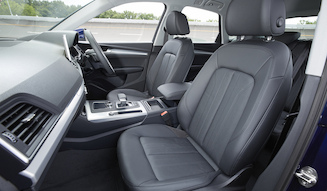
Audi Q5
Aerodynamically, it achieves a drag coefficient of 0.30, an excellent figure for an SUV.
Much of the increased body size has been allocated to the interior and luggage space. The interior space is now among the largest in its class, and the luggage capacity has increased by 10 liters over the previous generation to 550 liters, expandable to a maximum of 1,550 liters.
Audi Q5 | The Audi Q5
Audi SQ5 | Audi SQ5
All-New Audi Q5 Arrives in Japan (4)
Audi-esque Design and Latest Safety Assistance Features
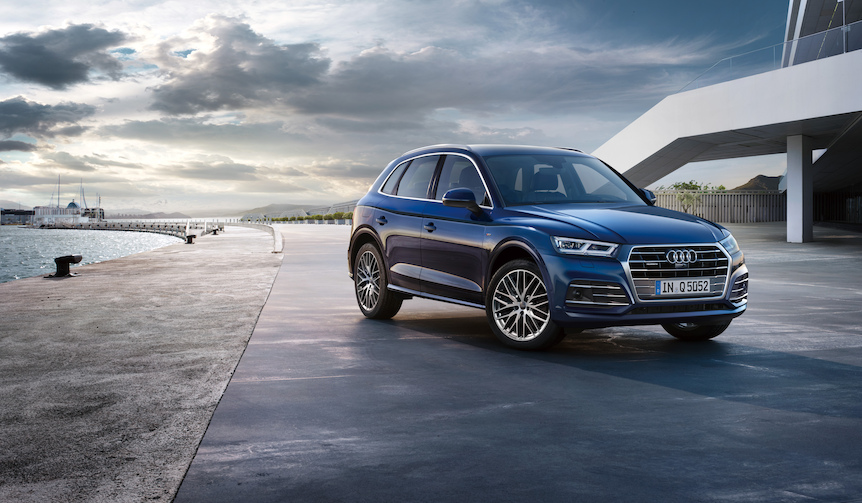
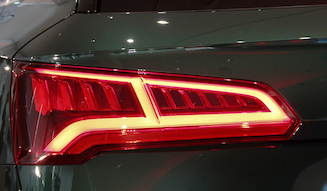
As Toru Saito, President of Audi Japan, states, "The re-engineered exterior, with its robust and sporty styling, gives the impression of a lean, athletic physique honed by rigorous training." Following Audi's latest design language, the front features an enlarged, horizontally oriented Singleframe grille, further emphasizing its sharp appearance. The side view is characterized by a coupe-like roofline that gently slopes towards the rear and a powerful shoulder line that flows dynamically from the headlights to the taillights.
The interior also adopts a horizontal design, mirroring the exterior. While designed to convey spaciousness and comfort, both front and rear headroom and shoulder room have been expanded compared to the previous generation. The wrap-around design from the door trims to the dashboard enhances the sense of spaciousness. The Audi Virtual Cockpit and Head-Up Display, commonly found in Audi vehicles, are also available as options.
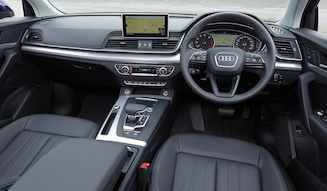
Audi Q5
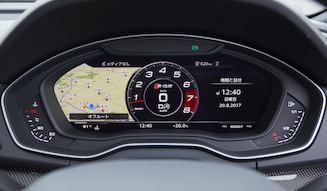
Audi SQ5
Standard equipment includes the MMI touch navigation system, Audi connect services providing internet information, Wi-Fi hotspot functionality, and smartphone interface.
Also included are the Audi connect safety services, introduced this year. These services encompass four functions: Audi SOS call, online roadside assistance, maintenance request, and myAudi manager.
Additionally, like other Audi models, safety and assistance systems are comprehensive. The latest driver assistance systems are equipped, detecting and warning of potential dangers ahead and behind the vehicle, and applying brakes if necessary. Audi pre sense city with pedestrian detection and adaptive cruise control are standard.
The first generation Q5 was unveiled in 2008 and launched in Japan the following year, 2009. It achieved significant global success, with cumulative sales of 1.6 million units by 2016.
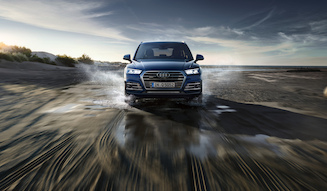
Audi Q5
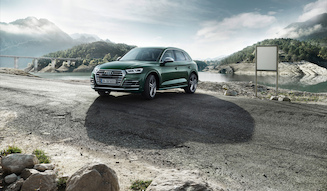
Audi SQ5
The Q5 belongs to the mid-size SUV segment, a category actively seeing new model introductions from both Japanese and import brands, and which has grown significantly in recent years. Audi is also strengthening its SUV lineup. Following the full model change of the new "Q7" last year,new Q7, and the introduction of the new"Q2" this year,Mr. Saito commented, "With the addition of the new Q5, we now have four attractive SUVs in our lineup, alongside the Q3."
Audi Japan's sales figures are currently down 2% as of August. Regarding this, Mr. Saito stated, "This is due to supply delays for popular models. Order numbers are significantly exceeding last year's pace. With the launch of the new Q5 and the Tokyo Motor Show in the fall, we aim to surpass last year's annual sales." He expressed his expectations for the Q5.

Audi Q5 2.0TFSI quattro | Audi Q5 2.0TFSI quattro
Body Dimensions | Length 4,680 x Width 1,900 x Height 1,665 mm
Wheelbase | 2,825 mm
Weight | 1,820 kg
Engine | 1,984cc Inline 4-cylinder DOHC Intercooled Turbocharger
Max. Output | 185 kW (252 ps) / 5,000-6,000 rpm
Max. Torque | 370 Nm / 1,600-4,500 rpm
Transmission | 7-speed AT (S tronic)
Drivetrain | 4WD
Tires | 235/60R18
Fuel Economy (JC08 mode) | 13.9 km/ℓ
Price | 6.57 million yen
Audi Q5 1st edition | Audi Q5 First Edition
Body Dimensions | Length 4,685 x Width 1,900 x Height 1,665 mm
Wheelbase | 2,825 mm
Weight | 1,820 kg
Engine | 1,984cc Inline 4-cylinder DOHC Intercooled Turbocharger
Max. Output | 185 kW (252 ps) / 5,000-6,000 rpm
Max. Torque | 370 Nm / 1,600-4,500 rpm
Transmission | 7-speed AT (S tronic)
Drivetrain | 4WD
Tires | 255/45R20
Fuel Economy (JC08 mode) | 13.9 km/ℓ
Limited Units | 250 units
Price | (Ibis White) 7.04 million yen (Metallic colors) 7.13 million yen
Audi SQ5 | Audi SQ5
Body Dimensions | Length 4,685 x Width 1,900 x Height 1,635 mm
Wheelbase | 2,825 mm
Weight | 1,930 kg
Engine | 2,994cc V6 DOHC Intercooled Turbocharger
Max. Output | 260 kW (354 ps) / 5,400-6,400 rpm
Max. Torque | 500 Nm / 1,370-4,500 rpm
Transmission | 8-speed AT (Tiptronic)
Drivetrain | 4WD
Tires (Front/Rear) | 255/45R20
Fuel Economy (JC08) | 11.9 km/ℓ
Price | 8.87 million yen
Audi Communication Center
0120-598-106