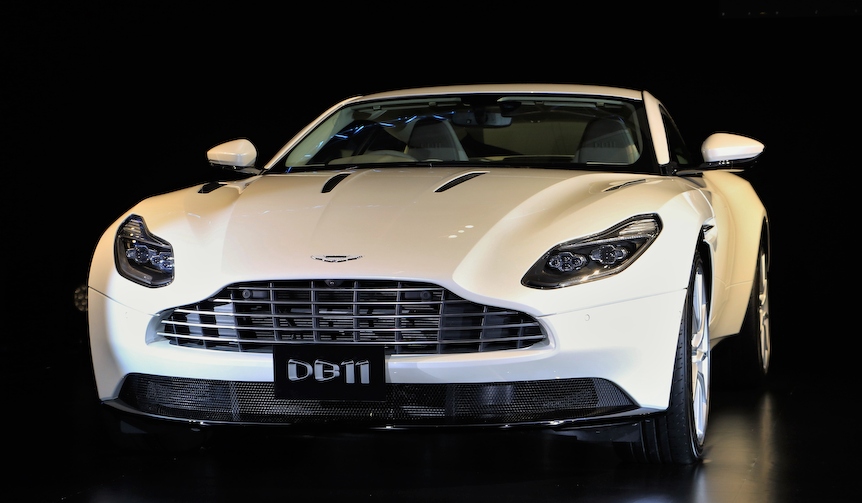
Aston Martin DB11 Arrives in Japan
Aston Martin DB11 | Aston Martin DB11
Aston Martin DB11 Arrives in Japan
This year marks Aston Martin's 103rd anniversary, with approximately 80,000 units produced. Of these, models bearing the "DB" name account for one-third. The latest model, theDB11has been launched in Japan. The base model is priced at 23.8 million yen, with the launch edition at 25,915,720 yen.
Text by Shunichi UchidaPhotographs by Chizuko Uchida
The First Step in the Second Century Plan
The DB series traces its history back to the "DB2," introduced in 1950. The "DB" initials stand for David Brown, the company's owner at the time. Famous DB series models include the "DB4GT Zagato," which competed in the first Japan Grand Prix, the "DB5," known for its role as a Bond car, and the "DB6," used at Prince William's wedding.
"Andy Palmer, who became Aston Martin's CEO in 2014, has a strong affinity for Japan," says Shoichi Terajima, Managing Director of Aston Martin Japan. Palmer's previous role was as Vice President at Nissan Motor Corporation, making him well-versed in Japanese affairs.

Aston Martin DB4 Zagato

Aston Martin DB5
Palmer states, "We aim to develop the brand by merging Aston Martin's traditional British craftsmanship and design philosophy with Japan's proud manufacturing spirit, quality control, and hospitality. We have named the next 100 years the 'Second Century Plan' and are advancing various projects. The DB11 is the car that leads this Second Century Plan."
Aston's First Twin-Turbo Engine
The DB11 is powered by a 5.2-liter DOHC V12 twin-turbo engine, producing 608 ps and 700 Nm. It accelerates from 0 to 100 km/h in 3.9 seconds and has a top speed of 322 km/h, making it the most powerful road-going Aston Martin to date. It is paired with a ZF 8-speed automatic transmission.
Furthermore, thanks to cutting-edge variable valve timing, intelligent bank activation, and stop/start technology, it is also the most fuel-efficient engine in the marque's history.
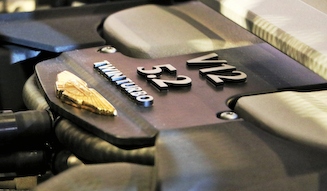
This intelligent bank activation technology deactivates one bank of cylinders during low engine load conditions, such as during cruising with the accelerator released or during light acceleration, significantly reducing fuel consumption. If the catalyst converter temperature drops below the optimal range while a bank is deactivated, the engine management system immediately reactivates all 12 cylinders. This ensures efficiency and improved emissions characteristics without compromising performance or driving pleasure, even when unleashing the engine's full potential.
Aston Martin DB11 | Aston Martin DB11
Aston Martin DB11 Arrives in Japan (2)
Chassis Balancing Ride Comfort and Performance
The DB11 features Bilstein adaptive damping, along with brake-actuated active torque vectoring and multiple dynamic modes, to deliver optimal response according to driver needs. Key to this are three dynamic drive modes and chassis technology that harmoniously balances steering, ride comfort, and handling.
The fundamental chassis development involved a three-dimensional analysis of various loads, vehicle speeds, steering angles, steering rates, longitudinal G-forces, lateral G-forces, and vertical movements using various sensors. Based on this data, the latest generation of Bilstein active damping, electric power steering, and active torque vectoring were tuned and calibrated.
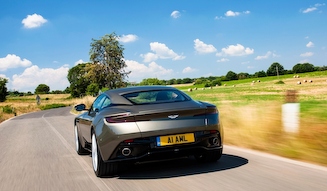
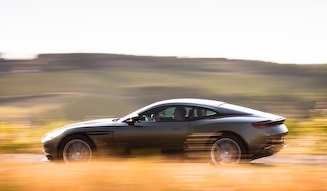
The first of the three dynamic drive modes, "GT Mode," provides a ride and character befitting a grand tourer. Switching to "Sport Mode" enhances the vehicle's overall rigidity, control, and responsiveness. Specifically, the new electric power steering and active torque vectoring respond more rapidly, emphasizing agility.
In "Sport Plus Mode," the suspension, steering, engine, transmission, and active torque vectoring work in concert to unleash the DB11's full potential. "This allows the driver to engage more actively and directly with the driving experience," explains Terajima.
Aerodynamically Optimized Exterior
The DB11's hood is a "clamshell" design, hinged at the front, opening like an inverted alligator. This hood, one of the largest single-piece aluminum structures in the industry, features cut lines along the fenders, eliminating any lines on the hood itself for a seamless finish.
The front grille is the deepest and most sculpted in Aston Martin's history, excluding Zagato models, and the Aston Martin wing badges are also the largest ever.
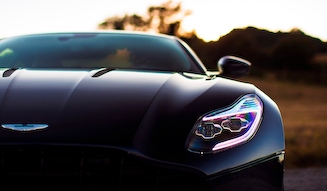
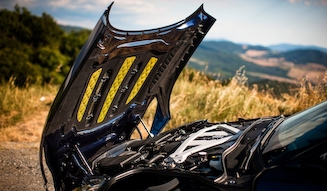
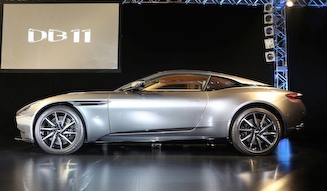
A distinctive feature of the side design is the "roofストレーキ" (roof strake). This design, arching from the A-pillar to the C-pillar, is one of the DB11's design signatures and requires significant manufacturing effort. Specifically, after extruding the material, it undergoes stretching and bending, followed by stamping, laser cutting, polishing, and finally anodizing to achieve the shape envisioned by the design team.
Additionally, the "side strake" on the front fenders, an Aston Martin symbol, was merely decorative on previous models. However, on the DB11, it channels air from the front and expels it through the side strake, contributing to improved high-speed stability.
In terms of aerodynamics, the "Aston Martin AeroBlade" system is also employed. This system draws air through the gap in the rear quarter glass and channels it over the trunk lid, generating downforce across the entire rear section. This achieves high-speed stability without compromising the sleek silhouette with spoilers.
Aston Martin DB11 | Aston Martin DB11
Aston Martin DB11 Arrives in Japan (3)
A New Approach to the Interior
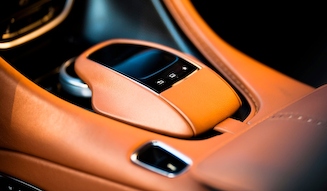
The interior retains Aston Martin's traditional design while significantly enhancing practicality. One example is the improved usability of the navigation and infotainment systems, thanks to the integration of Daimler's electrical technology. The instrument panel also features a 12-inch TFT panel for the first time in an Aston Martin. The panel's color changes when modes are switched, making the current mode easily recognizable.
Furthermore, innovative touches include the application of "broguing," a finishing technique typically used on leather shoes, to the interior leather.
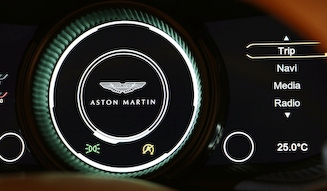
Terajima describes the Aston Martin brand: "While it's becoming more recognized in Japan, many customers still aren't clear whether it's a GT, a sports car, or a sedan. In fact, Aston Martin embodies aspects of both a sports car and a GT car." He emphasizes that it's a car that can be enjoyed in various ways, from circuit driving and long-distance touring as a GT to attending parties in a tuxedo. He concluded by stating that the DB11, with its selectable dynamic drive modes and various settings, "is a car that performs admirably in any situation."

Aston Martin DB11 | Aston Martin DB11
Body Dimensions | Length 4,739 x Width 1,940 x Height 1,279 mm
Wheelbase | 2,805 mm
Weight | 1,770 kg
Engine | 5,204 cc V12 Direct Injection DOHC Twin-Turbo
Compression Ratio | 9.2
Maximum Output | 447 kW (608 ps) / 6,500 rpm
Maximum Torque | 700 Nm / 1,500-5,000 rpm
Transmission | 8-speed AT
Drivetrain | FR
Brakes Front | Ø400 x 36 mm Ventilated Discs
Brakes Rear | Ø360 x 32 mm Ventilated Discs
Suspension Front/Rear | Double Wishbone / Multi-link
Tires Front/Rear | 255/40R20 / 295/35R20 (Bridgestone S007)
Trunk Capacity | 270 Liters
0-100 km/h Acceleration | 3.9 Seconds
Top Speed | 322 km/h
Price | 23.8 million yen (Launch Edition: 25,915,720 yen)