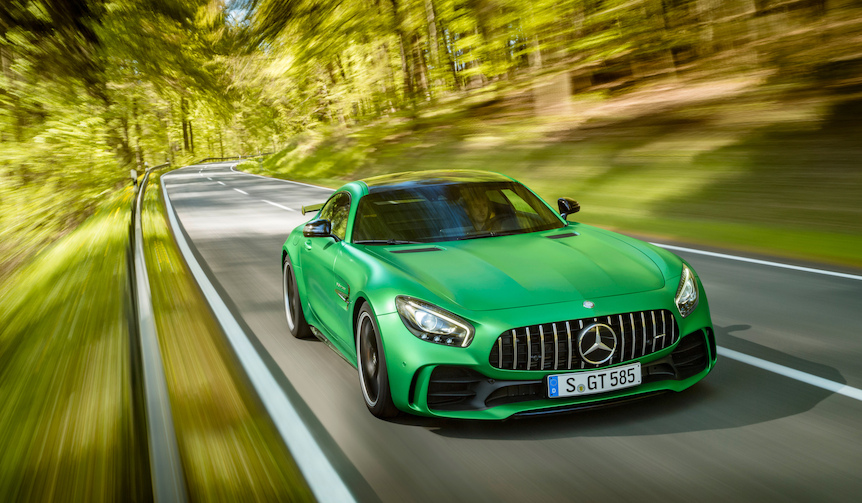
The Most Powerful Version of the Mercedes-AMG GT Arrives | Mercedes-AMG
Mercedes-AMG GT R | Mercedes-AMG GT R
The Most Powerful Version of the Mercedes-AMG GT Arrives
Daimler unveiled the most powerful version of the Mercedes-AMG "GT," the Mercedes-AMG "GT R," at the Goodwood Festival of Speed in the UK, held from June 24. The AMG GT lineup previously consisted of two models: the "GT" with a maximum output of 340 kW (462 ps) and the "GT S" with an increased maximum output of 375 kW (510 ps), both powered by a 4-liter V8 twin-turbo engine. This new model represents the top-tier grade, boasting the strongest performance yet.
Text by SAKURAI Kenichi
The Rival: The 911 Turbo, Plain and Simple
The engine in the Mercedes-AMG "GT R," mounted in a front-midship configuration, is a 4-liter V8 twin-turbo known as "hot inside V," featuring a unique structure with two turbochargers positioned between the cylinder banks. Its maximum output has been increased to 430 kW (585 ps), and its maximum torque to 700 Nm (71.3 kgm).
Conventional "GT"With the "GT" producing a maximum output of 340 kW (462 ps) and maximum torque of 600 Nm (61.2 kgm), and the "GT S" producing 375 kW (510 ps) and 650 Nm (66.3 kgm), it's astonishing to realize that this AMG 4-liter V8 twin-turbo still had room for improvement. Despite the same displacement, this represents an increase of 123 ps and 100 Nm (10.1 kgm) over the entry-level "GT".
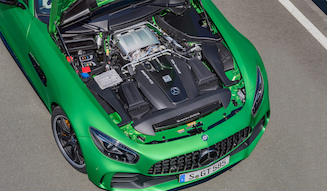
The performance increase in the 4-liter V8 twin-turbo, crafted under AMG's "One Man, One Engine" philosophy (where a single technician is responsible for the entire engine assembly process), was achieved through a redesigned turbocharger with improved compressor side, a more compact wastegate actuator capsule, and refined engine mapping. The boost pressure from the turbochargers has been increased from the conventional 1.2 bar to 1.35 bar, a 0.15 bar increase compared to the "GT." This was accompanied by optimized exhaust systems and compression ratios, leading to a significant overhaul of the overall combustion process.
Furthermore, the two-mass flywheel is 0.7 kg lighter than that of the "GT S," contributing to a more agile engine response. These incremental improvements result in a 0-100 km/h acceleration time of 3.6 seconds and a top speed of 318 km/h. This performance rivals that of the Porsche911 Turbo"911 Turbo." While the 911 Turbo achieves 0-100 km/h in 3.6 seconds and a top speed of 318 km/h, with the "911 Turbo S" boasting 0-100 km/h in 2.9 seconds and a top speed of 330 km/h, the GT R is poised to offer a fierce competition on circuits and winding roads where handling is paramount.
Mercedes-AMG GT R | Mercedes-AMG GT R
The Most Powerful Version of the Mercedes-AMG GT Arrives (2)
Latest Technology Inherited from the AMG GT3 Racing Machine
The GT R features iconic aerodynamic components such as a wide front splitter and a large fixed rear wing. It also adopts the vertical-bar front grille, a signature element of the "AMG GT3" racing car, immediately conveying its evolved performance, its DNA rooted in circuits, and its status as a special model. The 15 chrome fins that catch the eye on the front fascia are known as the "AMG Panamericana Grille." This is not only an icon of the AMG GT3 but also traces its roots back to the victorious "300 SL" at the 1952 Carrera Panamericana in Mexico.
These design elements and new aerodynamic add-ons, along with the newly introduced Active Air Management System, are crucial devices for improving stability at high speeds. The Active Air Management System, when the RACE mode is selected and the vehicle reaches speeds above 80 km/h, deploys a lightweight, carbon-fiber underbody panel (weighing just 2 kg) that lowers by 40 mm, increasing airflow beneath the body. This creates an effective Venturi effect, generating approximately 40 kg of downforce at 250 km/h and significantly enhancing front-end grip.
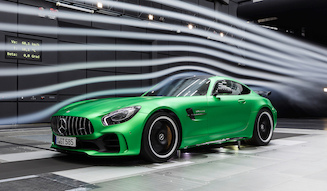
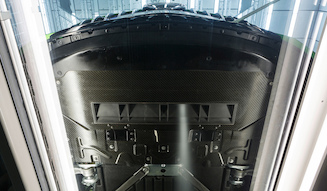
The bodywork, comparable to that of the AMG GT3, has undergone reinforcement measures to the extent that it could race as is, were comfort equipment removed. Furthermore, the use of aluminum and magnesium has been increased in various parts. Lightweight construction has also been achieved through the adoption of components like a torque tube made from carbon fiber. The result is a vehicle that is 15 kg lighter than the GT S.
Moreover, the chassis incorporates cutting-edge technology never before seen in an AMG model: Active Rear Wheel Steering, which allows for up to 1.5 degrees of rear-wheel steering, is making its debut in an AMG model. Controlled by two electro-mechanical actuators via a steer-by-wire system, the rear wheels steer in the opposite direction to the front wheels at speeds up to 100 km/h, enabling tighter turns for everyday driving and parking. At speeds above 100 km/h, the rear wheels steer in the same direction as the front wheels, facilitating agile lane changes.
Mercedes-AMG GT R | Mercedes-AMG GT R
The Most Powerful Version of the Mercedes-AMG GT Arrives (3)
Exclusive "Green Hell" Color
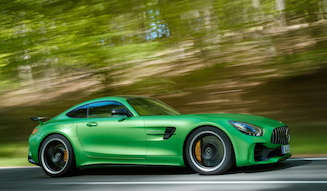
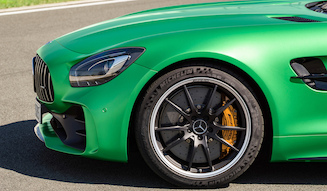
The GT R also incorporates AMG High Performance Sports Suspension, optimized for circuit use and derived from the AMG GT3 racing car, along with a stiffer rear stabilizer and a nine-stage adjustable AMG Traction Control. It is equipped with Michelin "Pilot Sport Cup 2" tires, sized 275/35ZR19 at the front and 325/30ZR20 at the rear, mounted on lightweight 10-spoke forged aluminum wheels.
The braking system comes standard with ventilated discs measuring 390 mm at the front and 360 mm at the rear, fitted with yellow-painted brake calipers. Optional ceramic discs, measuring 402 mm at the front and 360 mm at the rear, are available. These ceramic discs offer a total weight saving of 17 kg compared to the standard discs.
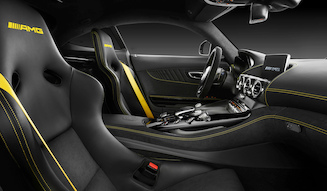
The motorsport-inspired interior is coordinated with Nappa leather and Dynamica microfiber. It comes standard with extremely lightweight, manually adjustable AMG sports bucket seats, but AMG performance seats can be ordered as an option at no additional cost. The GT R includes the AMG Interior Night Package as standard, accentuating the sporty feel with features like paddle shifters, steering wheel bezels, door sills, and boot crossmembers. Matte black carbon fiber trim is also available as an option. Furthermore, optional yellow accents for the seatbelts, highlights, and dials can be selected.
The striking green body color is specially prepared for the GT R. Named "AMG Green Hell Magno," it refers to the nickname of the Nürburgring Nordschleife, the "Green Hell." This color is a tribute to the extensive development time dedicated to the Nürburgring for this GT R.
The "GT R," with its roots in the "AMG GT3" racing car and developed at the Nürburgring, is not chasing titles for top speed or 0-100 km/h acceleration. Its pursuit is the enhancement of overall performance, aiming for the title of the most powerful car on public roads. The fastest AMG officially goes on sale on November 21, 2016, with deliveries in the European market commencing in March 2017.

Mercedes-AMG GT R | Mercedes-AMG GT R
Weight (DIN) | 1,555 kg
Engine | 3,982 cc V8 Direct Injection Twin-Turbo
Max. Output | 430 kW (585 ps) / 6,250 rpm
Max. Torque | 700 Nm / 1,900-5,500 rpm
Transmission | 7-speed Dual-Clutch (AMG SPEEDSHIFT DCT)
Drivetrain | FR
Suspension Front/Rear | Double Wishbone
Brakes Front | φ390 mm Ventilated Disc
Brakes Rear | φ360 mm Ventilated Disc
Tires Front/Rear | 275/35ZR19 / 325/30ZR20
0-100 km/h Acceleration | 3.6 seconds
Top Speed | 318 km/h
Fuel Consumption (NEDC) | 11.4 ℓ/100km (approx. 8.8 km/ℓ)
CO2 Emissions | 259 g/km