Audi's Pride: "Audi ultra" | Audi
Audi | Audi
Audi ultra—Audi's Pride
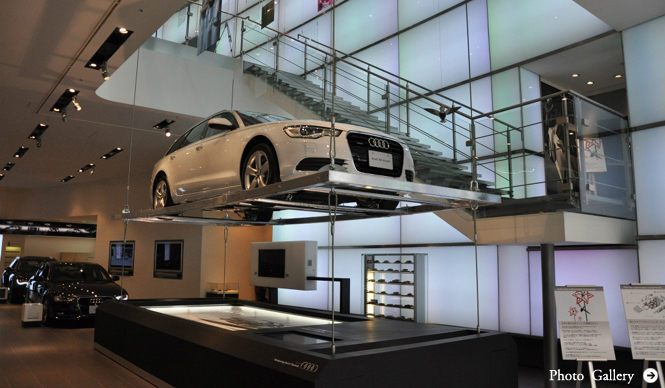
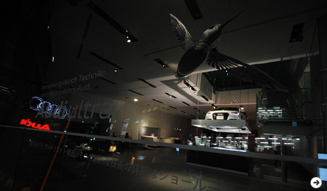
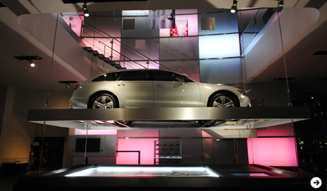
Until the end of this month, Audi Forum Tokyo is hosting a special exhibition to showcase its lightweight technology, "Audi ultra," by suspending anAudi A6 Avantfrom the ceiling. Lightweight technology in automobiles is a topic frequently heard these days. What exactly is it? And what is Audi ultra? OPENERS asked Audi Japan for answers.
Text by SUZUKI Fumihiko (OPENERS)
Photographs by Audi Japan
Cars Tend to Get Heavier
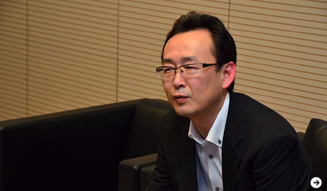
"While 'Audi ultra' sounds cool, it's actually the result of painstaking, incremental efforts," said Kazuto Amano of Audi Japan, explaining Audi's lightweight technology.
Kazuto Amano of Audi Japan began by explaining Audi's lightweight technology.
As automobiles become more advanced, it's natural for them to become heavier. The enhancement of comfort features like power windows and air conditioning, the pursuit of high driving performance through improved suspension rigidity and the adoption of four-wheel-drive systems, and the evolution of crash safety to protect occupants—technologies that didn't exist in cars of the past are invented and incorporated into new vehicles. This not only increases the product value of automobiles but also responds to the demands of the times. As cars become more luxurious and larger out of necessity, they inevitably gain weight. Descendants of the mass-produced cars that emerged around 1970 are now about 1.5 times heavier than their ancestors.
However, this normal evolution of automobiles presents a significant problem. Moving a heavier car requires a more powerful, and simply put, a heavier engine. In other words, if the performance and functionality of a car are pursued without restraint, the increasing weight of the vehicle could literally become a heavy burden, sacrificing driving performance. More importantly, the deterioration of fuel economy and environmental performance becomes a major obstacle. This is particularly serious in the current climate, where irresponsibility towards the environment is no longer acceptable.
Improving environmental performance while continuing to enhance car functions and performance. Lightweighting is one solution to this challenge that all automobile manufacturers worldwide are now seriously addressing. "It is generally said that making a car 100kg lighter can improve fuel economy by 1 km per liter," said Mr. Amano.
However, lightweighting is not easy for production cars. If the entire body could be made from aluminum and resin, the car would be 40% lighter than one made solely of steel. Nevertheless, even when using lightweight materials, ensuring sufficient strength, processing them into the desired shapes, and achieving mass production requires accumulated technology and extensive facilities. Therefore, the use of lightweight materials is often limited to specific parts such as hoods and doors, or confined to expensive sports cars. However, Audi is different, and this is one of the primary selling points of "Audi ultra."
The History and Diligent Efforts of Lightweighting
The "Audi A6" is the model that strongly emphasizes "Audi ultra" this time. Depending on the specifications, the 3.0-liter TDI model in the German domestic specification has achieved an 80kg weight reduction compared to the previous generation. It has broken free from the conventional cycle where cars become heavier as they become more advanced. Of course, lightweighting is not limited to the Audi A6 but is a company-wide initiative at Audi. Audi's success in lightweighting is supported by two factors.
One is history. The "NSU," which manufactured automobiles and motorcycles, was the predecessor to one of Audi's current factories, the Neckarsulm plant in Germany. This "NSU" had been developing cars using aluminum since 1913. Mr. Amano added, "While it's uncertain how much of that DNA remains today," this Neckarsulm plant is the birthplace of Audi's aluminum spaceframe body. In other words, it is the birthplace of the all-aluminum body, completed by attaching aluminum panels to an all-aluminum spaceframe that debuted in 1994 with the "Audi V8" (a precursor to the A8), and it is also the birthplace of the current "Audi A6."
"Audi already possesses the production lines and accumulated expertise to utilize aluminum," he stated.
The other is diligent effort. "'Audi ultra' might strongly evoke the image of using aluminum and lightweighting the body shell, but that's for the sake of clarity. In reality, we are pursuing weight reduction in grams across the entire vehicle."
Indeed, the Audi A6 has achieved significant weight reduction through the proactive use of aluminum in its body, and while this is certainly the largest contributor, lightweighting measures have also been applied to the engine, chassis, fluids, and electrical systems—in every part of the car. More specifically, for the engine, the cylinder block is made thinner; electrical system cables are replaced from copper to aluminum; disparate steel parts are integrated into single aluminum die-cast components; and by downsizing the fuel tank to improve fuel efficiency, further weight reduction is possible... Mr. Amano continued to provide numerous examples.
Certainly, it seems that lightweighting can be achieved through these methods. However, implementing this in actual production vehicles requires not only a background of accumulated technology but also diligent and serious effort. After all, changes in minor details could render existing parts unusable or necessitate the redesign of machinery that relies on delicate balances.
Audi had expressed confidence in the completeness of the Audi A6, announcing that it surpasses its competitors in performance aspects such as acceleration and power, while also having the lowest CO2 emissions. This confidence was evident from the time of its announcement.
The term "Audi ultra," which can be cited as one of the major factors driving this progress, embodies Audi's pride: "We are pioneers in lightweight technology and continue to lead the way."
Audi Forum Tokyo
Location | 6-12-18 Jingumae, Shibuya-ku, Tokyo
TEL. 03-5464-7200
FAX. 03-5464-7205


