A Closer Look at the Evolved New 7 Series, Part 1 | BMW
BMW 7 Series
A Showcase of Cutting-Edge Technology
An In-Depth Look at the Evolved New 7 Series, Part 1
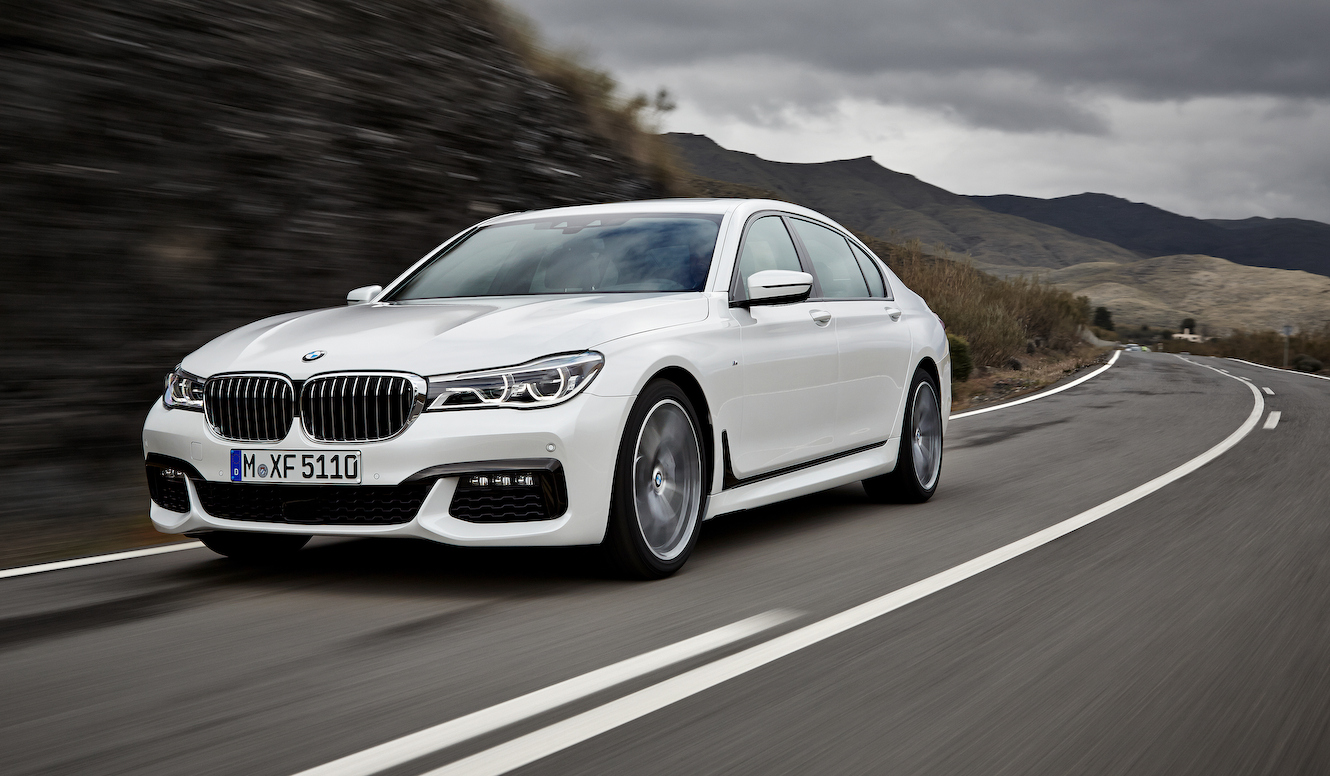
Immediately following the world premiere held on June 10th local time, BMW's flagship saloonFirst Report on the Full Model Change of the "7 Series"was delivered, and here we provide a more detailed look at the new "7 Series" that has evolved from model codes F01/F02 to G11/G12 with its first full model change in six years. Since the debut of the first model in 1977, the 7 Series has reigned as BMW's flagship model for nearly 40 years. What cutting-edge technologies has BMW endowed it with?
An In-Depth Look at the Evolved New 7 Series, Part 2
Text by SAKURAI Kenichi
Model Code Evolves from F to G
The first point not to be overlooked in this full model change is the evolution of the model code from F01/F02 to G11/G12. For a long time, BMW used model codes starting with E, with the first "7 Series" being E23, the second E32, the third E38, and the fourth generation, which began sales in Japan in 2001, was called E65 (the long-wheelbase version being E66). The current fifth generation model advanced the alphabet from E to F, adopting the name F01 (long-wheelbase version F02), and debuted in 2009.
In contrast, the new 7 Series, which debuted in June, has been given the model code G11 (long-wheelbase version G12), a further advancement of the alphabet. Although the official reason has not been announced, it is natural to consider that this evolution of the alphabet signifies the birth of the most advanced and diverse flagship model, combining the latest safety technologies, lightweight construction, and fuel efficiency. If this is not the arrival of a new generation, a redefinition of the flagship model, what is?
BMW 750Li
BMW 750Li
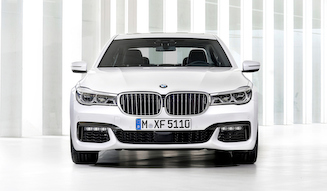
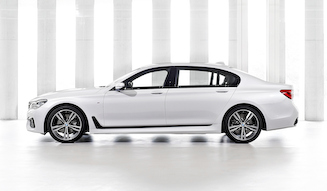
As introduced in the first report, the body dimensions are 5,098mm in length, 1,902mm in width, and 1,478mm in height. The long-wheelbase version extends the normal wheelbase model by an additional 140mm, resulting in a length of 5,238mm and a height of 1,479mm. The width is the same for both models. The wheelbase is 3,070mm for the standard and 3,210mm for the long-wheelbase.
These dimensions are virtually unchanged from the previous model, with only a 19mm increase in length (the same 19mm for the long-wheelbase model) compared to European specifications. The width is identical for both new and old models, and the height has only decreased by 4mm for the new model (2mm for the long-wheelbase version). The wheelbase of 3,070mm and 3,210mm are common values for both new and old models. The reason for not excessively increasing the body size is to suppress an increase in vehicle weight and because sufficient interior space is already secured with the current dimensions.
Even if the car gets bigger, the width of urban roads doesn't easily change. This is a situation also faced by rivals like Mercedes-Benz'sS-Class"S-Class", which has dimensions of 5,116mm (5,246mm for the long-wheelbase model) in length, 1,899mm in width, and 1,496mm in height. As a result, the new 7 Series has achieved almost the same dimensions as the S-Class. For cars driven by chauffeurs, this might be different, but for rivals positioned at the pinnacle of owner-driven vehicles, these dimensions might represent the maximum size for an owner's car.
BMW 7 Series
A Showcase of Cutting-Edge Technology
An In-Depth Look at the Evolved New 7 Series, Part 1 (2)
Exterior Design: A Story of Evolution
The exterior design adopts a strong impression that allows anyone to immediately recognize it as a BMW brand and, furthermore, as a flagship model. In other words, at the center of the front mask sits the large kidney grille, which, although somewhat sharper, continues to convey its history.
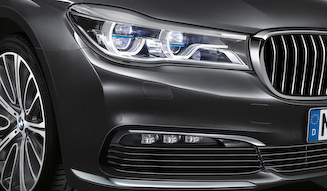
The headlights3 Series" and4 Series", andX3" andX5", andX6" adopt a new, sharp design where the LED position lights extend from the center of the kidney grille to the left and right four-eyed lamp sections, a design that continues to be inherited in the 7 Series, creating the impression of a new generation's face.
These headlights are equipped with full LEDs as standard, and BMW Laserlight with the BMW Selective Beam function is available as an option. "i8" is already familiar, this BMW Laserlight is a state-of-the-art headlight system with an illumination range approximately twice that of full LED lights, capable of adapting to curve angles and automatically dimming for oncoming traffic. The unique feature is the blue illumination that remains after the lights are turned off, fading away with a delay.
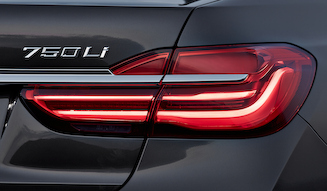
The rear section, on the other hand, is characterized by a design with a horizontal silver-trimmed molding in the center of the trunk lid, a design inherited from the E65 model of two generations ago, which gives the impression of a thick body that appears low and wide. Another characteristic is that all headlights and taillights use LEDs, with the entire rear combination lights having a unified red lens surface. The only part with a lens that appears white depending on the angle is the backlight, which has moved from the upper to the lower part of an L-shaped motif design.
The silver molding that encircles the side windows and the "Hofmeister kink" (derived from Wilhelm Hofmeister, the head of exterior design at the time; "kink" means twist) at the rear end of the rear window, which is an iconic design element familiar to BMW cars, are also present.
The body design of the new 7 Series, with its extremely short front overhang, front mid-ship engine placement, and silhouette suggesting rear-wheel drive, evokes a sense of stability. This exterior design can be described as a refined evolution without resorting to radical changes.
BMW 7 Series
A Showcase of Cutting-Edge Technology
An In-Depth Look at the Evolved New 7 Series, Part 1 (3)
Lightweight Technology Inherited from i8 and i3
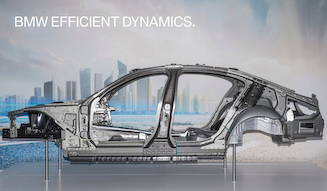
Indeed, the body incorporates technology from BMW's sub-brand "i Series", which includes models like the i8 and i3. The new 7 Series achieves significant weight reduction by extensively using carbon fiber, derived from the i Series, in addition to aluminum and steel. BMW calls the technology of effectively using these different types of materials in each part to construct the body "Efficient Lightweight Technology," and the 7 Series is the first production car to utilize this technology.
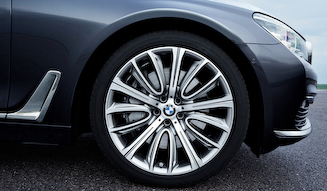
For example, the B-pillar is a hybrid structure of ultra-high-strength steel and carbon fiber, and aluminum is used for the doors and trunk lid. The brakes and wheels have also contributed to a weight reduction of approximately 15%, helping to reduce unsprung weight. As a result, compared to the previous generation, a weight loss of up to 130kg has been achieved.
For reference, the lightest model, the "740i," has a curb weight of just under 2 tons at 1,725kg (the previous generation Japanese model weighed 1,950kg). Of course, BMW's commitment to a 50:50 static weight distribution is also maintained in this new model.
The suspension, benefiting from this weight reduction, features double track control arms at the front and a five-link setup at the rear. This differs from the previous suspension (which used double wishbones at the front and integral arm type at the rear). Furthermore, it comes standard with air suspension with self-leveling dynamic dampers offering a 20mm adjustment range, and for the first time, the "Exclusive Drive Pro" package is available, which includes electronically controlled anti-roll bars to suppress body roll during cornering.
Moreover, this new suspension is linked to stereo cameras. The stereo cameras monitor road conditions, and when they detect a step or undulation ahead, the dynamic dampers instantly adjust the suspension stiffness to maintain a consistently flat and comfortable ride. The suspension of the new 7 Series is programmed to balance the sporty handling expected of a BMW with a comfortable ride.
To be continued in An In-Depth Look at the Evolved New 7 Series, Part 2