Porsche Boxster E Prototype | Michelin Challenge Bibendum
Porsche Boxster E Prototype
Porsche's Electric Sports Car Challenges Tesla
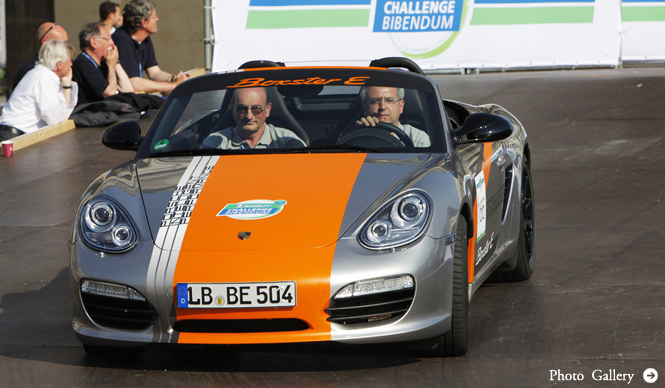
PorscheAG exhibited two types of Boxster E prototypes at the Michelin Challenge Bibendum in Berlin.
Text by OPENERS
Available in 4WD and Rear-Wheel Drive Models
In February 2011, Porsche's electric version of the Boxster, designed to challenge the EV sports car segment dominated by Tesla, was unveiled in photographs. While details were scarce and it was said to be not planned for commercial release, the Boxster E Prototype was displayed at the Michelin Challenge Bibendum in Berlin, Germany. Three units were available for test drives, and more details gradually emerged.
The Michelin Challenge Bibendum, held annually worldwide for its 11th year, aims to foster a cleaner, safer, and more sustainable mobility society. This year, researchers from various fields including politics, industry, and economics gathered to discuss environmentally friendly transportation and the future of automobiles.
The Boxster E prototypes displayed this time included one all-wheel-drive model with motors on both the front and rear axles, and two rear-wheel-drive models. Structurally, an electric motor, a constant-mesh transmission with all gears permanently engaged, and power electronics to control the electric motor are housed where the conventional manual transmission and exhaust system would normally be. This unit drives the rear wheels. A second drive unit is placed in the front, occupying the space where the 64-liter fuel tank would be, and is controlled by power electronics located within the luggage compartment. Synchronization of the motors is managed by a central electric control unit, which also controls the torque distribution between the front and rear axles.
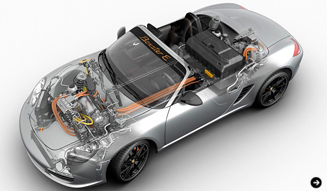
The 4WD model, equipped with two motors, boasts a maximum output of 180 kW and a peak torque of 540 Nm at a high 12,000 rpm. The Boxster E Concept offers not only zero emissions but also the driving pleasure unique to electric propulsion. Its performance figures include a 0-100 km/h acceleration in 5.5 seconds and a top speed of 200 km/h.
The rear-wheel-drive model, which lacks an electric motor at the front, has a maximum output of 90 kW and a peak torque of 270 Nm. It achieves 0-100 km/h acceleration in 9.8 seconds and has a top speed of 150 km/h.
The battery is a 29 kWh lithium-ion unit, manufactured by Porsche, located in the space normally occupied by the engine. Comprising 440 cells, this battery weighs a relatively light 341 kg, resulting in a vehicle weight of 1,600 kg, just 35 kg less than a standard Boxster. For comparison, the Tesla Roadster's battery weighs 450 kg, with a total vehicle weight of 1,238 kg.
Charging is done via a port located in the same place as the fuel filler cap. A full charge takes 9 hours, though it can be completed more quickly using a rapid charger. The maximum range on a single charge is 170 km.
Like other EVs, it features an energy recovery function. While typically regenerative braking is activated automatically by releasing the accelerator, the Boxster E operates slightly differently: pressing a button on the steering wheel engages engine braking, which simultaneously initiates energy regeneration.
Porsche's unique approach to electric sports cars is becoming increasingly evident. While currently in the testing phase, supported by government funding as part of Stuttgart's ongoing electromobility development, a commercial release may not be an entirely distant dream.