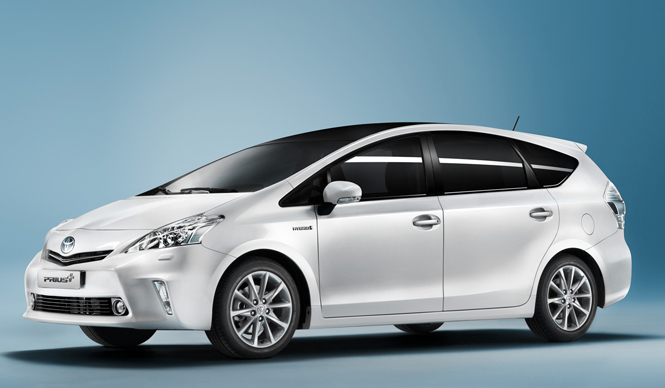
TOYOTA Prius + | The Toyota Prius +: A Spacious 7-Seater Prius
TOYOTA Prius +
The Large, Seven-Seater Prius
Toyota Motor Corporation exhibited the Prius + at the Geneva Motor Show, held from March 1st.
Text by Dai Matsuo
On Sale Late April
Following the Prius v and Prius c in Detroit, the Prius + (Plus) has been unveiled at the Geneva Motor Show as a derivative of the Prius. It essentially shares the wagon body with the Prius v and is a size larger than the current Prius.
The body dimensions are 4,615mm long, 1,775mm wide, and 1,575mm high, exactly the same exterior dimensions as the Prius v: 155mm longer, 30mm wider, 85mm taller, and with an 80mm longer wheelbase than the current Prius. However, the biggest feature of the + is its significantly expanded interior space compared to the current Prius, with a third row of seats, making it a seven-seater.
The '+' in the name signifies 'something more,' likely referring to the spacious interior in addition to the Prius's outstanding economy, environmental performance, and design. The use of a compact lithium-ion battery allowed for sufficient headroom even with the raised seat position in the Prius v, offering a front-to-rear seat pitch of 38 inches (approx. 96.5 cm). The luggage space was marked at 34.3 cubic feet (approx. 971 liters), but it's thought that the luggage space and seat pitch are reduced due to the addition of the third row.
The hybrid system is said to be the same as the standard Prius. The Atkinson cycle 1.8-liter 2ZR-FXE engine produces a maximum output of 73 kW (99 PS) at 5,200 rpm and a maximum torque of 142 Nm (14.5 kgm) at 4,000 rpm. The motor has a maximum output of 60 kW (82 PS) and a maximum torque of 207 Nm (21.1 kgm), resulting in a total system output of 100 kW (136 PS).
While pricing for the Prius + has not been announced, it is scheduled to go on sale in Japan in late April, along with the previously unveiled Prius v.
BRAND HISTORY
Toyota's founding as an automobile manufacturer dates back to 1936. The initial lineup consisted of a six-cylinder model with the then-popular streamlined body and a model targeting the upper market. In the late 1950s, the 1-liter Corona and 1.5-liter Crown were added to the lineup. In the 1960s, in adopting a corporate strategy to expand sales in the US market, Toyota developed a range of vehicles from compact models to V8-powered cars, embarking on the path of a full-line manufacturer.
The key to Toyota's growth lies in its thorough market-centric approach. In the 1960s, the company succeeded in the US market by introducing models targeting small British and Italian cars. Subsequently, a product strategy of offering appropriate performance at appropriate prices was applied to a wide range of vehicles, from large sedans to sports cars. Later, by building factories in the US, Toyota began producing many vehicles specifically for the American market, such as large pickup trucks.
Domestically, with the period of high economic growth in the 1960s as a peak, Toyota secured a solid position through diverse product development, supported by sales and marketing efforts. In its main market, the US, the two oil crises of the 1970s proved to be a tailwind, leading to rapid growth driven by its strengths in small size and fuel efficiency. A significant leap occurred in the late 1980s when, in response to a growing demand for luxury cars in the US, Toyota launched Lexus as a separate brand. Adopting a 'source-based' approach with meticulous quality control from the smallest component, Lexus emphasized its high-quality feel.
Another major leap was the launch of the Prius in 1997. Although the hybrid drive system was unfamiliar to the general public, it was criticized by the automotive industry at the time as 'meaningless in the technological progression from internal combustion engines (like gasoline and diesel) towards fuel cells.' However, its foresight is evident in its current success. Manufacturers worldwide are promoting hybridization, albeit with slight variations in their approaches. Furthermore, other automakers have had to acknowledge that the battery technology essential for hybrid vehicles is also necessary for electric vehicles and the fuel cell vehicles that will follow.
Since the Lehman Shock in September 2008, which originated in the US, sales of luxury cars have slowed, and around the same time, product recalls became a major topic in the US Congress. It can be said that Toyota is currently facing headwinds. The early withdrawal from F1 racing in 2009, after entering in 2002, also disappointed fans. However, Toyota has announced a resumption of international racing activities, with an eye on the World Rally Championship, raising expectations for the future. (Updated August 2010)