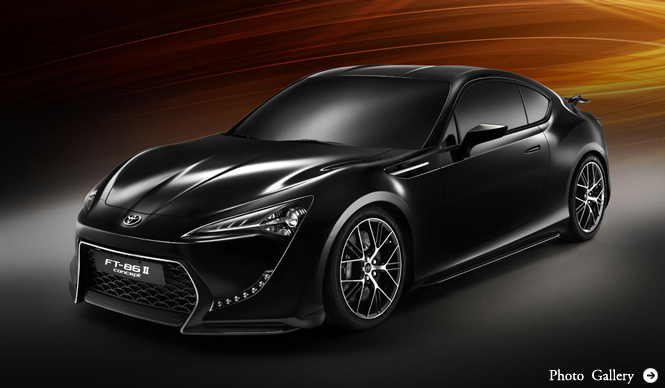
TOYOTA FT-86 II concept Exhibited at Geneva
TOYOTA FT-86 II concept
FT-86 Concept Evolves to II, Unveiled
Toyota Motor Corporation exhibited the compact FR sports car "FT-86 II concept" at the Geneva Motor Show, which opened on March 1st.
Text by Dai Matsuo
The World's Only Boxer-Engine FR Sports Car
The FT-86 II concept is an evolved version of the FT-86 concept, a next-generation FR sports car that Toyota has been jointly developing with Subaru, with whom it has had a partnership as a major shareholder since 2005. The company is enthusiastic, stating, "By fusing the core technologies of both companies, we aim to create a sports car with the world's only boxer-engine FR layout, proposing the joy of driving and the pleasure of ownership that are the car's appeal."
The FT-86 concept, exhibited at the 41st Tokyo Motor Show in 2009, generated significant buzz. As its name suggests, it aims to revive the AE86 (Corolla Levin and Sprinter Trueno), a legendary car that thrilled young people in the 1980s, with modern technology. Toyota plans to hone this evolved version, the FT-86 II concept, on roads worldwide before its production model makes its world premiere at the 42nd Tokyo Motor Show this autumn.
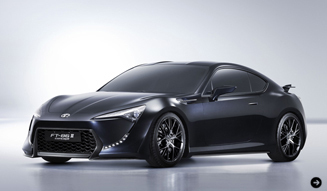
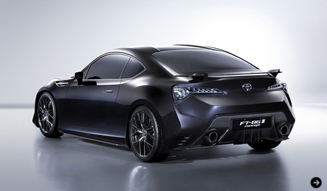
As mentioned, the car is being developed as the world's only "boxer-engine FR sports car," and the adoption of a dedicated platform has resulted in a low center of gravity and a lightweight, compact body.
The body dimensions are announced as 4,235mm in length, 1,795mm in width, and 1,270mm in height, with a wheelbase of 2,570mm. For comparison, these figures represent an increase of 55mm in length (20mm over the Trueno) and 170mm in width compared to the AE86 Levin, a decrease of 65mm in height, and an increase of 170mm in wheelbase. In any case, it can be said to be finished in a very compact size for a modern sports car.
The engine is announced as Subaru's signature boxer engine, a 2.0-liter flat-four DOHC, but its specifications and other details remain unknown. We look forward to seeing how much the FT-86 II concept will be refined over the next nine months until the Tokyo Motor Show in December.
BRAND HISTORY
Toyota's founding as an automobile manufacturer dates back to 1936. Its initial offerings were a six-cylinder model with a streamlined body, popular at the time, and a model targeting the upper market. In the late 1950s, the Corona, a 1-liter model, and the Crown, a 1.5-liter model, were added to the lineup. In the 1960s, adopting a corporate strategy to expand sales in the US market, Toyota developed a range of vehicles from compact models to those equipped with V8 engines, embarking on a path as a full-line manufacturer.
Toyota's growth has been driven by its thorough market-centric approach. In the 1960s, it successfully introduced models in the US market targeting small cars from Britain and Italy. Subsequently, its product strategy of offering appropriate performance at appropriate prices was applied to a wide range of vehicles, from large sedans to sports cars. Later, by establishing factories in the US, Toyota began producing many vehicles specifically for the American market, such as large pickup trucks.
Domestically, the period of high economic growth in the 1960s marked a peak, and with contributions from sales and marketing efforts, Toyota secured a solid position through diverse product development. In its main market, the US, the two oil crises of the 1970s proved to be a tailwind, and Toyota achieved rapid growth by leveraging its strengths in small size and fuel efficiency. A significant leap occurred in the late 1980s when, in response to a growing demand for luxury cars in the US, Toyota launched Lexus as a separate brand. Adopting a philosophy of "genryu" (source) management, which involved meticulous quality control from the smallest component, Lexus emphasized its high quality.
Another major leap was the launch of the Prius in 1997. Although the hybrid drivetrain was unfamiliar to the general public and criticized by the automotive industry at the time as "meaningless in the technological progression from internal combustion engines (like gasoline and diesel) to fuel cells," its foresight is evident in its current success. Manufacturers worldwide are now promoting hybridization, albeit with slight variations in approach. Furthermore, other automakers have had to acknowledge that the battery technology essential for hybrid vehicles is also necessary for electric vehicles and the fuel cell vehicles that lie beyond.
Since the Lehman Shock in September 2008, which led to a slowdown in luxury car sales, and around the same time, facing significant scrutiny from the US Congress regarding product recalls, Toyota can be said to be facing headwinds. Its early withdrawal from F1 in 2009, after entering in 2002, also disappointed fans. However, Toyota has announced its intention to resume international racing activities, with an eye on the World Rally Championship, raising expectations for the future. (Updated August 2010)