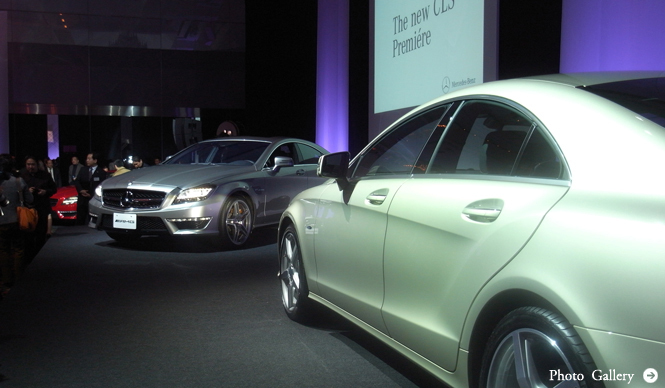
Mercedes-Benz CLS-Class | The Second Generation Mercedes-Benz CLS Makes Its Japanese Debut!
Mercedes-Benz CLS-Class
Second-Generation CLS Debuts in Japan! (1)
Mercedes-Benz Japan has fully redesigned the four-door coupe "CLS-Class" for the first time in six years, launching sales on February 18th.
By Matsuo Dai
Cd Value of 0.26
The CLS, which sparked the four-door coupe trend worldwide with its long hood, narrow window area that appears to be shallow top-to-bottom, and roofline that slopes down towards the rear, has evolved into its second generation. In the new CLS, the radiator grille is designed to appear separate from the hood, rather than integrated. The sides have taken on a more muscular impression. The wide rear combination lamps, incorporating LED technology, wrap around to the sides, serving as a connection to the rear end. Furthermore, by revising the aerodynamics, including the new door mirrors on the door panels, the Cd value has improved by approximately 13 percent compared to the previous model, reaching 0.26, despite an increase in body size and frontal projected area.
The adoption of full LED headlights and LED high-performance headlights is also a notable feature. Each side uses as many as 71 LEDs (turn signals = 13, position lights = 22, low beams = 8 for short distance, 8 for medium distance, high beams = 8, cornering lights = 2, infrared illuminators for Night View Assist Plus = 10 *optional). The internal design is divided into three layers from top to bottom, with turn signals in the top layer, low beams below that, and high beams and infrared illuminators for Night View Assist Plus in the bottom layer.
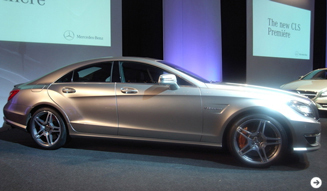
CLS 63 AMG
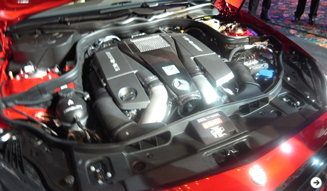
CLS 63 AMG
Over 30% Fuel Efficiency Improvement with Enhanced Combustion Engine
Inside, the eye is drawn to the cockpit's wraparound design, with a line running at a high position from the driver's door to the instrument panel support and the passenger door. The COMAND display, used for navigation and other functions, is also integrated into the upper part of the instrument panel. The CLS 63 AMG features semi-aniline leather and AMG sports seats in the front, which hold passengers in a stable driving position during lateral G-forces. Other features include an Alcantara roof liner and an AMG performance steering wheel covered in Nappa leather, flat at the top and bottom. The AMG meter panel & instrument cluster, and the AMG drive unit system, which concentrates AMG selector levers for one-touch gear selection, transmission mode, ESP mode, and suspension mode switches on the center console, are also installed.
There are two engine options. The CLS 350 BlueEFFICIENCY is equipped with a newly developed 3.5-liter, 60-degree V6 direct-injection engine, producing a maximum output of 225 kW (306 hp) and a maximum torque of 370 Nm (37.7 kgm). Combined with a 7-speed automatic transmission (7G-TRONIC PLUS), it achieves a 33% improvement in fuel efficiency and a 34% reduction in CO2 emissions compared to the previous model, while also increasing output and torque. It utilizes piezo injectors with a maximum pressure of 200 bar and a spray-guided combustion system. The system injects fuel up to five times per intake stroke with a reaction speed of 1/10,000th of a second to constantly create optimal combustion conditions. Additionally, the MSI (Multi-Spark Ignition) system, which generates up to four sparks within 1/1,000th of a second, is said to shorten combustion time. The high-performance CLS 63 AMG is powered by the same 5.5-liter V8 direct-injection twin-turbo engine found in the CL 63 AMG and other models already on the market, boasting a maximum output of 386 kW (525 hp) and a maximum torque of 700 Nm (71.4 kgm). Despite this high output and torque, it achieves excellent environmental performance with fuel efficiency improved by over 30% compared to the previous model and CO2 emissions of 232 g/km, thanks to the ECO start-stop function (idling stop function) and the AMG SPEEDSHIFT MCT.
Mercedes-Benz CLS-Class
Second-Generation CLS Debuts in Japan! (2)
Newly Developed High-Rigidity Body
The body has been completely redesigned, inheriting the design philosophy from the SLS AMG. Approximately 72% of the entire body is made of high-strength steel plates, resulting in a static bending strength that is approximately 28% higher and torsional rigidity that is approximately 6% higher than the previous model. Furthermore, the use of frameless doors made entirely of aluminum achieves a weight reduction of approximately 24 kg. In terms of body design, the doors feature the dropping line, a side line that slopes diagonally, which is a cornerstone of Mercedes-Benz's exterior design.
The CLS 350 BlueEFFICIENCY features DIRECT CONTROL suspension with a selective damping system (variable damping shock absorbers) on both the front and rear. When the input to the dampers is small during normal driving, the damping force is automatically reduced to greatly enhance ride comfort. Conversely, during high-speed cornering or evasive maneuvers when the input to the dampers is large, the system provides maximum damping force to effectively stabilize the vehicle. The CLS 63 AMG's suspension is an AMG RIDE CONTROL sports suspension that uses coil springs at the front and dedicated air springs at the rear. The damping characteristics of the shock absorbers can be switched between three modes: Comfort, Sport, and Sport Plus.
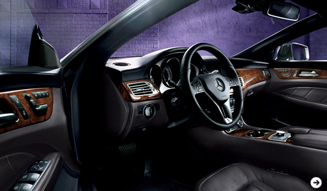
CLS 350 BlueEFFICIENCY
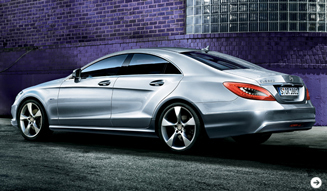
CLS 350 BlueEFFICIENCY
AMG Performance Package Option Delivers 557 hp
In terms of equipment, the steering is electrified, contributing to reduced fuel consumption (0.3 L/100 km) and CO2 emissions (7 g/km). All models come standard with Adaptive Highbeam Assist (variable illumination range: 65m-300m), which uses a multifunction camera on the windshield to detect preceding and oncoming vehicles and automatically adjust the headlight beam pattern, and ATTENTION ASSIST. Lane Keeping Assist and Night View Assist Plus are available as options. Airbags include driver, passenger, front and rear side, and window airbags, as well as an SRS knee airbag to protect the driver's knees and prevent forward movement during a collision, and SRS pelvic airbags to reduce strain on the torso and pelvis of the driver and front passenger during side impacts, totaling 11 airbags.
The CLS 63 AMG, like recent AMG models, offers the AMG Performance Package as an option. This increases the maximum output to 557 hp (+32 hp compared to normal) and maximum torque to 800 Nm (+100 Nm). It also includes 19-inch AMG 5-twin-spoke forged alloy wheels painted in titanium grey, an AMG carbon fiber trunk lid spoiler lip, and specially tuned suspension for enhanced sportiness. Furthermore, AMG carbon-ceramic brakes are available for the CLS 63 AMG. These brakes, also available on the SLS AMG, provide excellent braking power and fade resistance even under demanding conditions such as track driving. They achieve approximately a 40% weight reduction compared to the AMG high-performance brake system fitted to the standard model, reducing unsprung weight and improving driving performance.
The price for this new CLS is 9.3 million yen for the CLS 350 BlueEFFICIENCY and 16.25 million yen for the CLS 63 AMG. The optional AMG Performance Package is 1.1 million yen, and the AMG carbon-ceramic brakes are 1.4 million yen.
Mercedes-Benz CLS 350 BlueEFFICIENCY
Body | Length 4,940 x Width 1,881 x Height 1,416 mm
Wheelbase | 2,874 mm
Vehicle Weight | 1,735 kg
Engine | 3.5-liter V6
Maximum Output | 306 hp (225 kW) / 6,500 rpm
Maximum Torque | 370 Nm (37.7 kgm) / 3,500-5,250 rpm
Transmission | Electronically Controlled 7-Speed Automatic
Drivetrain | FR
Fuel Consumption | 6.8-7.0 L/100 km
CO2 Emissions | 159–164 g/km
Price | 9.3 million yen
Mercedes-Benz CLS 63 AMG
Vehicle Weight | 1,870 kg
Engine | 5.4-liter V8 Twin-Turbocharger
Maximum Output | 525 hp (386 kW) / 5,250-5,750 rpm
Maximum Torque | 700 Nm (71.4 kgm) / 1,750-5,000 rpm
Fuel Consumption | 9.9 L/100 km
CO2 Emissions | 232 g/km
Price | 16.25 million yen
* Fuel consumption and CO2 emissions not obtained in Japan are based on data from the home country.