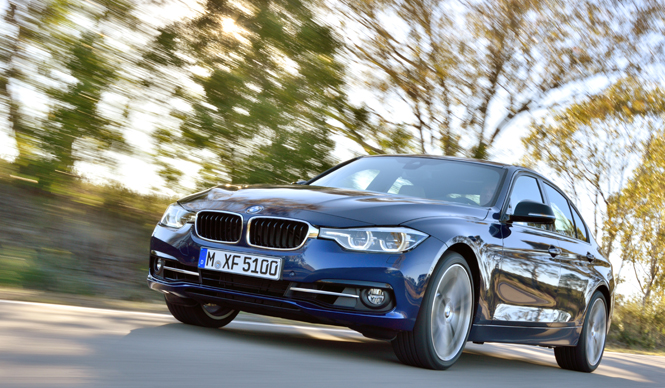
BMW 3 Series Receives Minor Change | BMW
BMW 3 Series
BMW M3
First 3-Cylinder Model Added to 3 Series Lineup
BMW 3 Series Minor Change
BMW recently unveiled the minor change model of the "3 Series" in Europe. Notable additions include the first 3-cylinder model and plug-in hybrid models for the 3 Series. The updates focus on environmental performance, such as further improving the fuel efficiency of the "320d EfficientDynamics Edition" equipped with a clean diesel engine designed for low fuel consumption.
Text by SAKURAI Kenichi
40 Years Since Debut. Over 14 Million Units Sold
The BMW "3 Series" debuted with its first model in 1975. Since then, it has been the core model supporting BMW's backbone for 40 years. To date, over 14 million 3 Series units have been delivered to customers worldwide, accounting for approximately 25 percent of total production. BMW positions the 3 Series Sedan and Touring as "the most successful models in the BMW brand" and places great importance on them.
In this minor change, exterior and interior design modifications have been kept to a minimum, with substantial refinements focused on the powertrain. On the exterior, you'll notice the redesigned front headlights, now sharper and sportier, and the redesigned rear combination lights. The headlights feature a new design where LED position lights extend from the kidney grille to the circular four-light clusters on each side.
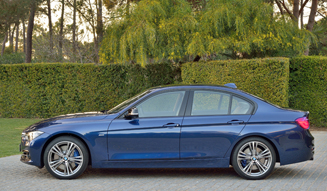
BMW 3 Series Sedan Sport Line
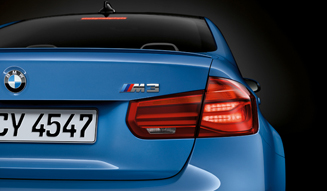
BMW M 3
The rear combination lights have a unified red lens surface, and the backup lights have been relocated from the upper part to the lower part of the L-shaped motif. While a subtle change, it should be easily noticeable to those familiar with BMW.
The power unit is a highlight, with updated turbochargers for the conventional 4-cylinder, 6-cylinder gasoline, and diesel engines, further improving fuel efficiency. Compared to the previous power units, fuel efficiency has improved by up to 11 percent. Consequently, CO2 emissions have also been reduced for each engine.
The "316i" (Sedan/Touring), which was part of the European market's entry-level lineup and equipped with a 4-cylinder gasoline engine, is now the "318i" and has been replaced by a new 3-cylinder engine. This 3-cylinder engine is already used in the "2 Series Active Tourer" and has been introduced in Japan; this marks its first application in the 3 Series. This 1,499cc DOHC 4-valve turbo engine produces a maximum output of 100kW (136ps) at 4,400-6,000rpm and a maximum torque of 220Nm (22.4kgm) at 1,250-4,300rpm. It is highly regarded as an easy-to-use engine in urban driving, delivering maximum torque from just above idling speed.
BMW 3 Series
BMW M3
First 3-Cylinder Model Added to 3 Series Lineup
BMW 3 Series Minor Change (2)
Plug-in Hybrid Model Also in 2016
The current entry-level model in Japan is the "320i," equipped with a 1,997cc inline 4-cylinder DOHC turbo engine producing a maximum output of 135kW (184ps), but it is highly likely to be replaced by the 3-cylinder 318i.
Many may feel that downsizing has finally reached this point even for D-segment engines, but its torquey characteristics make it easy to use in urban settings and do not betray the brand's reputation for driving performance. BMW describes this characteristic of the 3-cylinder engine as "an engine that combines the fuel efficiency of a 3-cylinder with the power of a 4-cylinder." Incidentally, the European specifications achieve fuel economy of 18.5 - 20 km/liter in the ECE combined cycle with an 8-speed automatic transmission, a figure that is quite attractive on its own.
Furthermore, the "320d EfficientDynamics Edition," equipped with a 1,995cc inline 4-cylinder diesel turbo engine and emphasizing fuel efficiency, achieves even more efficient driving performance. Through refinements such as low rolling resistance tires, an 8-speed Steptronic transmission, a modified masked kidney grille for improved aerodynamics, and a lowered ride height, it achieves excellent fuel economy of 24.3 - 26.3 km/liter in the ECE combined cycle with the 8-speed automatic transmission and low CO2 emissions of 99g/km. This represents a 3 percent improvement in fuel efficiency compared to the previous model.
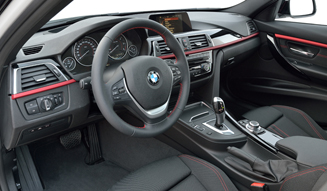
BMW 320d Touring EfficientDynamics Edition Sport Line
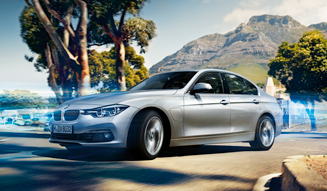
BMW 330e Plug-in-Hybrid
Additionally, in 2016, a plug-in hybrid model called the "330e," which can be charged from an external power source, will be added. The powertrain combines a 135kW (184ps) 2-liter inline 4-cylinder gasoline engine with an 80kW electric motor, producing a total system output of 185kW (252ps) and a maximum torque of 420Nm (42.8kgm). While capable of a top speed of 225km/h and 0-100km/h acceleration in 6.3 seconds, it can travel approximately 35km on pure electric power (EV driving) on a full charge. The fuel economy in the ECE combined cycle is 47.6 km/liter, with CO2 emissions of 49g/km.
The minor change model of the 3 Series is expected to go on sale in Japan as early as this year. In particular, the entry-grade model equipped with the 3-cylinder engine is a downsizing model that holds the potential to overturn the conventional wisdom of D-segment sedans, which have traditionally favored multi-cylinder luxury, and is worth watching.

BMW 318i
Body Size | Length 4,633 x Width 1,811 x Height 1,429 mm
Wheelbase | 2,810 mm
Tread Front/Rear | 1,543 / 1,583 mm
Weight | 1,400 kg
Engine | 1,499 cc Inline 3-Cylinder TwinPower Turbo
Bore x Stroke | 94.6 x 82.0 mm
Compression Ratio | 11.0 : 1
Max Output | 100 kW (136 ps) / 4,400–6,000 rpm
Max Torque | 220 Nm (162 kgm) / 1,250–4,300 rpm
Transmission | 6-speed MT / 8-speed AT Steptronic
Drivetrain | FR
Suspension Front | Double-joint spring-strut
Suspension Rear | 5-link
Brakes Front | Ventilated discs
Brakes Rear | Ventilated discs
Tires Front/Rear | 205/60 R16
0-100 km/h Acceleration | (MT) 8.9 sec (AT) 9.1 sec
Max Speed | 210 km/h
Fuel Economy (ECE) | (MT) 5.5–5.1 ℓ/100km (AT) 5.4–5.0 ℓ/100km
CO2 Emissions | (MT) 129–119 g/km (AT) 126–116 g/km
Trunk Capacity | 480 ℓ
BMW 320d Touring
Body Size | Length 4,633 x Width 1,811 x Height 1,429 mm
Wheelbase | 2,810 mm
Tread Front/Rear | 1,543 / 1,583 mm
Weight | 1,510 kg
Engine | 1,995 cc Inline 4-Cylinder Diesel TwinPower Turbo
Bore x Stroke | 90.0 x 84.0 mm
Compression Ratio | 16.5 : 1
Max Output | 140 kW (190 ps) / 4,000 rpm
Max Torque | 400 Nm (295 kgm) / 1,750–2,500 rpm
Transmission | 6-speed MT / 8-speed AT Steptronic
Drivetrain | FR
Suspension Front | Double-joint spring-strut
Suspension Rear | 5-link
Brakes Front | Ventilated discs
Brakes Rear | Ventilated discs
Tires Front/Rear | 205/60 R16
0-100 km/h Acceleration | (MT) 7.6 sec (AT) 7.4 sec
Max Speed | (MT) 230 km/h (AT) 226 km/h
Fuel Economy (ECE) | (MT) 4.7–4.3 ℓ/100km (AT) 4.5–4.1 ℓ/100km
CO2 Emissions | (MT) 123–113 g/km (AT) 119–109 g/km
Trunk Capacity | 495–1,500 ℓ