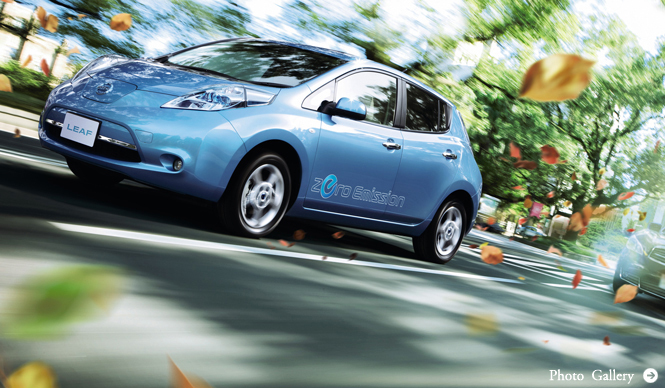
Nissan LEAF Unveiling
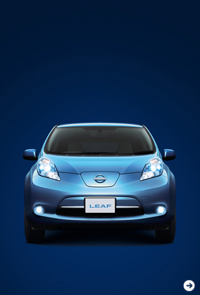
Nissan LEAF
A Car That Runs Like Falling Leaves
The five-seater electric vehicle "LEAF" was announced by Nissan Motor Co., Ltd. on December 3, 2010. Sales will begin on December 20. Along with its environmental compatibility with zero CO2 emissions, its high levels of comfort and driving performance are also key selling points.
Text by Fumio OgawaPhotos by Nissan Motor Co., Ltd.
Power Comparable to a 3-Liter Engine
The launch event was held at Nissan Motor Co., Ltd.'s Global Headquarters in Yokohama. Introducing the LEAF was Toshiyuki Shiga, Chief Operating Officer of Nissan Motor Co., Ltd. Along with the statement, "Nissan, together with Renault, has set the goal of becoming the world leader in zero-emission vehicles," he revealed that the first year's production of the LEAF, 6,000 units for Japan and 20,000 units for the US, had already been ordered.
The electric vehicle (EV) LEAF employs a three-phase AC synchronous motor, boasting a maximum output of 80 kW and a maximum torque of 280 Nm. It also features lithium-ion batteries, which Nissan Motor Co., Ltd. states have "approximately double the energy density compared to conventional batteries." In addition to its instantaneous acceleration, which generates maximum torque from the moment the accelerator is pressed, the company describes its mid-to-low speed acceleration as "comparable to a 3-liter gasoline car." The maximum speed is announced as 145 km/h.
The price of the LEAF is ¥3,764,250. By utilizing the FY2010 EV subsidy program, buyers can receive a subsidy of up to ¥780,000 per vehicle from the government.
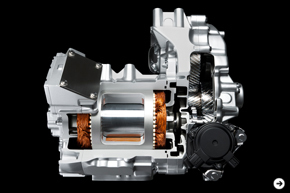
The price then becomes ¥2,984,250. Nissan Motor Co., Ltd. describes this as "a very affordable price."
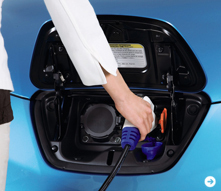
Charging infrastructure is crucial for EVs. The LEAF, which boasts a cruising range of 200 km under the JC08 mode, can travel even further if charging is available at the destination. Nissan Motor Co., Ltd. has equipped all Nissan dealerships nationwide (approximately 2,200 locations) with facilities for standard 200V charging. Among these, approximately 200 locations have been equipped with quick chargers capable of charging to about 80% in 30 minutes.
The LEAF was developed from the ground up on a dedicated platform, rather than being a modification of a gasoline engine car. By concentrating heavy components, including the battery, around the yaw axis, its handling and other driving characteristics have been improved. The agility when turning the steering wheel provides a sporty feel that is difficult to achieve with front-engine cars.
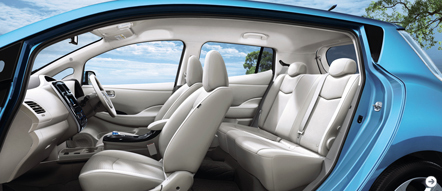
A New Connection with Your Car Through Dedicated ICT
Another characteristic of the LEAF EV is the introduction of a dedicated Information and Communication Technology (ICT) system. This system provides driving support functions on the navigation screen while driving. Simultaneously, before driving and after parking, owners can access a dedicated website via smartphones, mobile phones, or personal computers to manage EV usage history, battery status, and remotely control charging and air conditioning. Nissan Motor Co., Ltd. describes this as "energy management support for the future era of widespread renewable energy adoption."
Referring to his previous statement that EVs would account for 10% of passenger car sales by 2020, Chief Operating Officer Toshiyuki Shiga stated, "The speed of EV adoption is a matter of production capacity, along with expanding consumer needs. Currently, the annual production capacity at the Oppama plant is limited to 50,000 units, but production is scheduled to begin at plants in the UK and the US, establishing a production system of 250,000 EVs by 2012."
At the launch event, governors from various prefectures across Japan, including Hideo Higashikokubaru, Governor of Miyazaki Prefecture, sent video messages. Shigeo Matsuzawa, Governor of Kanagawa Prefecture, stated, "Kanagawa Prefecture is at the forefront nationwide in the adoption of EVs and quick chargers. We will continue to support this initiative." Governor Yuichiro Ito of Kagoshima Prefecture expressed his hope, "In Kagoshima Prefecture, home to the World Heritage site Yakushima, we expect the LEAF, which does not use petroleum, to help realize a CO2-free island."
At the end of the presentation, owners of LEAFs awaiting delivery appeared and waved to the assembled journalists with smiles. This was a production that emphasized that EVs, represented by the LEAF, are not just individual automobiles but a new form of transportation with a stronger social dimension.
Nissan LEAF
Body | Overall Length 4,445 x Overall Width 1,770 x Overall Height 1,545mm
Gross Vehicle Weight | 1,795kg
Motor | Electric Motor
Drive Battery | Lithium-ion Battery
Battery Total Capacity | 24kWh
Maximum Output | 80kW / 2,730-9,800rpm
Maximum Torque | 280Nm / 0-2,730rpm
Drive System | FWD
Cruising Range per Charge (JC08 mode) | 200km
CO2 Emissions | 0g
Price | From ¥3,764,250