New Audi Q7 Debuts in Detroit | Audi
Audi Q7 | The Audi Q7
A Renewed Flagship SUV
The New Audi Q7 Arrives in Detroit
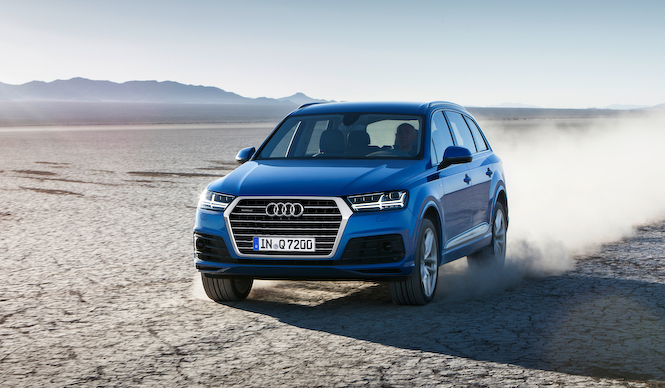
The new Audi Q7, Audi's flagship SUV, makes its debut at the Detroit Motor Show (NAIAS). With its new platform, the latest infotainment, and a redesigned singleframe grille that leads the way for other models, this is a vehicle that embodies the future of Audi.
Text by HORIGUCHI Yoshihiro (OPENERS)
325kg Lighter Than Its Predecessor
Audi has announced that the new flagship SUV, the Q7, will have its world premiere at the Detroit Motor Show.
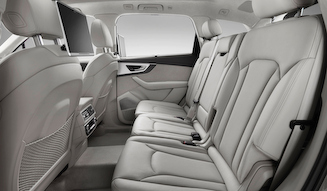
The new Q7 measures 5.05 meters long, 1.97 meters wide, and 1.74 meters high, with a wheelbase of 2.99 meters. While it is 37mm shorter and 15mm narrower than its predecessor, the interior is 21mm longer, and headroom has increased by 23-41mm in places, creating a more spacious feel.
Audi explains that the slight reduction in size accompanying the model change is due to weight reduction and a consequently lower center of gravity, achieved by balancing weight, height, and width.
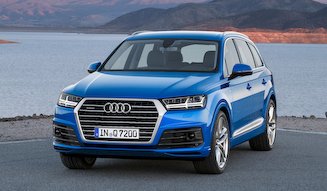
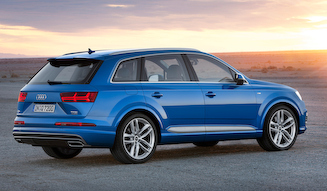
Weight reduction has been applied across the board, from the electrical systems to the luggage floor. The body structure utilizes high-strength steel and cast aluminum, with aluminum also used for the doors and rear hatch. This alone has reduced body weight by 71kg. Overall, the 3.0 TDI model with a V6 engine weighs 1,995kg, a reduction of 325kg from its predecessor.
The chassis has also been completely redesigned for the Q7, featuring the second generation of the "Modular Longitudinal Matrix" platform, developed for longitudinally mounted engines. Like the MQB platform for transverse engines, it enables the integration of efficient new technologies and a variety of drivetrains.
Audi Q7 | Audi Q7
A Renewed Flagship SUV
The New Audi Q7 Arrives in Detroit (2)
Audi's First Diesel Plug-in Hybrid
Two engine options will be available at launch. The "Q7 3.0 TDI" features a V6 turbo-diesel engine producing 200kW (272ps) and 600Nm of torque, achieving 0-100km/h in 6.3 seconds and a top speed of 234km/h. It boasts fuel economy of 5.7L/100km (approximately 17.5km/L) and CO2 emissions of 149g/km.
The gasoline engine is the "Q7 3.0 TFSI," equipped with a 3-liter V6 that delivers 245kW (333ps) and 440Nm of torque. It accelerates from 0-100km/h in 6.1 seconds and has a top speed of 250km/h. Fuel efficiency measures, such as deactivating the turbocharger under light load, contribute to improved economy, with an NEDC (New European Driving Cycle) rating of 7.7L/100km (approximately 13.0km/L) and CO2 emissions of 179g/km.
Future plans include a de-tuned version of the 3.0 TDI, with 160kW (218ps) and 370Nm of torque, focused on fuel efficiency. Additionally, for certain regions like Asia and North America, a "Q7 2.0 TFSI" with 185kW (252ps) and 370Nm of torque is also planned.
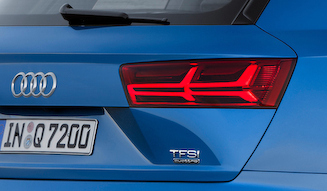
Further adding to the powertrain lineup, the "Q7 e-tron quattro" is scheduled for a later release. This will be Audi's first plug-in hybrid model featuring a diesel engine.
The power source combines a 190kW (258ps) V6 diesel engine with an 8-speed automatic transmission housing a 94kW electric motor. The system delivers a combined output of 275kW (373ps) and 700Nm of torque. With quattro all-wheel drive, it achieves 0-100km/h in 6.0 seconds and a top speed of 225km/h. It boasts impressive fuel efficiency of 1.7L/100km (58.8km/L) and CO2 emissions of 50g/km.
Equipped with a 17.3kWh lithium-ion battery, it offers an electric-only range of approximately 56km and can accelerate from a standstill to 60km/h in just 6.1 seconds.
As expected of a PHEV, it features a heat pump to reduce the electrical load for heating and cooling, and allows for pre-conditioning of the climate control via smartphone before entering the vehicle.
Audi Q7 | Audi Q7
A Renewed Flagship SUV
The New Audi Q7 Arrives in Detroit (3)
Up to 28% Improvement in Fuel Efficiency
The new Q7 features a newly developed 8-speed tiptronic automatic transmission. It incorporates a predictive efficiency assist function that optimizes shifts based on upcoming driving conditions to improve fuel economy. Of course, manual shifting is also possible via the paddles behind the steering wheel or the shift lever.
All models are equipped with quattro all-wheel drive. The differential, which manages torque distribution to each wheel, has been redesigned from the previous transfer case to a lighter, more compact unit integrated within the 8-speed automatic transmission. Under normal conditions, torque is split 40:60 front to rear, but this can be adjusted from 70:30 to 15:85 depending on wheel slip. The center differential also features torque vectoring.
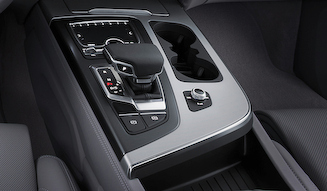
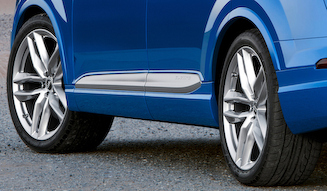
The front and rear suspension have been changed from the previous double-wishbone setup to a five-link design. While coil springs are standard, optional adaptive air suspension and sport air suspension are available. These air suspension systems work in conjunction with Audi drive select, allowing for adjustment of stiffness and ride height in seven stages.
The steering system uses an electro-hydraulic power steering system for improved fuel efficiency and responsiveness. All-wheel steering is available as an option. With this system, the rear wheels can turn up to 5 degrees in conjunction with the steering wheel. At low speeds, they turn in the opposite direction to the front wheels, reducing the turning radius by one meter (0.5 meters in Japanese radius terms). At high speeds, they turn in the same direction as the front wheels, enhancing vehicle stability and improving steering response.
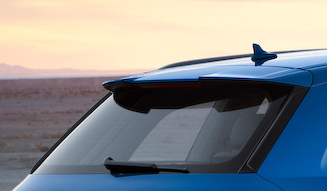
To enhance fuel efficiency, the new Q7's drag coefficient (Cd) has been reduced to 0.32. To achieve this, the underbody is nearly flat, with a small spoiler near the rear axle to suppress lift. For the more fuel-efficient 160kW (218ps) version of the Q7 3.0 TDI, planned for later release, fins will be integrated into the gap between the front singleframe grille and the top of the radiator, which can open and close as needed to optimize aerodynamic resistance.
Audi states that the combined effect of weight reduction measures and aerodynamic refinements has resulted in fuel efficiency improvements of up to 28% for gasoline engines and approximately 23% for diesel engines compared to the previous generation.
Audi Q7 | Audi Q7
A Renewed Flagship SUV
The New Audi Q7 Arrives in Detroit (4)
Audi's New "Face"
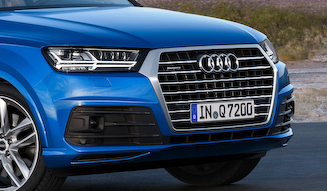
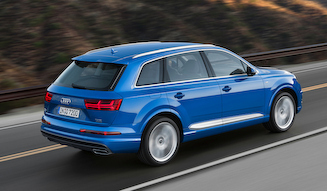
The exterior design of the new Q7 features a more pronounced, three-dimensional singleframe grille, echoing the "Prologue" concept car shown at the LA Auto Show, with chrome accents emphasizing its presence. The strong horizontal lines, particularly in chrome, are also a clear nod to the Prologue.
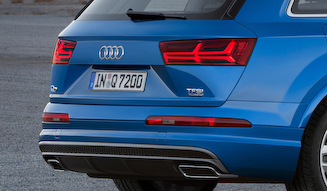
Headlights are available with xenon, LED, or the latest Matrix LED options. These are complemented by newly designed LED daytime running lights shaped like two arrows. The rear design follows Audi's Q-series tradition with a "wrap-around design" that incorporates the combination lamps into the tailgate.
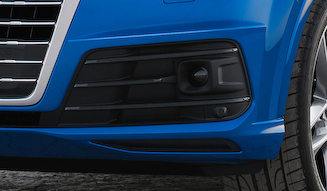
Sporty matte aluminum trim is used for the moldings. The lower bumper and wheel arches are finished in anthracite as standard, but can also be color-matched to the body. An S line exterior package is also available, further accentuating the bumper, air inlets, side sills, and roof spoiler. The standard tires are 235/65 on 18-inch wheels, with options up to 21 inches.
The interior, designed to be bright, sporty, and luxurious, offers a wide range of trim options including various aluminum and wood finishes. Seat upholstery options include fabric, Alcantara, Cricket leather, Valcona leather, as well as leather and design packages.
A thin LED ambient lighting strip, extending from the instrument panel to the doors, is now available as an option for the center tunnel, a first for Audi.
The cargo space offers 770 liters with all seven seats in use, expanding to 890 liters with five seats, and a maximum of 2,075 liters when the second row is folded. The power tailgate, operated by a foot-gesture control, has a lower opening height by 46mm compared to the previous model, facilitating easier loading.
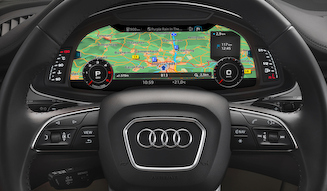
The infotainment system, which integrates communication, entertainment, and navigation, utilizes the second generation of the modular infotainment system (MIB). The Audi MMI controller has also been redesigned with a large touchpad for simpler operation.
The instrument panel features the "virtual cockpit," first seen in the "TT Sportback concept," which allows for customizable displays. In addition to traditional dual gauges, it can show minimal instrumentation with a large navigation display, or display media playback information, functioning as a flexible display.
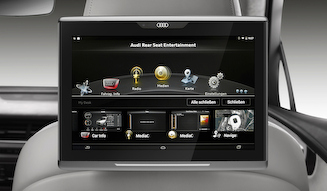
For rear passengers, a new 10.1-inch "Audi tablet" is available. Via the in-car Wi-Fi, passengers can access the car's HDD to enjoy stored music and movies, or browse the internet. Audi is also expanding the services available through Audi connect in Europe.
The system supports integration with smartphones via "Google Android Auto" for Android OS and "Apple CarPlay" for iOS.
Audi Q7 | Audi Q7
A Renewed Flagship SUV
The New Audi Q7 Arrives in Detroit (5)
Deliveries to Begin in Summer
As a flagship model, it offers a comprehensive suite of driver assistance systems. Standard features include parking aid, cruise control, adjustable speed limiter, rest assistant to suggest breaks, and Audi pre sense city with collision warning and automatic braking for pedestrians and vehicles at urban speeds. It also includes multi-collision brake assist to prevent secondary collisions after an initial impact.
Audi is also introducing cross-traffic assist for the first time, which uses radar to monitor the rear sides when reversing from parking spaces and warns of approaching vehicles or cyclists. Other optional features include Audi pre sense basic, which tightens seatbelts in anticipation of a potential accident to minimize damage, and night vision, which uses infrared to enhance visibility in the dark.
Future updates are planned to include a function for avoiding obstacles through automatic steering adjustments and automatic braking when detecting oncoming vehicles turning left (right in Japan) if a hazard is present.
In Germany, pre-orders for the new Q7 will begin in spring 2015, with deliveries starting in the summer. The estimated price in Germany is around 61,000 euros.