December 5, 2014
Geneva On-Site Report | Volkswagen
Volkswagen
A Glimpse into Volkswagen's Strategy
Last September's Paris Motor ShowNew GolfVolkswagen generated buzz by unveiling the 7th generation Golf last September. At this Geneva show, they presented the "XL1" which can travel over 100km on just 1 liter of fuel, and additional Golf grades such as the "GTI", the "GTD", and the derivative model "Golf Variant". Observing these lineups on-site, Mr. Tatsuya Otani suggests that Volkswagen's strategy can be discerned beneath the "Golf Festival."
Text by OTANI Tatsuya
Photographs by MOCHIZUKI Hirohiko & Volkswagen A.G.
The Golf Festival
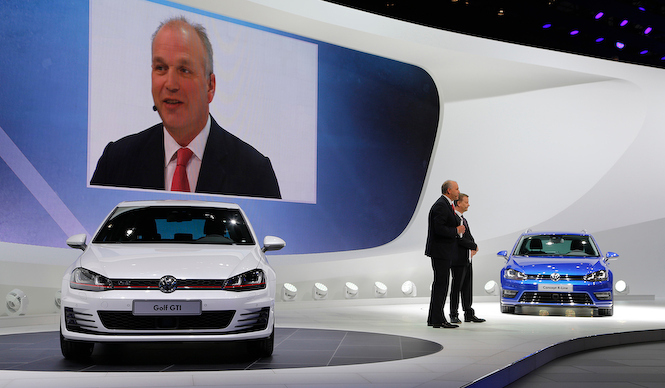
To describe Volkswagen's booth in a single word, it was a "Golf 7 Festival," especially after the Golf 7 was named Car of the Year just before the Geneva show opened. Adding to the festive atmosphere were the "XL1," a special model developed from scratch for ultra-low fuel consumption, and the "up!" family member, the "Cross up!" which joined the lineup.
The star of the Golf 7 festival was the "Golf Variant." This time, its variations were also introduced, including the fuel-efficient TDI BlueMotion, the 4WD version 4MOTION, and the sporty R-Line. Like the hatchback Golf 7, the new model strongly emphasizes weight reduction, being up to 105kg lighter than its predecessor. The exterior design features sharp lines reminiscent of the hatchback, and the distinctive C-pillar design of the Golf 7 is carried over to the D-pillar. Furthermore, the body, which is 307mm longer than the hatchback, offers a luggage capacity of 605 liters, exceeding the previous model by 100 liters. With the rear seats folded down, the capacity expands to a maximum of 1,620 liters (compared to 1,495 liters for the previous model).
Complementing the spotlight-grabbing Variant were additions to the powertrain lineup. Leading this was the TDI BlueMotion, equipped with a 1.6-liter direct-injection diesel engine, boasting an impressive European fuel economy of over 31 km/l. Additionally, the TGI BlueMotion, a bi-fuel model capable of running on both natural gas and gasoline, also achieved a low fuel consumption of 29.4 km/l.
The Jetta, a three-box version of the Golf launched in North America at the end of 2012, received a hybrid model that balances 0-100 km/h acceleration in 8.6 seconds with a fuel efficiency of 24.3 km/l.
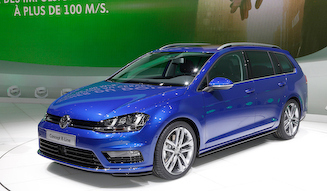
Volkswagen Golf Variant concept R-Line
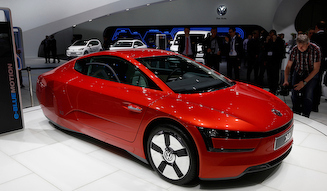
Volkswagen XL1
The familiar high-performance versions of the Golf, the GTI and GTD, also made their debut. For the gasoline-powered GTI, in addition to the standard 220 ps, a 230 ps version is available as an option. Fuel economy for both specifications is 16.7 km/l. Meanwhile, the diesel-powered GTD produces 184 ps, a 14 ps increase from the previous generation, while achieving a fuel economy of 23.8 km/l.
Speaking of the XL1, only its prototype had been known until now, but what was presented this time is its production version. By combining a lightweight, aerodynamically superior carbon composite body with a 48 ps two-cylinder TDI engine, a 7-speed DSG, and a hybrid system, it achieves an astonishing fuel efficiency of 111.1 km/l (!). However, even as a production model, it appears only a very limited number will be manufactured.prototypeSpeaking of the XL1, only its prototype had been known until now, but what was presented this time is its production version. By combining a lightweight, aerodynamically superior carbon composite body with a 48 ps two-cylinder TDI engine, a 7-speed DSG, and a hybrid system, it achieves an astonishing fuel efficiency of 111.1 km/l (!). However, even as a production model, it appears only a very limited number will be manufactured.
There's little need to say much about the Cross up!. This is the production version of the concept model announced at the 2011 Frankfurt Motor Show, a "Cross" branded model based on the up! with a 1.0-liter, three-cylinder engine producing a maximum output of 75 ps. It is expected to go on sale in the summer of 2013.
Looking at all of this, it becomes clear that Volkswagen is pursuing a remarkably sound strategy in economically troubled Europe. Apart from the XL1, all the models introduced this time are based on either the Golf or the up!. In other words, the company's stance is evident: to enhance the lineup of popular models and achieve steady sales without taking significant risks. Furthermore, the addition of either classic models like the GTI and GTD or fuel-efficient variants to the Golf lineup is a prudent choice. Even for a giant like Volkswagen, the need to tread cautiously reveals the depth of the European economic crisis.