Few EVs and Noticeable PHEVs | Geneva Motor Show
Geneva Motor Show 2017 | Analysis Part 3
Surprisingly Few New EV Models
Are PHEVs Just a Stopgap Until 2025?
The Geneva Motor Show 2017 concluded to great acclaim. This final report from the show floor, by Kazuhiro Nanyo, looks at the electric and plug-in hybrid vehicles that offer a glimpse into the near future.
⇒ Analysis Part 1: Supercars
⇒ Analysis Part 2: SUVs
Photographs by Horohiko MochizukiText by Kazuhiro Nanyo
Despite Pressure Towards Electrification
Last year, Norway and the Netherlands passed legislation to ban the sale of internal combustion engine cars by 2025, and Germany by 2030. While these laws currently have no binding force, the trend towards CO2 offsetting is increasingly pushing internal combustion engines out of society, becoming a major topic of discussion. At the end of 2016, German manufacturers announced a joint effort to develop charging infrastructure, creating a tone that suggested Europe was eagerly embracing the EV era.
However, when the Geneva Motor Show opened, surprisingly few high-end BEVs (Battery Electric Vehicles) from European manufacturers were on display.New BMW i8 ModelThe reality was a greater number of new plug-in hybrid models. If the narrative of shifting towards EVs were truly believed, European manufacturers would surely be more involved, making this a rather anticlimactic showing. More prominent were the plug-in hybrids (PHEVs), such as the Porsche Panamera Turbo S E-Hybrid, the completely redesigned Volvo XC60 T8, and the BMW 530e.
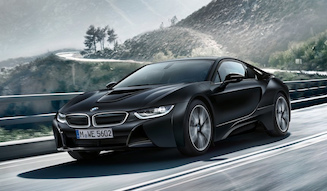
BMW i8
Renault ZOE
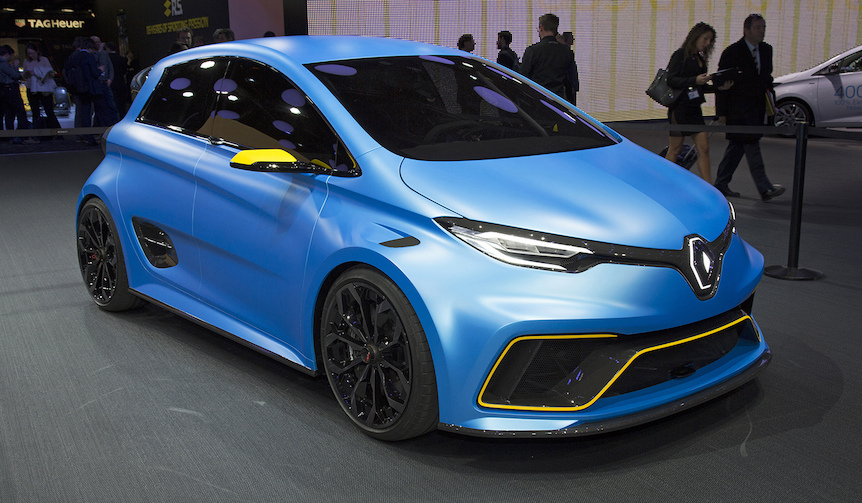
The notable EVs were limited to concepts, commercial vehicles, and mass-market models. Renault, with its "ZOE e-sport," demonstrated how the logic behind the "5 Turbo" and "Clio V6" eras could be applied to EVs. Shifting focus to production vehicles, we saw the EV versions of the Renault Kangoo ZE and Master ZE, and the Peugeot Partner Tepee, none of which are likely to be sold in the Japanese market. Opel also introduced the "Ampera-e." The Ampera-e, with its monospace design, boasts a range of 520 km on the NEDC cycle, though fast chargers and installation costs are sold separately.
Geneva Motor Show 2017 | Analysis Part 3
Surprisingly Few New EV Models
Are PHEVs Just a Stopgap Until 2025? (2)
European PHEVs Begin to Gain Traction
Ultimately, for vehicles with strong GT characteristics suited for inter-city travel, there's little rationale in fitting large, heavy batteries to extend range given the current energy density of lithium-ion batteries. The Opel Ampera-e, mentioned earlier, weighs over 1.6 tons despite being a B-segment car. The fact that the Lexus LS, recognized in Europe as a benchmark hybrid model, has reduced battery weight by 20% compared to the previous generation LS600h, may cast doubt on the push for BEVs.LS500hThe fact that the Lexus LS, recognized in Europe as a benchmark hybrid model, has reduced battery weight by 20% compared to the previous generation LS600h, may cast doubt on the push for BEVs.
Indeed, Europe can finally be said to be entering the hybrid adoption phase. PHEVs, still often perceived as "too much" by general consumers, were predominantly from Korean manufacturers. Conversely, non-plug-in hybrids remained the domain of Japanese automakers. The Toyota Yaris Hybrid (Vitz Hybrid in Japan), a European strategic model for Toyota, received a minor update and was symbolically displayed alongside the high-end Lexus LS500h. Infiniti introduced the "Q50 Hybrid," and Suzuki proposed its Smart Hybrid (SHV, a hybrid where the motor exclusively assists the engine) for the new "Swift," following its implementation in the "Baleno" and "Ignis."
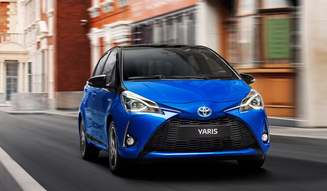
Toyota Yaris Hybrid
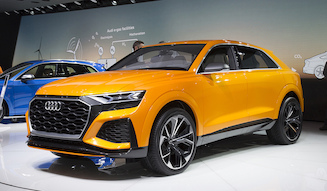
Audi Q8 sport concept
Meanwhile, German manufacturers are taking a different approach. Audi presented the "Q8 sport concept" featuring a powertrain that uses a 3-liter, straight-six TFSI engine assisted by a 20kW electric motor. A consensus seems to be forming that hybrids will be the way forward for the next seven to ten years, and it's likely the true sentiment of European manufacturers and lobbyists is that they cannot afford to overlook the game that Japanese automakers are currently dominating.
However, in countries like Norway, where 97% of energy comes from hydropower, the government subsidies have led to a situation where "e-Golf" models are selling rapidly. If the energy supply can continuously become cleaner, the possibility that the role of hybrids will soon end is not zero.
⇒ Geneva Motor Show 2017 Analysis Part 1: Supercars
⇒ Geneva Motor Show 2017 Analysis Part 2: SUVs