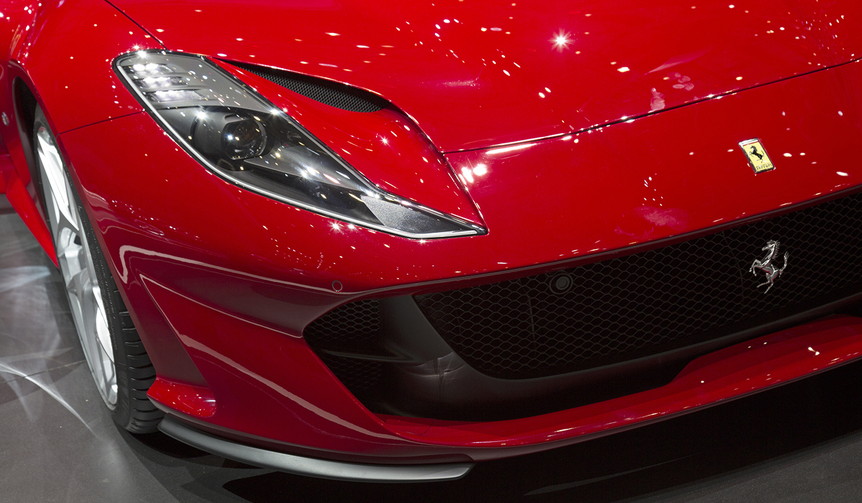
Sports Cars: Two Expressions, One Direction - Geneva Motor Show
Geneva Motor Show 2017 | Analysis Part 1
Sports Cars: Two Expressions, One Direction
It closed its doors after a hugely successful run.Geneva Motor Show 2017While new supercars made their dazzling debut, the ever-popular SUVs vied for attention. Eco-friendly cars like plug-in hybrids and the latest technologies also drew significant public interest. This report, divided into three parts, comes from Kazuhiro Nanyo, who toured the venue during this banner year. The first part focuses on the supercars that captured the spotlight.
Text by Kazuhiro NanyoPhotographs by Horohiko Mochizuki
2017 Geneva: A Fierce Competition Among Super Sports Cars
The Geneva Salon has always served as a premier stage for sports cars, and 2017 was no exception to this expectation. However, the resurgence of sports car enthusiasm felt different from the past; it wasn't a simple equation of customers flocking to powerful sports cars. Instead, it seemed underpinned by various considerations, strategies, and demand from emerging markets.
The keyword here is 'nobility as mechanism.' In other words, it's about how to maintain and justify the integrity of a sports car. My apologies for the abundance of loanwords, but concepts that are difficult to translate into Japanese, or that don't have direct equivalents, are key to recent trends. This also signifies the expanding realm that can be expressed in Japanese.
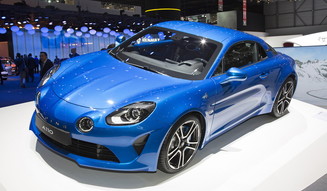
Alpine A110
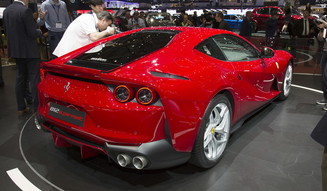
Ferrari 812 Superfast
The main focus seemed to be on super sports cars with large-displacement engines, particularly naturally aspirated ones. On the other hand, among lightweight sports cars, the revival of 'Alpine' was noteworthy. Both represent an interesting exercise in how to present the pure essence of a sports car in 2017.
Geneva Motor Show 2017 | Analysis Part 1
Sports Cars: Two Expressions, One Direction (2)
Will the 812 Superfast Be the Last Naturally Aspirated V12?
First, the FerrariF12's successor, the V12 FR model, the Ferrari812 Superfast, boasts specifications of 6,496cc, 800ps/8,500rpm, which are truly astonishing. While the question of where one could possibly unleash the full potential of an 800ps road car is, of course, a foolish one, it is crucial that supercars remain 'super' as they always have been.
Key chassis dynamics, such as Ferrari's first electric power steering (EPS) and the rear-wheel steering system, which has been used since theF12tdf, are electronically integrated. Unleashing 800ps on public roads requires a certain resolve from the manufacturer.
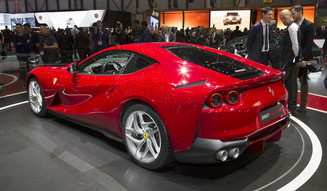
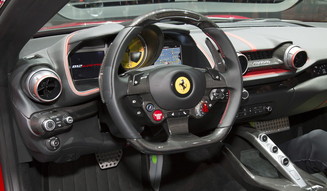
Incidentally, the silhouette of the 812 Superfast evokes the '365 GTB/4 Daytona,' but it is also said to be the last naturally aspirated V12 Ferrari. This likely stems from the sentiment that the continuation of the noble V12 mechanism may not be guaranteed without hybridization in the future. This could be considered a paradigm shift greater than when Porsche's911transitioned from air-cooling to water-cooling.
Aston Martin's New Brand, Directly Linked to Racing
Aston Martin also sees the current preference of sports car purists in the genre of large-displacement, naturally aspirated, high-revving engines. Here in Geneva, they announced the launch of a sub-brand, 'AMR,' unveiling the 'Vantage AMR Pro' and 'Rapide AMR.'“AMR” sub-brand, launching “Vantage AMR Pro” and “Rapide AMR”.
AMR is positioned similarly to 'AMG' for Mercedes or 'M' for BMW, and its logic seems to be about preserving Aston Martin's pure lineage through direct connection with technologies and know-how born from the racetrack.
However, the existence of such extreme models will likely broaden the appeal of the existing lineup towards comfort and utility. This also opens up possibilities for 'different kinds of sports,' such as SUVs and shooting brakes that incorporate utility.
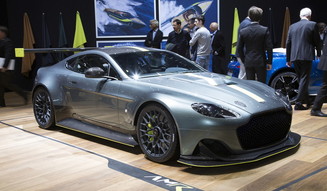
Aston Martin Vantage AMR Pro
Incidentally, Aston Martin will sell the mid-engined model, developed with Red Bull Racing under the codename AM-RB001, as a production car called theValkyrie. What is certain is that it will feature a mid-mounted V12 engine, a power-to-weight ratio below 1 kg/ps, a chassis designed by F1 engineer Adrian Newey, and is expected to be produced in around 100 units with a price tag of 3.3 million euros (approximately 400 million yen).
Geneva Motor Show 2017 | Analysis Part 1
Sports Cars: Two Expressions, One Direction (3)
Lamborghini Steals Porsche's Thunder
And it was Lamborghini'sHuracán Performantethat demonstrated the pure thrill of large-displacement, naturally aspirated engines through a pragmatic approach to performance. While not just a minor update to the model formerly known as Superleggera, its record-breaking lap time of 6:52.01 on the Nürburgring Nordschleife, surpassing Porsche's918 Spyder, is arguably its defining characteristic.
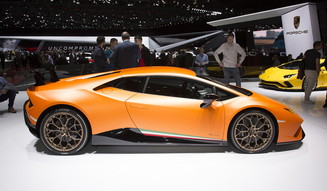
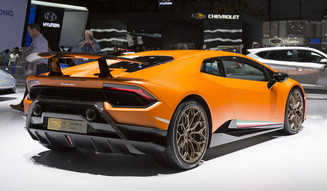
Porsche, traditionally focused on proving its mettle through lap times at the Nürburgring and elsewhere, seemed to have its thunder stolen. However, Lamborghini also undertook a non-traditional minor update. They added a 6-speed manual transmission, inherited from the '911 R,' to the '911 GT3,' which had previously only offered the PDK. For the GT3, 'efficiency' has now taken a backseat to 'emotion.' Furthermore, the engine displacement was increased from 3.8 liters and 450ps to 4.0 liters and 500ps. This also reflects the trend towards increased efficiency and larger displacement.
The Revival of Lightweight Sports Cars
Turning to lightweight sports cars, the revival of Alpine under the name 'A110' was nothing short of a historic moment. While attention is drawn to its light weight of 1,040 kg and its body, made of 96% aluminum, the development team focused on placing the roll center around the driver's seat.
Lightness is a key requirement, but the agility with which the car turns around the driver is what defines the Alpine experience. The MR18, a 1.8-liter turbo engine making its debut in the Renault-Nissan alliance, produces 252ps. Its compact size allows for longer A-arms, eliminating the need for stiff shock absorbers, resulting in an unexpectedly comfortable ride.
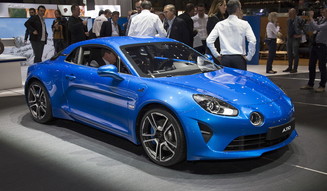
Alpine A110
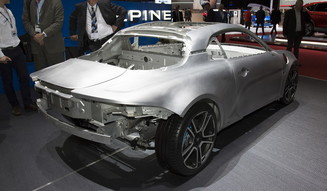
The brilliance of the revived Alpine lies in the installation of over 20 robots at the Dieppe factory, capable of both forming and polishing aluminum panels. This can be seen as a modern, automated approach to traditional coachbuilding. Although the current order count is only around 2,600 units, and the investment cannot be recouped solely from cars priced under 7 million yen, rumors suggest Alpine's next venture will be an SUV. Renault, with its numerous factories in Normandy, could likely leverage the production and supply system for lightweight aluminum panels. This strategy suggests not only intelligence in lightness but also logistical prowess and economies of scale. Conversely, it implies that the integrity of the Alpine sports car is worth preserving to such an extent.
(Continued in Analysis Part 2)