Special Feature: Eco-Car Trio Test Drive in Niigata - Part 1
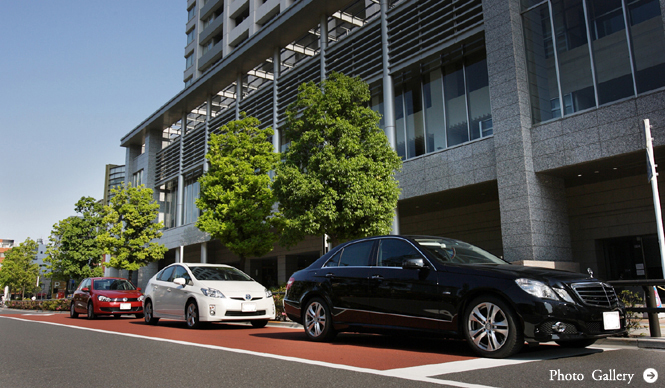
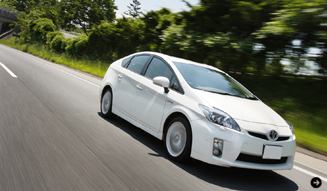
TOYOTA PRIUS G Touring
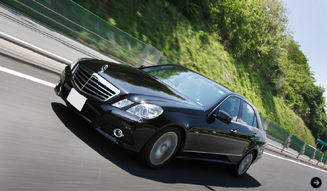
Mercedes-Benz E 350 BlueTEC AVANGARDE
Volkswagen Golf TSI Trendline
Special Feature: A Comparative Drive of Three Eco-Cars to Niigata - Part 1 (1)
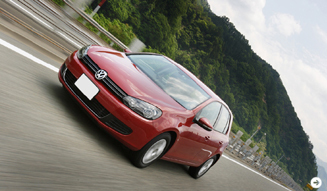
This long-term report is a special feature. We compared three cars: the Prius (car No. 2), the E 350 BlueTEC AVANGARDE (car No. 3), and the much-talked-about Volkswagen Golf TSI Trendline, which achieves low fuel consumption through its direct-injection engine and downsizing concept. Our destination was Ogino-mura in Niigata, a village where thatched-roof houses still remain. We set off for Ogino-mura, a place that preserves traditional ways of life, in three latest eco-cars with different approaches.
Text by OPENERSPhotos by Masayuki Arakawa
This Tour: A Three-Way Battle of Eco-Cars
Although all three are eco-cars, their approaches are entirely different. The Toyota Prius (hereafter Prius) is a hybrid car that has continued to evolve since its debut in 1997. In contrast, the Mercedes-Benz E 350 BlueTEC AVANGARDE (hereafter E 350 BlueTEC) features 'BluTEC,' which is gaining attention for offering the highest environmental performance among diesel engines. Diesel engines, known for their high thermal efficiency and environmental consciousness, account for over 50% of new car registrations in Europe.
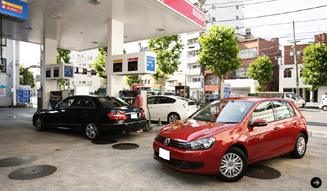
And then there's the Volkswagen Golf TSI Trendline (hereafter Golf), which employs the downsizing concept with a supercharged engine, a recent trend.
In Japan, hybrid cars are the mainstream when we talk about eco-cars. This tour pits a hybrid, a novel clean diesel, and the TSI, born from the idea of downsizing existing engines, against each other. It was organized to highlight the distinct characteristics of each.
On a clear Friday morning, the three eco-cars gathered and were all fueled up at a gas station near our editorial office. From there, the tour began. The full itinerary is as follows.
07:30 Fueling at a gas station in Kameido 0 km
08:00 Hirai Ohashi Entrance (Tokyo Metropolitan Expressway Central Circular Route) 2.9 km
08:35 Bijōgi JCT (Tokyo Metropolitan Expressway Saitama Omiya Route) 29.4 km
08:45 Oizumi IC (Kan-Etsu Expressway) 37.9 km
09:05 Tsurugashima JCT (Kan-Etsu Expressway) 65.3 km
11:00 Muika-machi Exit (Kan-Etsu Expressway) 224.8 km
11:30 Lunch
12:30 Departure
13:00 Entering Kashiwazaki City 259.9 km
13:30 Arrival at Ogino-mura Kayabuki (Thatch-roofed) Village 264.4 km
15:30 Departure for Tokyo
16:30 Muika-machi Entrance (Kan-Etsu Expressway) 304.2 km
19:00 Break at Miyoshi PA 491.5 km
19:15 Kinshicho Exit 541.3 km
19:30 Fueling at a gas station in Kameido 543.4 km
Although we encountered some traffic congestion on the Central Circular Route of the Metropolitan Expressway on the way there, it was a smooth drive overall, thanks to it being a weekday. Including breaks and photo opportunities, it was a 12-hour round trip. The air conditioning was kept on constantly, and we aimed to drive in sync with the traffic flow. The resulting fuel economy for each car is as follows:
Toyota Prius 23.48 km/ℓ
Mercedes-Benz E 350 BlueTEC AVANGARDE 14.65 km/ℓ
Volkswagen Golf TSI Trendline 19.05 km/ℓ
As expected, the Prius won decisively in terms of fuel efficiency. However, fuel economy alone doesn't determine whether an eco-car is good or not. On the next page, the three car-focused editors who participated in this tour will have a candid discussion.
TOYOTA PRIUS G Touring
Mercedes-Benz E 350 BlueTEC AVANGARDE
Volkswagen Golf TSI Trendline
Special Feature: A Comparative Drive of Three Eco-Cars to Niigata - Part 1 (2)
Our Impressions of the Three Models
Staff AThe Golf was the most enjoyable to drive. The Prius was adequate as a means of transportation. The E 350 BlueTEC... I found the unsettled ride quality bothersome. Upon investigation, the E350 AVANGARDE with its 3.5-liter V6 gasoline engine weighs 1,710 kg. In contrast, the E 350 BlueTEC with its 3-liter V6 diesel weighs 1,910 kg, comparable to the E63 AMG with its 6.3-liter V8, which weighs 1,920 kg. While a direct comparison isn't straightforward, that's a 200 kg difference. Of course, not all of that is engine weight, but the 'AdBlue system' containing urea solution must be quite heavy. I heard the tank is built very robustly to protect the urea solution from shock and temperature changes. Perhaps that weight is a burden.
Staff BCould it be due to the run-flat tires? A heavier vehicle can sometimes offer a smoother, more settled ride.
Staff AThat might be the case, but the cylinder strength is also increased to withstand the ultra-high pressure injection of the direct-injection diesel engine, which adds to the engine's weight. With a 200 kg increase, I doubt it would feel merely 'settled.' I wondered if the hybrid system was also heavy, given the weight increase in the clean diesel, so I looked into that too. For example, comparing the Prius with the Premio, which has the same wheelbase of 2,700 mm, the Premio weighs 1,230 kg, while the Prius weighs 1,350 kg. Again, it's not a direct comparison, but there's a difference of over 100 kg.
Staff BSo, you felt the balance between the vehicle's weight and the suspension setup wasn't quite right. Diesel engines are inherently ecological, offering good combustion efficiency, low fuel consumption, and reduced CO2 emissions. However, to further address air pollution, systems like common rails are used, along with devices that spray urea into the exhaust gas to break down harmful nitrogen oxides into harmless nitrogen and water. This results in an increased load on the entire vehicle.
Staff AHowever, even though the Golf has succeeded in improving fuel efficiency with its downsizing concept and offered a comfortable ride this time, I don't think Volkswagen can be definitively called the number one manufacturer. I'd be interested to see Volkswagen's clean diesel and hybrid offerings as well.
Staff BIndeed. The E 350 BlueTEC is in a situation where it must add components, while the Golf has a smaller engine. Turbocharged engines were developed in 1905, but they've been applied to downsizing engines. The fundamental approach is different: one adds components, while the other reduces or shrinks them. It's difficult to say which is the number one approach to environmental friendliness.
To be continued in the next installment