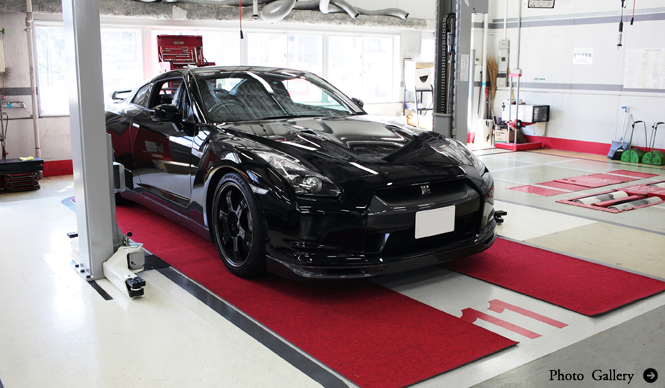
April 15, 2015
NISSAN | The Nissan GT-R Spec V | 3rd Long-Term Test
NISSAN GT-R Spec V | LONG TERM TEST Vol. 3
Preparing for a Future Circuit Debut
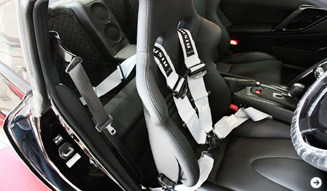
One of the themes of this report is whether a Japanese supercar exceeding 15 million yen can offer the same joy and satisfaction as its European rivals in daily use. However, its potential and charm cannot be fully revealed unless it is taken to its true home ground: the circuit. In preparation for a future circuit debut, we have installed a four-point seatbelt.
Text by OPENERSPhoto by JamandfixSpecial Thanks to PF LINK SYSTEMS
The “first” car
NISSAN GT-R Spec V
Car No. 1
Nissan GT-R Spec V
NISSAN GT-R Spec V
Vol. 3
Introduction Date: February 13
Purchase Price: 15,750,000 yen
Mileage: 2,763 km
Fuel Economy This Period: 4.18 km/ℓ
Overall Average Fuel Economy: 4.98 km/ℓ
The Circuit is Its Home Ground
As reported previously, the OPENERS GT-R Spec V has successfully completed its break-in period and is steadily accumulating mileage. However, its driving has been primarily in city conditions. Even on the expressways of Tokyo late at night, when traffic is light, we've only glimpsed a fraction of the Spec V's extraordinary potential.
One of the themes of this report is whether a Japanese supercar exceeding 15 million yen can offer the same joy and satisfaction in daily use as its rivals in the same price range or with similar performance—Porschesuch as the 911 Turbo andFerrarithe 430. We aim to clarify this by reporting on daily life with the Spec V. However, its potential and charm cannot be fully revealed unless it is taken to its true home ground: the circuit. Therefore, in preparation for a future circuit debut, we decided to install a four-point seatbelt.
Actually, when I previously drove a 2007 normal GT-R, the initial standard model, at a Nissan-hosted driving event at Sendai Highland, I experienced significant fatigue after several laps because the three-point seatbelt provided insufficient body support against the G-forces in all directions. At that time, a Nissan development driver advised that switching to a four-point system would drastically reduce the strain on the body, which is why we decided to proceed with the installation this time. Incidentally, we will use the standard three-point seatbelt for regular road driving.
Four-Point or Six-Point?
Currently, the Spec V division at Nissan Prince Tokyo Sales handles both NISMO's four-point system and a Sabelt six-point system. A six-point system secures the body not only at the shoulders and waist but also between the legs, preventing the body from sliding upwards and increasing safety during circuit driving. However, for the OPENERS GT-R Spec V, which is primarily used on public roads rather than the circuit, we determined that a six-point system would be unnecessary and opted for the four-point installation.
The Sabelt six-point seatbelt offered by Nissan Prince Tokyo Sales' Spec V division is a custom order item that utilizes the buckle from the standard three-point seatbelt. This means it functions as a three-point buckle for everyday city driving, but when heading to the circuit, the belt extending from the left hip can be inserted into the buckle, making it an excellent, versatile option.
According to Hiroaki Yamada, a mechanic at Prince Tokyo Kameido Store's Spec V section, the Spec V's Recaro full bucket seats have a wide gap between the center console and the seat, making it easy to install the anchor bolts for four- or six-point seatbelts. In contrast, the normal GT-R is equipped with thicker seats compared to the Spec V's Recaros, leaving insufficient space between the seat and the center console. The Sabelt six-point system, which uses the original three-point seatbelt buckle, might therefore be the ideal choice for the normal GT-R. While the four-point system, under the NISMO brand, is priced somewhat high at 99,750 yen, the Sabelt six-point system is more affordable at 78,750 yen.
Easier Installation on the Spec V Due to Lack of Rear Seats
The installation procedure involves first removing the seatbelt, then replacing the left bolt used as the buckle for the three-point seatbelt with an anchor bolt, and connecting the left side of the four-point belt with a hook. Similarly, the right hip bolt of the three-point seatbelt is also replaced with an anchor bolt, and the right side is secured with a hook.
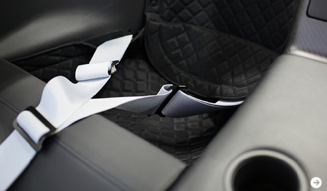
Next, the two belts extending over both shoulders are secured. Normally, this involves removing the rear seat cushion to install two anchor bolts. However, on the Spec V, which lacks rear seats, removing the quilted cover reveals holes through which the bolts can be passed, making the work easier than on the standard model.
As mentioned, the installation itself does not require specialized techniques or modifications. Anyone with the necessary tools and a hobby of working on cars should be able to install it themselves. However, we were advised to exercise extreme caution, especially when removing the seats, to avoid scratching the body.
Incidentally, the Spec V division also accommodates customers who bring their own seatbelts; in such cases, only the labor fee will be charged (plus parts cost if any additional parts are needed).
First Oil Change
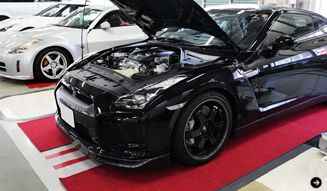
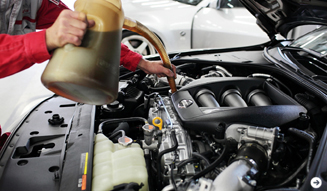
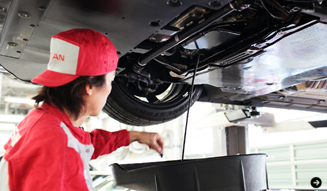
Since we had brought the car into the dealership, we requested two additional services besides the seatbelt installation. First, an engine oil and oil filter element change.
According to Mr. Yamada, the recommended timing for an oil change is every 15,000 km for city driving and every 5,000 km for circuit driving. However, this was the first oil change after completing the break-in period, so we decided to do it after exceeding 2,500 km.
He also advised that if the oil temperature exceeds 130°C during circuit driving, the oil should be changed immediately as it will no longer perform optimally. Furthermore, for primarily circuit use, the oil level is reduced by about 0.5 liters. Mechanic Yamada, who has extensive racing experience, explained that too much oil can be churned by the crankshaft, leading to higher oil temperatures.
All Fluids Are the Same as the Normal GT-R
Regarding the comparison between the standard GT-R and the Spec V, both the engine oil and transmission oil are exactly the same. Speaking of transmission oil, the recommended change interval is 60,000 km for city driving and 5,000 km for circuit driving. It is also recommended to change it if the oil temperature reaches 140°C.
While the car was at the dealership, we also requested a repair for a stone chip on the windshield. Shortly after delivery, while driving on the Tokyo Metropolitan Expressway, a stone hit the windshield directly, leaving a scratch about 3mm long. Mr. Yamada inspected it and determined that replacement was unnecessary, so we asked for a repair. Of course, the repair process is the same as for any other car, not specific to the Spec V; it's the same procedure used for a March or a Cube. The fact that this was handled in the same way, despite the Spec V's special nature, was strangely reassuring.
Work Performed and Costs This Time
| Work Performed / Parts Used | Labor Cost | Parts Cost |
| Engine Oil & Filter Element Replacement | 7,350 yen | |
| Mobil 1 0W-40 5.5L | 17,325 yen | |
| Oil Element | 1,313 yen | |
| Drain Washer | 168 yen | |
| Seatbelt Installation (including short parts) | 12,600 yen | |
| NISMO Racing Harness | 99,750 yen | |
| Windshield Repair | 15,750 yen |