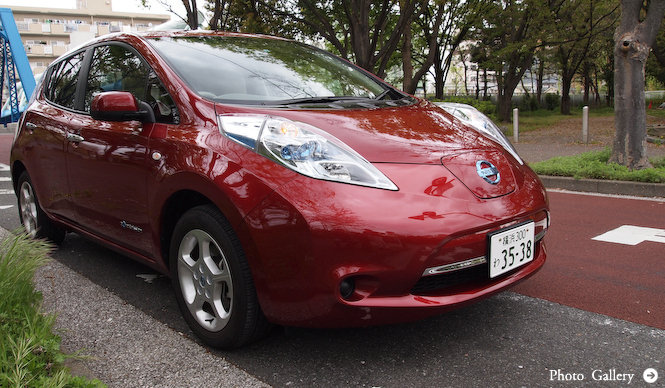
Nissan Leaf Long-Term Report: Final Installment | Nissan
Nissan Leaf
Final Installment
Run, Leaf, Run
Our reports began in October 2011, and the world's first mass-produced electric vehicle, the "Leaf",has finally received a minor model change.Every change addresses requests from Leaf users, clearly demonstrating Nissan's commitment to steadily enhancing its completeness. For its final long-term report, OPENERS takes stock of the Leaf, which has now become the "conventional model." Along with anticipation for tomorrow's mobility.
Text & Photographs by OPENERS
A Car of the Future
Over the six months we spent with the Leaf, the editorial department used it extensively, not only for reporting assignments but also for everyday tasks like transporting goods and shopping, as one would if they had purchased it. Most of our driving was on urban roads or expressways, but as we've reported previously,Challenging Long-Distance Drivesand for leisure activities likeGirls' Gatherings.
When evaluating the Leaf as a car, its high driving stability due to its low center of gravity is particularly noteworthy. With heavy components like the battery housed low in the chassis, it achieves a low center of gravity that sports cars struggle with. Conversely, it gives the impression of carrying weight beneath the floor, but this suppresses nose-diving during braking and pitching, resulting in a flat ride.
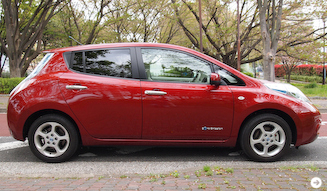
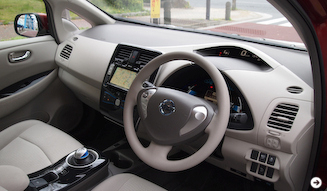
And then there's the overwhelming torque from the motor. This too provides a unique thrill that cannot be experienced with gasoline or diesel engines. The direct response and the complete lack of resistance, as if there were no mechanical connection, can, once you get used to it, even make the most sophisticated internal combustion engine feel outdated. It was truly a vehicle of the near future.
The luggage capacity is also more than sufficient for daily life. We even used it to transport photographic equipment at times, and there were absolutely no moments of dissatisfaction.
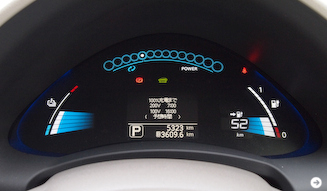
The concern about cruising range has been discussed ad nauseam, not just by OPENERS but everywhere, so I don't think there's much point in dwelling on it now. However, as the temperature rises, the cruising range naturally increases, with the displayed driving range fluctuating between about 150km and 180km. In either case, it's a perfectly adequate distance for daily use as a city runabout.
The Inscrutable ECO Mode
Naturally, after living with it for a while, one notices minor drawbacks. For instance, the unnatural brake feel remains a point of dissatisfaction. In particular, the engine-braking resistance when lifting off the accelerator, which seems to vary depending on whether regenerative braking is active or not, and also on the charging status, was something I never quite got used to.
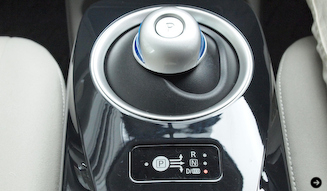
Another puzzling aspect is the existence of "ECO Mode" and "Normal Mode" in the driving modes, with "ECO Mode" requiring the selector to be moved to Drive twice before it can be selected.
With an internal combustion engine, the existence of an "ECO Mode" for better fuel economy is understandable. However, for the Leaf, which promotes itself as ecological, having only ECO Mode would be perfectly acceptable. In fact, it seems like the correct approach. One wonders how often drivers would actually find themselves enjoying the handling and power performance while consciously managing the battery level in this car.
Nissan Leaf
Final Installment
Run, Leaf, Run (2)
Bridging the Gap with Lifestyle
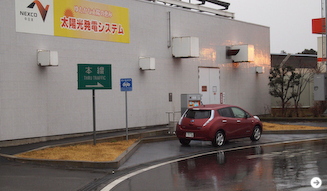
While managing the usual battery levels is not a major issue, similar to an internal combustion engine car, the problem arises when you need to leave unexpectedly and the battery is less than half full. In such situations, you're reminded that the Leaf was designed with the assumption that charging would occur overnight in a flat parking space equipped with charging facilities.
Since our parking space is a mechanical multi-story car park, we were forced to drive out and find a charging facility, consuming battery power in the process. In this sense, it contradicts the earlier statement that it's "perfectly adequate as a city runabout." Operation in large urban areas with many apartment buildings can be challenging. This is particularly problematic for affluent residents in city centers who often live in high-rise apartments, as they may not be able to install charging facilities.
Can We Realize Future Mobility?
Driving the Leaf naturally sparks an interest in ecology. Regardless of the actual facts, it instills a strong sense of "I am traveling with low emissions." This feeling extends beyond the moment of driving; it makes you feel involved in the development of infrastructure, for example.
In other words, increasing the adoption rate of EVs, whether it's the Leaf or even the "i-MiEV," directly translates into social pressure for the development of charging infrastructure. As user demand grows, commercial facilities like convenience stores and shopping centers, as well as entertainment venues, will likely introduce charging facilities proactively based on simple economic principles. This would significantly advance the resolution of the biggest issue: cruising range.
The Leaf is priced around 4 million yen. Even with subsidies, it's just over 3 million yen. For that price, you could buy a Nissan Teana, Serena, or X-Trail. Considering the ever-present issue of cruising range, many people likely purchase it as a second car for city commuting.
Being able to afford this price suggests a lifestyle with enough disposable income to prioritize environmental considerations. When such individuals purchase the car and lead eco-conscious lives, it essentially becomes a situation where affluent people indirectly contribute to the development of social infrastructure while satisfying their own sense of self-worth. This holds the potential to be a healthy cycle.
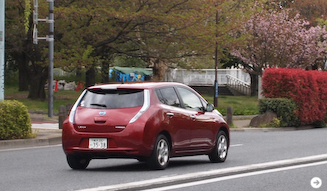
It was a car that made me feel a sense of responsibility towards the environment every time I drove it.
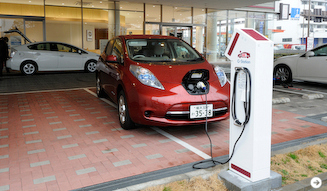
With the sale of the Prius PHV, charging is now possible at Toyota dealerships. However, it's only standard charging, so the opportunities to use it are limited. In the background, you can see a Prius PHV.
Introducing next-generation vehicles as an environmental consideration is something everyone likely feels they "must do." However, in the current situation where infrastructure is not yet in place, it is undoubtedly a highly challenging endeavor for companies that must pursue profits, even without looking at market research results. It's understandable that they might hesitate to commercialize vehicles after announcing them as show cars or demo cars.
Someone has to do it. Nissan stepped up to the plate. Regardless, I want to offer my wholehearted and resounding applause for that bold decision. It certainly has its contradictions, including cruising range. However, evaluating this car solely on its own merits today has little meaning. Perhaps, on the day when more ecological cars become commonplace in the future, the path paved by the "Leaf" will hold significant meaning.

NISSAN LEAF
Body | Overall Length 4,445 x Overall Width 1,770 x Overall Height 1,545 mm
Wheelbase | 2,700 mm
Tread (Front/Rear) | 1,540 / 1,535 mm
Power Source | Motor
Maximum Output | 80 kW (109 ps) / 2,730-9,800 rpm
Maximum Torque | 280 Nm (28.6 kgf-m) / 0-2,730 rpm
Battery Type | Lithium-ion battery
Total Battery Voltage | 360 V
Total Battery Capacity | 24 kWh
Weight | 1,520 kg
Minimum Turning Radius | 5.2 m
Tires | 205/55 R16
Drivetrain | Front-wheel drive
Energy Consumption (AC Power Consumption Rate) | 124 Wh/km (JC08 mode)
Energy Consumption (Driving Range per Charge) | 200 km (JC08 mode)