April 15, 2022
Test Drive of Mazda's New SUV Prototype, the CX-60—How Does the Handling, Similar to the Roadster 990S, Perform? | MAZDA
MAZDA CX-60 | Mazda CX-60
Test Drive of Mazda's New SUV Prototype, the CX-60
Mazda announced the new crossover SUV "CX-60" on April 7, 2022. We test-drove this new SUV prototype, which features a body one size larger than the CX-5, a newly developed 3.3-liter 6-cylinder (gasoline and diesel) mild hybrid, and Mazda's first PHEV. It also incorporates suspension technology called Kinetic Posture Control, similar to the Roadster 990S, showcasing Mazda's engineering prowess.
Text by OGAWA Fumio
A 6-Cylinder Unit That Reflects the Development Team's Strong Commitment
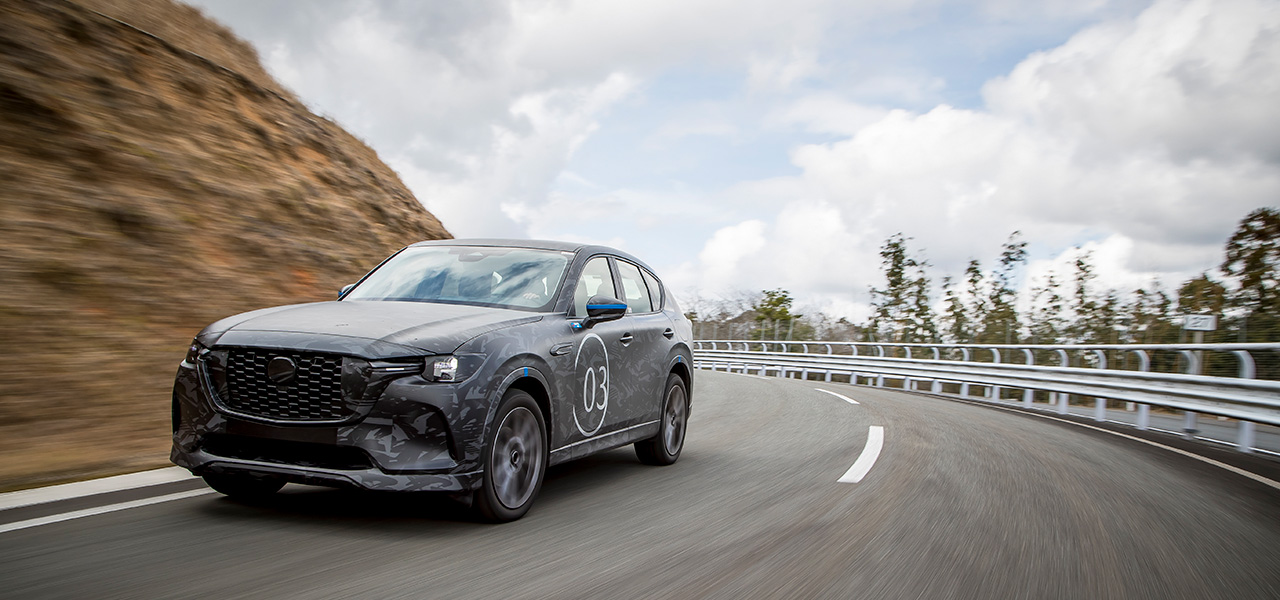
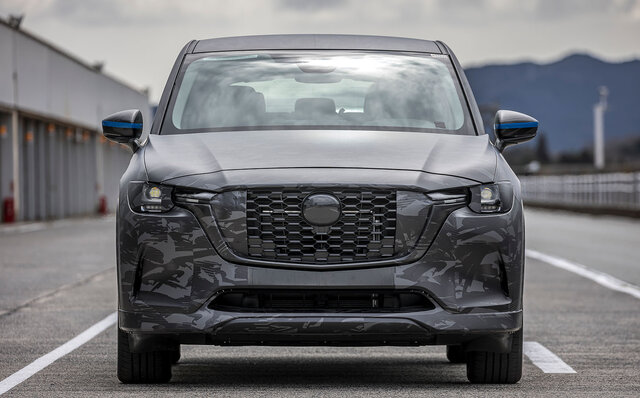
We test-drove a prototype of Mazda's new generation of larger SUVs, which the company calls its "Large Product Group." In mid-March 2022, journalists were given the opportunity to test drive the vehicle, which was still camouflaged due to its styling not yet being ready for public release, though mechanically it was nearly complete.
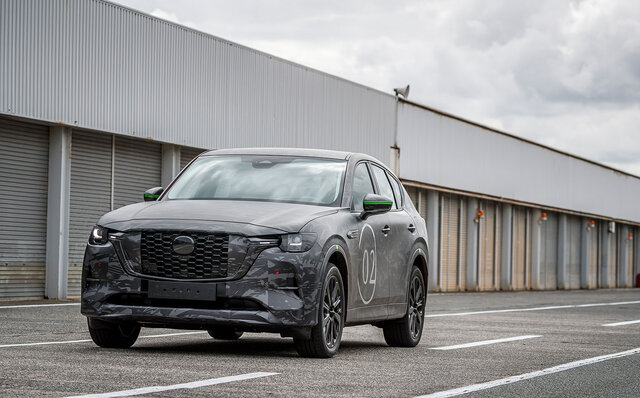
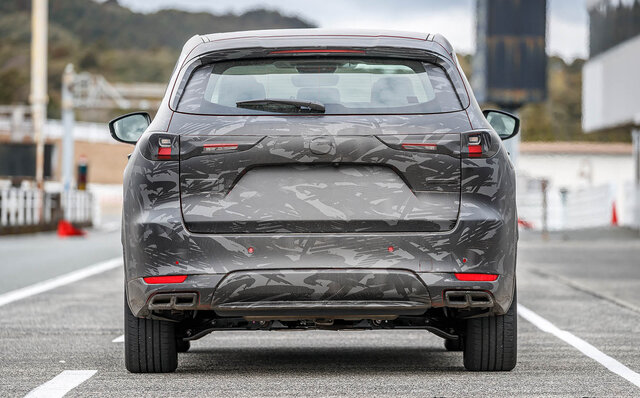
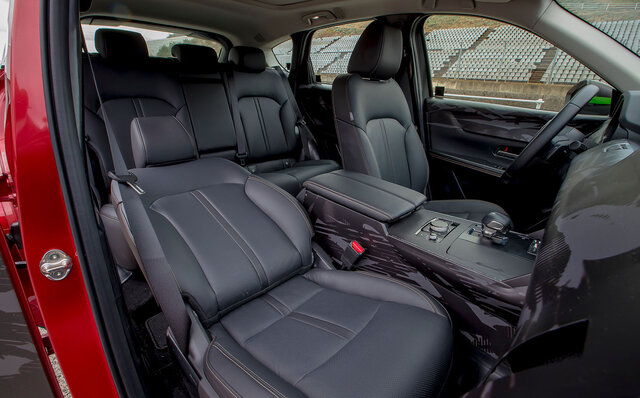
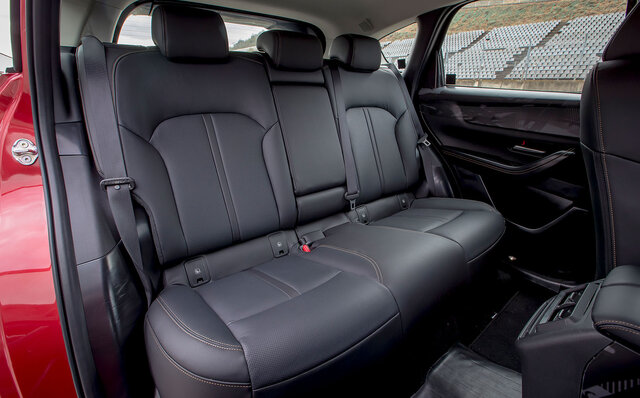
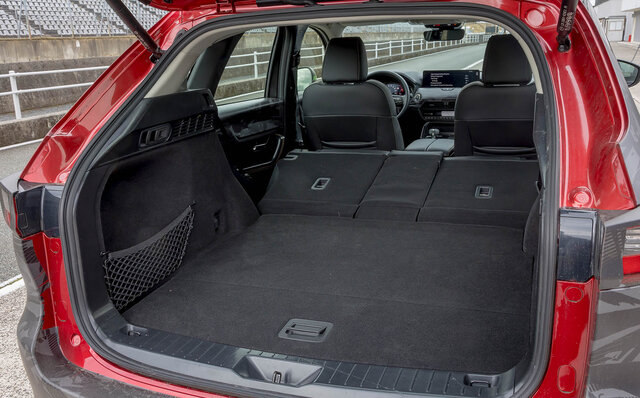
Mazda's Large Product Group includes the "CX-60," announced on April 7, 2022. Positioned above the CX-5, its dimensions are slightly larger: 4,742mm in length, 1,890mm in width, and 1,691mm in height (European specifications), compared to the CX-5's 4,575mm, 1,845mm, and 1,690mm respectively.
The most significant differences lie in the powertrain. This time, a newly developed 3,283cc inline 6-cylinder engine (with mild hybrid) is available in both gasoline and diesel variants, alongside a plug-in hybrid system using a 2,488cc 4-cylinder gasoline engine. The 6-cylinder engine appears to be offered only in diesel for the Japanese market.
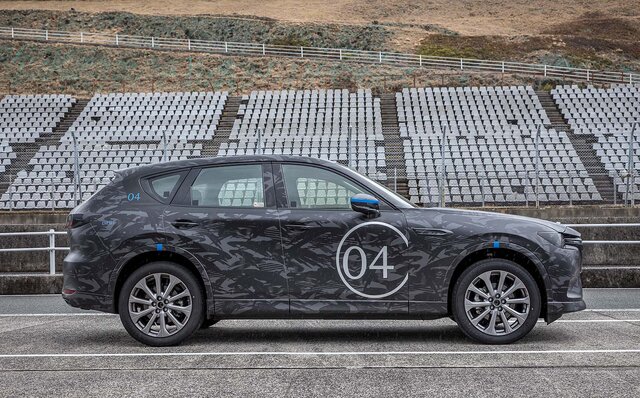
The combustion chamber is also newly designed, making this a 6-cylinder unit that clearly reflects the strong commitment of Mazda's development team. A notable feature is the deliberately chosen displacement of 3.3 liters, whereas many German manufacturers opt for 3 liters.
When I asked for the reason, Hiroyuki Matsumoto, an Executive Officer in Mazda's Vehicle Development Division, explained, "Our objective with this engine is to improve fuel efficiency through increased displacement. Multi-cylinder configurations enhance smoothness by reducing vibration. The optimal solution for these goals was the 3.3-liter inline 6-cylinder."
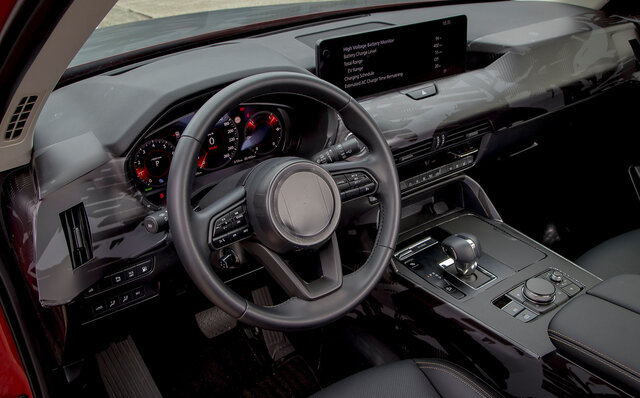
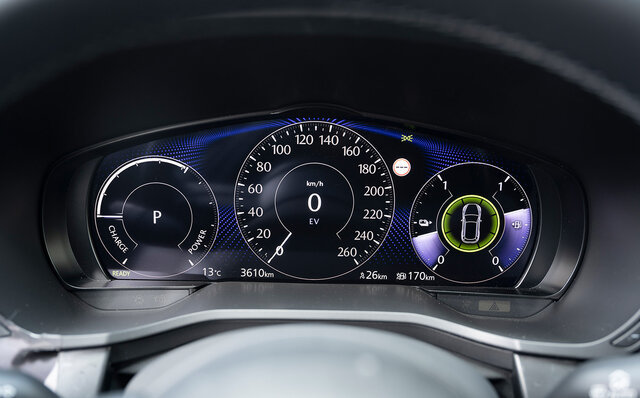
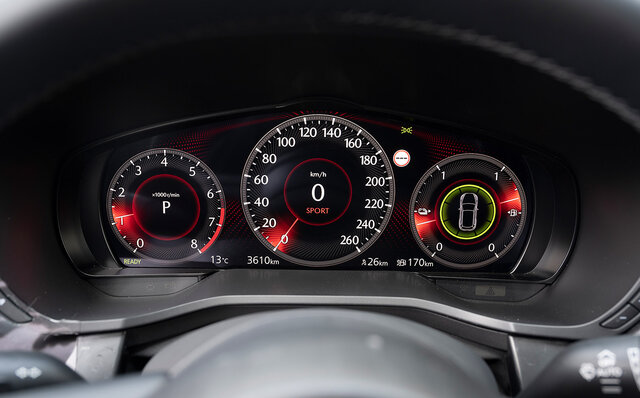
A transverse V-engine layout is a common mechanical configuration, as it positions the engine forward of the front axle with minimal overhang. In this case, however, it's mounted longitudinally rather than transversely. According to Mr. Matsumoto, this was done "to reduce inertial mass and enable the power of all four wheels to be converted into cornering motion without delay."
According to the specifications, the 6-cylinder diesel engine produces a maximum output of 187 kW (254 PS) at 3,750 rpm and a maximum torque of 550 Nm between 1,500 and 2,400 rpm. It is paired with a motor that provides additional torque during acceleration and contributes to fuel efficiency. This is a mild-hybrid system.
In overseas markets, a 3-liter 6-cylinder gasoline engine will also be introduced. In Japan, the new gasoline unit will be a plug-in hybrid combining a 2,488cc 4-cylinder engine with an electric motor. This externally chargeable system is powerful, with a combined system output of 241 kW and maximum torque of 500 Nm.