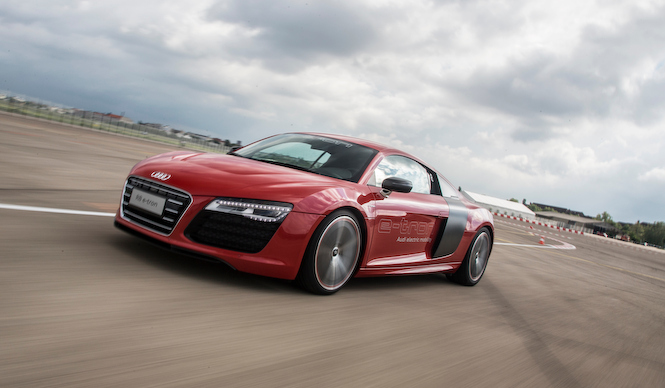
A Drive in the Audi R8 e-tron
Audi R8 e-tron | Audi R8 e-tron
Test Drive: Audi R8 e-tron
Audi Future Lab e-tron ExperienceAnother highlight was the test drive of Audi's electric supercar, the "Audi R8 e-tron." While its appearance is that of the "R8," its internals are almost entirely different. With its commercialization now shelved, opportunities to drive it are rare. How does it perform?
Text & Some photographs by OTANI Tatsuya
First Experience with the R8 e-tron
Testing the limits of cornering with the Audi R8 e-tron.
We had such a dreamlike experience in Berlin. It was part of the recent "Audi Future Lab e-tron Experience."
"You are likely the first Japanese journalists to have driven the R8 e-tron to its limits."
An Audi Japan representative accompanying us said so.
That's understandable.
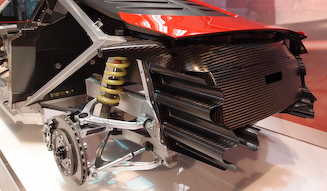
Prototype cars typically cost well over 100 million yen each. Furthermore, the R8 e-tron we test drove was a special model combining a bespoke light-alloy frame with a carbon fiber body.
With two electric motors generating a total of 380 ps and a large 48.6 kWh lithium-ion battery, it's impossible to even guess its price.
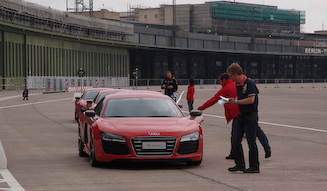
And we were allowed to drive it freely on a specially constructed course, simulating a circuit. It was certainly a generous offer.
The real question was whether we, the drivers, could fully extract the R8 e-tron's performance.
Audi R8 e-tron | Audi R8 e-tron
Test Drive: Audi R8 e-tron (2)
Why is it Different from the Regular R8?
Speaking of the R8 e-tron, did you know that three generations have been prototyped? Surprisingly, only the first generation used the same ASF (Audi Space Frame) as the production car and featured quattro all-wheel drive.First GenerationAfter that, it quickly switched to a dedicated chassis and rear-wheel drive, with the third generation we tested being an evolved version of the second.
Why wasn't the production ASF body adopted? And what was the reason for abandoning Audi's signature quattro in favor of rear-wheel drive?
The reason for the dedicated body was likely the high demand for weight reduction inherent to electric vehicles (EVs).
EVs tend to be heavy due to the large batteries they carry. Moreover, increased weight necessitates further reinforcement of the body.
This creates a negative spiral: increased weight requires a larger battery to maintain performance, which further increases weight.
This effect is far more significant than in conventional engine cars, making body weight reduction essential for EVs. BMW's "i" sub-brand, which uses an all-carbon body, is a prime example of this principle.
However, unlike BMW, Audi opted for a multi-material space frame structure, combining a light-alloy frame with a carbon fiber body. Making the entire body from carbon would require numerous molds, leading to increased costs.
Fundamentally, a body structure that strategically uses both metal and carbon can achieve greater rigidity at a lower weight than an all-carbon construction. Audi's Matthiasコルマン explained the benefits of the multi-material space frame this way during his presentation.
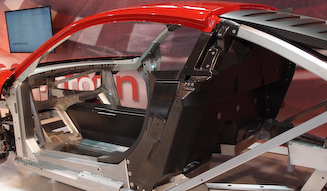
R8 e-tron's Dedicated Space Frame
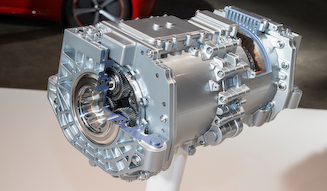
Powertrain with two electric motors, each producing 140 kW
The Reason for Not Being Quattro
So, why was rear-wheel drive chosen over quattro?コルマン explained, "With EVs, we can control driving force more quickly and precisely, so we believed we could achieve stability comparable to quattro with rear-wheel drive. Increased rolling resistance, etc., would also be a disadvantage for an EV."
In the R8 e-tron, two electric motors, driving the rear wheels independently, are placed coaxially with the rear axle.
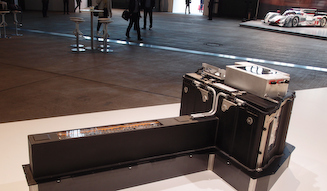
Furthermore, since the large lithium-ion battery is housed in the car's center tunnel, driving the front wheels would require either placing electric motors on the front axle or installing a propeller shaft that passes through the battery area.
The former is difficult due to weight considerations, and the latter is difficult due to structural issues.
These are likely the reasons why the R8 e-tron was made rear-wheel drive.
Audi R8 e-tron | Audi R8 e-tron
Test Drive: Audi R8 e-tron (3)
Driving Without Restraint
The test drive venue was set up at an old airfield in Berlin. A special course was created using pylons and temporary curbs, offering a sophisticated opportunity to fully experience the R8 e-tron's performance.
The course layout primarily consisted of low-speed corners, but also included a few medium-speed corners and S-bends for quick direction changes. It was more than sufficient for testing the handling.
Initially, we drove at a controlled pace behind a lead car, but after two or three laps, we were allowed to drive freely without the lead car.
We were instructed to stop briefly at the start/finish line to maintain distance from the car ahead, but this was a remarkably bold test program.
The assumption was likely that with no obstacles on the airfield, even a slight off-course excursion wouldn't result in a crash. Naturally, this was exactly what we wanted. We decided to make the most of this opportunity.
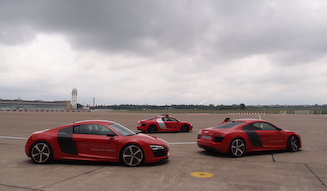
On the first straight, we accelerated at full throttle. The 380 ps electric motors accelerated the 1,780 kg body smoothly, without any noise or vibration.
Initially, the driving torque was likely limited to ensure drivability and sufficient traction, but after about a second, the acceleration increased exponentially, becoming almost terrifyingly rapid within two to three seconds.
The 0-100 km/h acceleration is 4.2 seconds, slightly slower than the V10-powered R8 quattro. However, in terms of drama and intensity, the R8 e-tron is clearly superior. This might be because we are still not fully accustomed to the characteristics of electric motors as a power source.
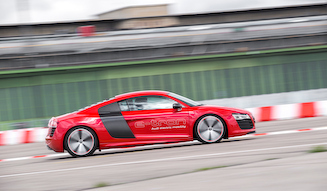
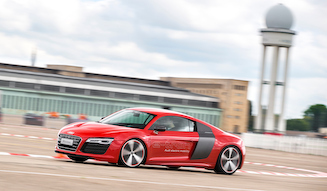
Next, we moved on to the handling section. The R8 e-tron offered three driving modes: Efficiency, Auto, and Dynamic. Here, we will focus on the most sporty mode, Dynamic.
When turning the steering wheel and applying throttle excessively, some understeer occurs. However, with careful weight transfer, the nose smoothly turns in. At low cornering speeds, no amount of throttle will induce oversteer, but as the pace increases, you can feel the rear beginning to slide outwards at a moderate speed.
What's remarkable is what happens next.
Audi R8 e-tron | Audi R8 e-tron
Test Drive: Audi R8 e-tron (4)
This Can't Be Done with Gasoline
To prevent spinning out, the stability control intervenes, as expected. However, its operation is incredibly smooth, unlike anything possible with an engine car.
First, when the rear slip angle reaches a certain point, the throttle input no longer increases power. Then, while maintaining the oversteer attitude, the motor output is gradually reduced.
With conventional engine cars, when stability control engages, it can abruptly cut engine power as if punishing the driver, often extinguishing the passion for sporty driving. The R8 e-tron is entirely different.
It gently corrects the trajectory while preserving the joy of driving. This is largely due to the characteristics of electric motors, which allow for rapid output control. In this sense, the R8 e-tron even points towards the direction of future super sports cars.
Ready for Production
Audi has previously stated its intention to put the R8 e-tron into production. The R8 e-tron we test drove this time has completed development for commercialization and is ready for mass production at any time.
However, for a specific reason, Audi has decided not to mass-produce the R8 e-tron for the time being.
Through EV demonstration experiments led by the German government, it was concluded that electric vehicles, even if they are EVs, will not be accepted by users unless they have a cruising range comparable to that of gasoline-powered cars.
The R8 e-tron's cruising range is 215 km in the European driving mode. Audi's judgment was that this is still insufficient.
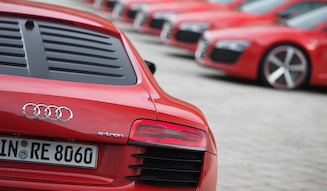
Still, it's a shame to give up on the futuristic driving feel of the R8 e-tron.
Wolfgang Durheimer, Audi's Board Member for Research and Development, stated, "If battery energy density doubles and prices halve, we will commercialize EVs."
We eagerly await the day when that happens.