Tesla Model S: An Early Test Drive in Japan | Tesla
Tesla Model S
A Fully Original EV from Silicon Valley, Driven in Japan
Test Drive: Tesla Model S
It's unlikely that personal transportation will be exclusively electric vehicles in the near future. However, a society without electric cars is also unimaginable. "Roadster"Tesla Motors, the American electric car manufacturer that made a striking debut with its latest and final Tesla Roadster, has completed its first fully original machine, the "Model SThe Model S, reservations and test drives for which have already begun in Japan. OPENERS took it for an immediate spin with Satoshi Shiomi.
Text by SHIOMI Satoshi
Photographs by MOCHIZUKI Hirohiko
Want to Drive the Model S in Japan
Ten months ago, I was shocked by the Tesla Model S I test-drove in America. This time, I drove it in Tokyo and was just as shocked.
The Model S, Tesla Motors' second model and its first fully original EV. After rolling off the production line at the company's Fremont factory last summer, it sold 4,750 units in North America alone by the first quarter of this year, exceeding the target of 4,500 units. With the test vehicle now bearing license plates, I immediately raised my hand and took it for a spin on public roads in Tokyo.
Large and Spacious
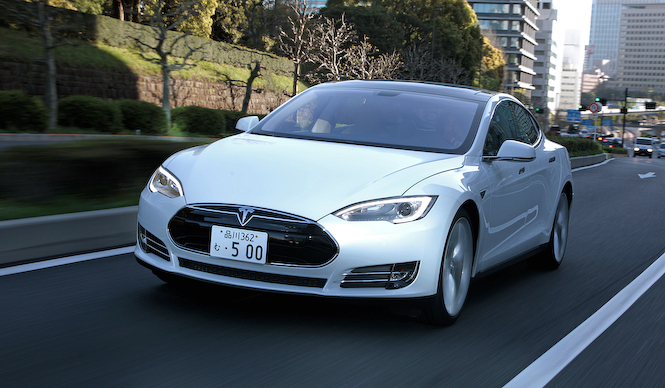
The Model S is large. With a length of 4,978mm, width of 1,964mm, height of 1,435mm, and a wheelbase of 2,959mm, it rivals the Maserati Quattroporte, Jaguar "XJ (SWB), and Mercedes-Benz "S-Class" in terms of its imposing stature.
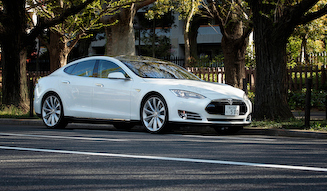
However, it's not a sedan but a five-door hatchback. The designer, Franz von Holzhausen, is a former Mazda employee. Come to think of it, it does evoke a sense of similarity with models like the Mazda Atenza".
The interior is exceptionally roomy. It's definitely more spacious than the Quattroporte or XJ I compared it to, and likely more so than the S-Class. The simple interior design and slim front seats contribute to a feeling of being in a comfortable living room.
The test vehicle was equipped with the optional panoramic glass roof, which further enhanced the sense of spaciousness with its bright interior.
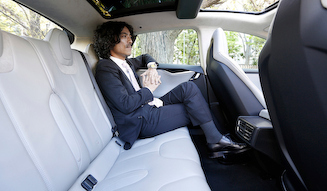
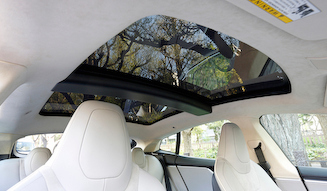
The leather seats are not exceptionally luxurious, but they are not uncomfortable either. Despite the lithium-ion battery pack spread across the entire floor, the seating position feels standard, or perhaps slightly low. It's bright, spacious, and simple, making for a very pleasant place to be.
Tesla Model S
A Fully Original EV from Silicon Valley, Driven in Japan
Test Drive: Tesla Model S (Part 2)
The World of Tesla
Once seated in the driver's seat, you notice the scarcity of hard buttons. The shift lever and turn signal stalk extending from the steering column, along with the power window switches on the door, are sourced from Mercedes-Benz, but everything else is original.
The instrument cluster behind the steering wheel is a screen, displaying necessary information digitally while driving.
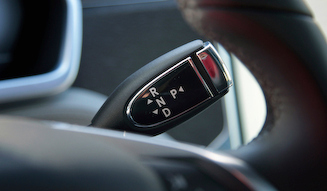
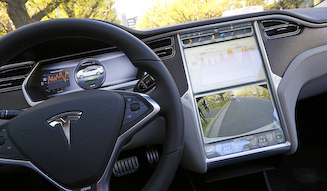
The 17-inch touchscreen on the center console is the interior's highlight. Most functions can be controlled from here. The Model S features 3G data connectivity (carrier in Japan not yet announced), allowing web access, so Google Maps can be used for navigation.
As this test vehicle was the US specification, I couldn't use the web. However, based on my test drive in America last year, displaying Google Maps across the entire 17-inch screen was quite a spectacular sight.
Additionally, the sunroof operation, regenerative braking strength, creep function on/off, steering feel adjustment, traction control on/off, trunk opening, and even starting the car—or perhaps 'powering on' is a more fitting term—are all handled through this touchscreen, resulting in very few physical buttons. Only the hazard lights and glove box release are physical switches.
Tesla Model S
A Fully Original EV from Silicon Valley, Driven in Japan
Test Drive: Tesla Model S (Part 3)
Your Brain Will Be Left Behind
Just like with an internal combustion engine car, after starting, you put the lever in drive and press the accelerator, and the car moves. Well, before that, there's the daily task of unplugging the charging cable.
The Model S has only one forward and one reverse gear. The speed is determined solely by the motor's RPM, which corresponds to the accelerator input.
I floored it suddenly on a straight and regretted it. It delivered that sensation of your brain being left behind, similar to the rapid acceleration experienced in some exceptionally powerful cars, those with over 500 horsepower. It boasts a maximum output of 310 kW (416 hp) from 5,000 to 8,600 rpm and a peak torque of 600 Nm from 0 to 5,100 rpm. The transmission is a single-speed with a fixed gear ratio of 9.73:1.
The test car was the powerful 85kWh Performance version, capable of accelerating from 0 to 60 mph in 4.2 seconds. While faster cars exist, the Model S envelops you in an unprecedented sensation during those 4.2 seconds of silent acceleration. It can feel eerie at first, but you'll soon get hooked.
It might not be the most elegant reason, but frankly, I believe buying the Model S is about buying this acceleration.
Externally, you can cite reasons like "environmental friendliness" or "innovation." But this acceleration, both from a standstill and during mid-range overtakes, is addictive. However, be cautious, as the steering feel becomes less pronounced during sudden acceleration due to the lack of weight in front.
Tesla Model S
A Fully Original EV from Silicon Valley, Driven in Japan
Test Drive: Tesla Model S (Part 4)
The Driving Experience
The vehicle weighs 2,108 kg. At a conservative estimate, 500 kg of that is the lithium-ion battery. The 85 kWh battery pack is spread thinly, about 10 cm thick, across the floor between the wheelbases.
This weight could be a hindrance to performance, but currently, it's unavoidable for EVs to gain battery weight as they increase range. Tesla's design, placing the battery thinly under the floor for optimal weight distribution (48:52 front-rear), mitigates this. The motor is located on the rear axle along with the inverter.
Thanks to this optimal weight distribution and abundant torque, you don't feel like you're driving a 2.1-ton car. While I haven't had the chance to test its cornering capabilities extensively, it turns smoothly and without delay when you turn the steering wheel. In congested traffic, you need to be mindful of its size, but the near-zero latency between operating the steering, accelerator, and brakes makes it easy to maneuver.
The response to accelerator input is particularly sharp; simply intending to accelerate seems to increase speed.
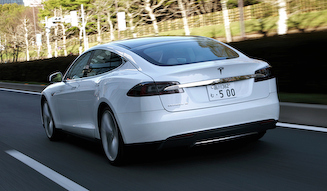
The suspension, a double wishbone at the front and multi-link at the rear, moves supplely, but the flatness across all speed ranges isn't quite there, an area where existing premium cars excel. Whether powered by a motor or an engine, suspension tuning likely requires experience. However, the quality and ride comfort have improved since the unit I drove 10 months ago, suggesting it will get better as production progresses.
What About the Range?
The range for the 85 kWh specification I drove is 265 miles (426 km) according to the US EPA 5-cycle test, and 500 km under Europe's NEDC. The Japanese specification appears to use these figures as catalog specs. While there's no need to discount them by 70% like typical fuel economy ratings, even with a 70% figure, it allows for approximately 300 km of travel on a single charge. The EPA combined MPGe is 89 MPGe. The Nissan Leaf" has a slightly better MPGe at 99 MPGe, with the difference in range attributed to battery capacity.
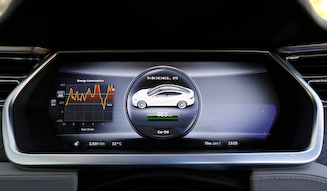
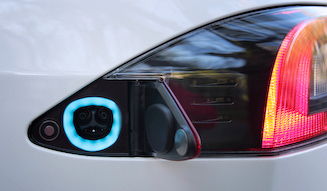
According to Tesla Motors Japan, one hour of charging at 200V provides approximately 85 km of range. The distance from Tokyo Station to Hakone-Yumoto Station via the Tomei Expressway and Odawara-Atsugi Road is 86.0 km (according to Google Maps; the return trip ignores elevation changes). For a two-day trip including 20 km of driving around Hakone, you could return without needing to charge midway. Considered this way, it's quite practical. The Japanese specification is planned to support CHAdeMO charging.
Tesla Model S
A Fully Original EV from Silicon Valley, Driven in Japan
Test Drive: Tesla Model S (Part 5)
Excellent Cargo Capacity
I'd also like to touch upon its practicality. Opening the rear hatch reveals a 744-liter luggage space, which expands to 1,645 liters when the rear seatbacks are folded down.
Furthermore, this car has a "frunk" (a portmanteau of "front trunk" coined by Tesla) with a capacity of 150 liters. As mentioned, the cabin is spacious, and numerous storage compartments are available in the front area, allowing it to accommodate five people plus a considerable amount of luggage.
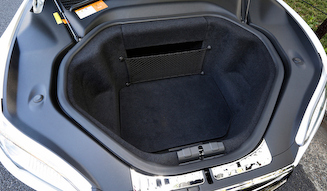
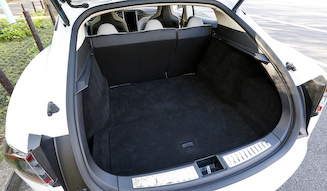
The rear luggage space is deeply recessed at the very back, allowing for two optional rear-facing child seats to be fitted, where occupants would sit facing backward. However, these are strictly for children.
While it doesn't seem to offer the popular pre-crash braking systems, it is otherwise equipped with nearly all the features found in modern luxury cars.
Tesla Model S
A Fully Original EV from Silicon Valley, Driven in Japan
Test Drive: Tesla Model S (Part 6)
Tesla vs. The Media
Tesla, a completely new player not belonging to the established automotive industry, enjoys fervent support from its fans but has also faced its share of scrutiny.
For instance, the popular British TV show 'Top Gear' broadcasted its usual commentary, stating, "It's fast, but charging takes too long, making a trip to Scotland take three days," and "The range is much shorter than advertised." Tesla filed a lawsuit against them, but it was dismissed, with the court ruling that 'Top Gear' is an entertainment program and its expressions fall within the scope of humor.
Furthermore, Tesla was furious when a New York Times reporter who tested the Model S reported, "Despite proper charging, the battery quickly depleted, requiring a tow truck." Tesla retaliated by releasing the data from the reporter's drive, stating, "He did not charge properly and drove much faster than reported." The newspaper acknowledged the reporter's error and apologized, but regarding the release of the driving data, they issued a statement saying, "A reporter's notes and data do not necessarily align (which does not prove intentional falsehoods)."
Where Are EVs Heading?
The Nissan Leaf has sold less than expected, leading to two price reductions. The Mitsubishi Outlander PHEV experienced battery issues shortly after its launch, causing sales to be halted. Although not a car, the Boeing 787, which debuted with much fanfare, also encountered battery problems.
Despite these setbacks, the trend of electric motors taking over a certain percentage of transportation, previously handled by engines, is irreversible. We cannot continue solely with internal combustion engines forever.
There are various issues during this transitional period, but by addressing them one by one, EVs hold immense, if not infinite, potential. The Model S makes this abundantly clear.
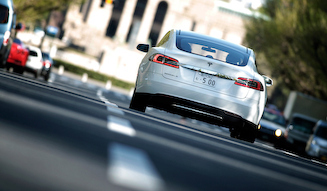
The price in Japan is yet to be determined, but reservations have already begun, and test drives are being accepted. Delivery in Japan is scheduled to start in the latter half of this year. For the higher-end Signature model tested, the reservation deposit is 3.5 million yen. Right-hand drive versions are also expected to arrive eventually.
In the US, prices start at $62,400 for the 60 kWh model, $72,400 for the 85 kWh model, and $87,400 for the 85 kWh Performance version. However, considering the limited number of units expected to arrive, the price in Japan will likely be significantly higher.
Nevertheless, with a considerable number of reservations already placed, the era of EVs may have already arrived for the affluent.

Tesla Model S
Body Dimensions | Length 4,978 x Width 1,964 x Height 1,435 mm
Wheelbase | 2,959 mm
Tread Front/Rear | 1,661 / 1,699 mm
Trunk Capacity (VDA) |
(Frunk) | 150.1 liters
(Front Total) | 229 liters
(Rear) | 755.7-1654.2 liters
Weight | 2,108 kg
Maximum Output |
(85 kWh Battery Performance) | 310 kW (420 hp)
(85 kWh Battery) | 270 kW (362 hp)
(60 kWh Battery) | 225 kW (302 hp)
Maximum Torque |
(85 kWh Battery Performance) | 600 Nm
(85 kWh Battery) | 440 Nm
(60 kWh Battery) | 430 Nm
Drivetrain | RR
Front Suspension | Double Wishbone
Rear Suspension | Independent Multi-link Coil Springs
Tires | 245/45R19 (245/35R21 optional)
*Figures are for US specification