July 18, 2018
Test Drive of the Fully Redesigned Toyota Crown | Toyota
Toyota Crown | The Toyota Crown
Test Drive of the Fully Redesigned Toyota Crown
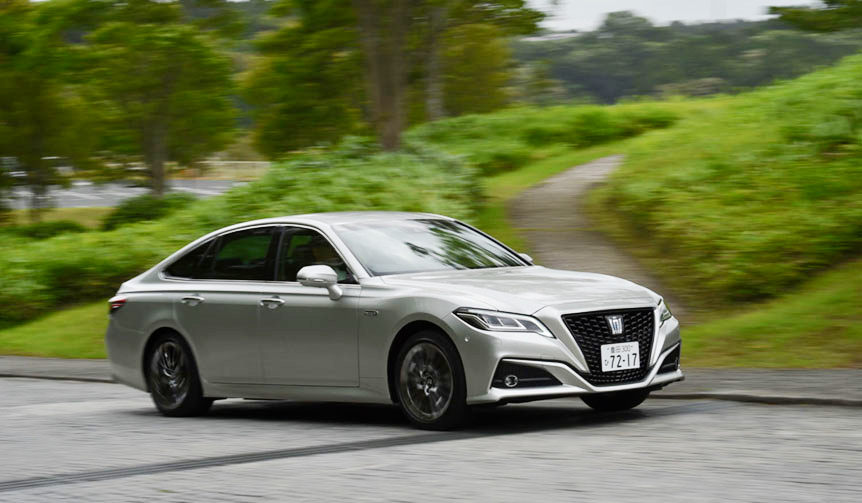
Toyota's flagship sedan, the Crown, has been fully redesigned for its 15th generation. We tested its capabilities on the roads of Chiba.
Text and Photographs by HARA Akira
A New Generation Aiming for a Resounding Revival
The new Toyota Crown went on sale June 26th. Since its debut in 1955, it has been developed as Toyota's, and Japan's, flagship sedan – a luxury car exclusively for the Japanese market. From the first generation born from founder Kiichiro Toyoda's vision, the "White Crown" of the third generation, the "Whale Crown" of the fourth, "Someday, a Crown" of the seventh, the "Zero Crown" of the twelfth, and the "ReBORN" of the fourteenth, each generation has seen bold updates. This is the 15th generation, a full model change.
The Crown faces a challenging market: an aging customer base (average age in their late 60s), increasing market share for German luxury sedans like the Mercedes-Benz C-Class and E-Class, BMW 3 Series and 5 Series, and Audi A4 and A6 series, and the diversification of vehicle types with SUVs and minivans. To address this, the new model, while considering existing customers, targets the 40-50 age group, aiming for a resounding revival.

Chief Engineer Akira Akiyama
Akira Akiyama, the Chief Engineer, was responsible for development. Inspired by a commercial for the 7th generation Crown, he decided to join Toyota Motor Corporation, even writing "Someday, a Crown" in his graduation yearbook. He introduced the new model by saying, "Inheriting the spirit of the founding era when the first Crown was born, we developed this car with the ambition to surprise the world once again with Japanese ingenuity. I feel we have created a car that will impress customers in every aspect – design, driving performance, and connectivity."
We drove the production model on public roads in Chiba Prefecture to test its capabilities.
Toyota Crown | The Toyota Crown
Test Drive of the Fully Redesigned Toyota Crown (2)
The V6 Hybrid: The Ultimate Crown
Previous ModelPreviously, the lineup included the "Majesta" for chauffeured driving, the formal "Royal," and the personal "Athlete." For its new beginning, the redesigned model unifies these. Instead, it adopts three powertrain options to define the car's character.
The first model we drove was the "G-Executive," equipped with the 8GR-FXS 3.5-liter V6 multi-stage hybrid system. This powerful setup combines a V6 engine producing a maximum output of 220 kW (299 hp) at 6,600 rpm and peak torque of 356 Nm at 5,100 rpm, with a 132 kW (180 hp), 264 Nm electric motor and a lithium-ion battery, delivering a total system output of 264 kW (359 hp).
This powertrain is also used in the LexusLSandLC, and this is its first application in a Toyota vehicle. When accelerating deeply, the V6 engine's refined sound accompanies a breathtaking surge of speed, reaching legal limits in an instant.
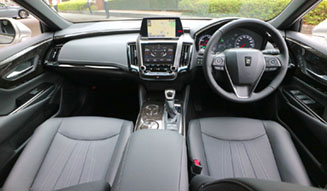
The hybrid system is paired with a geared transmission, offering a 10-speed shift control. With paddle shifters, drivers can enjoy spirited driving on winding roads, precisely as they intend.
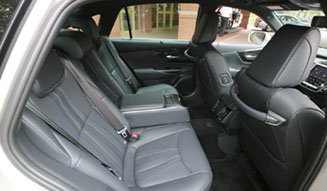
Conversely, switching to NORMAL drive mode allows for extended EV driving, providing a quiet and elegant ride. Notably, the G-Executive model exclusively features enhanced soundproofing with thicker rear glass and additional sound-absorbing materials around the rear seats and wheel wells. Owners seeking the "ultimate Crown" should find this model to be their sole choice.
Toyota Crown | The Toyota Crown
Test Drive of the Fully Redesigned Toyota Crown (3)
The All-Around 2.5 Hybrid and the Sporty 2.0 Turbo
Next, we drove the "G," likely the highest-volume model, featuring the A25A-FXS 2.5-liter inline-4 engine with the THSII hybrid system with reduction gear. This model combines an engine producing 135 kW (184 hp) and 221 Nm with a 105 kW (143 hp), 300 Nm electric motor and a nickel-hydrogen battery, for a total system output of 166 kW (226 hp).
While it doesn't offer the same exhilarating acceleration as the 3.5-liter model, its performance is entirely satisfying. The stable handling during acceleration and deceleration, the precise cornering where the steering locks in instantly, and the minimal body roll all exemplify the driving dynamics the new Crown aims for. This model was reportedly taken to the Nürburgring Nordschleife for testing, attesting to its confidence-inspiring performance in all situations. Considering its excellent fuel economy of 24.0 km/L (JC08 mode) and the fact that the 2.5-liter version uses regular gasoline, its economic advantages are significant.
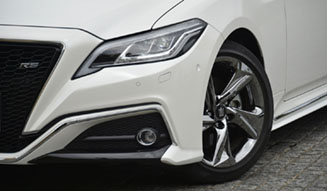
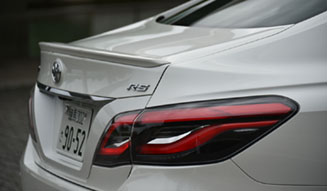
Finally, we tested the "RS," powered by the 8AR-FTS 2.0-liter inline-4 direct-injection turbo engine, delivering a maximum output of 180 kW (245 hp) at 5,200-5,800 rpm and peak torque of 350 Nm from 1,650-4,400 rpm.
The curb weight of the 3.5-liter model we tested was 1,900 kg, and the 2.5-liter model was 1,750 kg. In contrast, the 2.0-liter turbo, without a complex hybrid system, weighs in at 1,730 kg. Naturally, it offers superior agility and cornering performance. Perhaps due to the absence of hybrid system switching, the connection between the accelerator pedal and vehicle speed feels more intuitive from low to high speeds.
Selecting Sport+ mode mixes engine sound with synthesized audio from the speakers, creating a rhythmic beat. However, on rough roads, the ride becomes noticeably firm. In such cases, switching to Comfort or customizing settings in the Custom mode offers a more compliant experience. Fuel economy is 12.8 km/L, which is respectable. For those seeking a sporty Crown, this model, with its quad exhaust tips, small trunk lid spoiler, and chrome-finished five-spoke wheels, is the definitive choice.
Toyota Crown | The Toyota Crown
Test Drive of the Fully Redesigned Toyota Crown (4)
Expressing a Refined Sports Sedan with a Six-Window Design
After test driving the new model, which features a six-window design eliminating the iconic thick C-pillar, we spoke with KuniShige Ken, Chief Engineer of Global Design Planning, who was in charge of the exterior design; Kikuchi Takumi, Team Leader of Vehicle Dynamics Testing at Vehicle Engineering Development, responsible for driving performance; and Ochiai Hiroaki, Senior Engineer at MS System Design, who handled the electrical systems.
Mr. KuniShige cited two main reasons for the significant shift towards a sportier exterior: the "Athlete" trim surpassing the "Royal" in sales for the first time in the previous generation, accounting for 60-70% of sales, and the diversification of corporate fleet vehicles from sedans to minivans and other types.
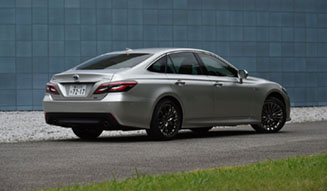
Consequently, the design was completely revamped to align with global trends, featuring a long hood, short deck, short overhangs, and wheels pushed to the corners, appealing to younger buyers. Furthermore, during the early stages of design exploration, an internal sketch competition was held. Every submission featured a thick C-pillar. To signal the car's transformation, the decision was made to remove it. The adoption of a sleek six-window design and a gracefully flowing roofline expresses a refined sports sedan.
However, maintaining the vehicle width at 1,800mm was a paramount objective, and considerable effort was dedicated to the lines that taper the front and rear to create a sense of width.
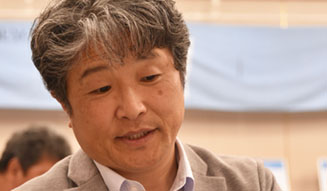
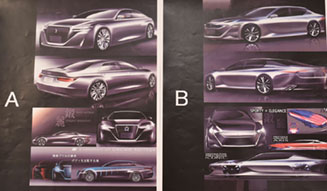
Conversely, while the body design underwent a significant transformation, the front fascia retains elements of its heritage, ensuring the Crown is recognizable from any angle. He also highlighted the meticulous Japanese craftsmanship, such as the elegant grille design where the chrome elements are positioned inside the three-dimensional structure, with a separate black wall installed to prevent reflections of the grille's texture.
"The Crown's identity is expressed in how we've preserved essential Crown characteristics, such as its spacious interior, the ability to fit golf bags in the trunk, and maintaining a width under 1,800mm," said Mr. KuniShige. "Among Crowns, the fourth-generation 'Whale Crown' is memorable, and outside of that, the first-generation Celica remains a favorite. Although I'm in charge of developing large cars, I actually drive a small car myself. And I enjoy washing my car, feeling the three-dimensional form of the body through my hands."
Toyota Crown | The Toyota Crown
Test Drive of the Fully Redesigned Toyota Crown (5)
Taking the Best of the BMW 5 Series and Mercedes-Benz E-Class
Mr. Kikuchi recounted an anecdote from the vehicle dynamics testing conducted at the Nürburgring Nordschleife. A top European test driver, after a full-throttle run in the new Crown with Mr. Kikuchi in the passenger seat, remarked, "Is this level of performance necessary for a Japan-only car? It's more than enough. You could sell this overseas as is." He added that the current Crown incorporates the best aspects of its rivals, the BMW 5 Series and Mercedes-Benz E-Class.
Having been involved in the development of sporty models like the Lexus GS, IS, and RC, Mr. Kikuchi found the greatest challenge with the new Crown to be balancing the need to satisfy long-time customers with achieving modern driving stability.
Mr. Ochiai, responsible for the electrical systems, introduced the Crown's dual-screen display, designed for operation without diverting the driver's gaze, and the connected services, a key feature of the new model. We tried out the connected services. The "Operator Service" allows users to converse with a dedicated operator 24/7 via a single steering wheel button for detailed requests like navigation settings or information on desired restaurants. Alternatively, the "Agent Service" enables searches and other functions through voice commands. The convenience is addictive once experienced.
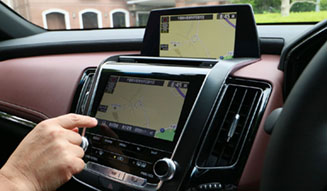
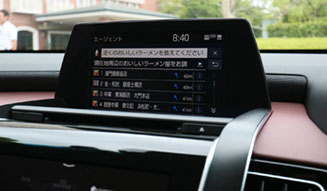
After driving all three models, the 1,800mm width and 5.3-meter minimum turning radius clearly offer a significant advantage over imported cars. The driving dynamics, enabled by the narrow-body TNGA platform developed for the Crown, highlight the extent of its evolution. Inside, the smooth, premium movement of the cup holders and storage compartments is particularly impressive. The result is a car that should satisfy both long-time owners and new, younger customers. The three individuals we spoke with have, dare I say, achieved remarkable work.
Prices range from 6,237,000 to 7,187,400 yen for the 3.5 HV, 4,978,800 to 6,323,400 yen for the 2.5 HV, and 4,606,200 to 5,594,400 yen for the 2.0 turbo.