A Test Drive of the New Aston Martin Vantage | Aston Martin
Aston Martin Vantage | Aston Martin
A Test Drive of the New Aston Martin Vantage
Positioned as a sports car within Aston Martin's lineup, theVantagehas been reborn in its latest generation. Tatsuya Otani, a motor journalist, reports from the international test drive event held at the Algarve Circuit in western Portugal.
Text by OTANI Tatsuya
Brakes Hold Up Even After 20 Minutes of Continuous Driving on the Circuit
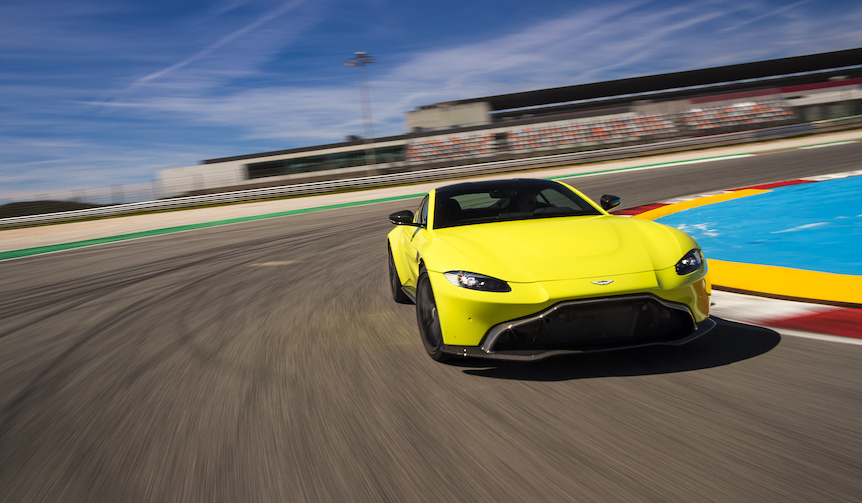
Approaching the final corner of the challenging Algarve Circuit, a winding downhill section in western Portugal, at 135 km/h, the tail momentarily drifted as the gradient steepened.
However, the grip from the rear tires was still palpable, and the slide was so brief that I cleared the clipping point with minimal counter-steer, then accelerated gently onto the main straight.
The new Aston Martin Vantage slices through the nearly 1km-long straight as if parting the air itself. Shifting from fifth to sixth, then to seventh gear, the speedometer climbs from the 230 km/h range into the 240 km/h range. Yet, as it approaches 250 km/h, acceleration begins to taper off.
I registered 253 km/h on the downhill approach to the first corner. Here, I applied full braking force. Although the pedal feel had softened slightly after nearly 20 minutes of continuous driving, the ABS was engaging, confirming that the tires were being utilized to their full potential for deceleration.
This sensation was clearly conveyed through the front tires' grip, felt via the steering.
After clearing the relatively tight first corner, I passed through the second corner almost at full throttle, approaching the uphill third corner while trying to maintain as much momentum as possible.
The Vantage I was driving thus began another attack lap.
The Second Model Utilizing New Generation Technology
The Vantage is positioned as a sports car among Aston Martin's three main models. The other two are the GT car "DB" series and the super sports car "Vanquish" (it was recently announced that the next-generation Vanquish will use the traditional name DBS).
Aston Martin, which hand-builds luxurious high-performance cars in very limited numbers, has historically created a variety of characters by combining different engine and suspension specifications, and by arranging interior trims and seating configurations, all based on a single body structure.
The underlying technology is renewed approximately every ten years. In 2016, the "DB11" introduced a new body structure and engine lineup. The Vantage, released this time, is the second model to utilize this new generation technology.

However, the engineering approach naturally differs between the DB11, which prioritizes long-distance cruising, and the Vantage, born for the enjoyment of cornering.
For the DB11, key considerations include a powerful engine for a relaxed ride, comfort that minimizes fatigue on long journeys, and the "Plus 2" compact rear seats, convenient for stowing small luggage or jackets.
Aston Martin Vantage | Aston Martin
A Test Drive of the New Aston Martin Vantage (2)
Specifications Prioritizing Dynamic Performance
Conversely, the Vantage, which demands pure driving performance, places less emphasis on comfort and requires no rear seats. Its engine needs to be not only powerful but also lightweight and compact to achieve optimal weight balance.
Therefore, the new Vantage transitions from the DB11's 2+2 seating layout to a pure two-seater configuration. While the DB11 uses rubber bushings between the rear subframe and the body, the Vantage omits these to pursue more precise handling.
While the DB11 offers two engine options—the flagship 5.2-liter V12 and the 4.0-liter V8—the Vantage focuses on a lightweight, compact design, exclusively featuring the 4.0-liter V8.
Both are clearly specified with dynamic driving performance as the priority.
As a result, I was able to fully enjoy the kind of sporty driving described earlier at the Algarve Circuit.
Its Positioning as a Sports Car is Now More Defined
However, if driving on public roads were uncomfortably harsh, it would fail as a road-going sports car.
While omitting the rubber bushings for the rear subframe did increase road noise (noise generated by tires during driving) somewhat, it was not excessive. Although the ride is firmer, the enhanced body rigidity quickly damps vibrations, making the experience far from unpleasant.
Furthermore, the precise positioning of the tires, also a result of omitting the rubber bushings, has improved straight-line stability on undulating surfaces. In this sense, physical fatigue during long cruises may actually be reduced.
Therefore, it should comfortably handle a day trip, such as a Vanquish owner living in the city departing early in the morning, enjoying sporty driving in Hakone and Izu, and then cruising home.
The styling, similar to the DB11, is futuristic and edgy, yet it adopts a simpler form than the DB11, visually emphasizing its pure performance and functionality.

This creates a visual that befits a sports car.
The Vantage, with its more clearly defined positioning as a sports car compared to the GT car DB11,
is a testament to the excellence of the new architecture and design language introduced with the DB11, which allows for such distinct character differentiation.