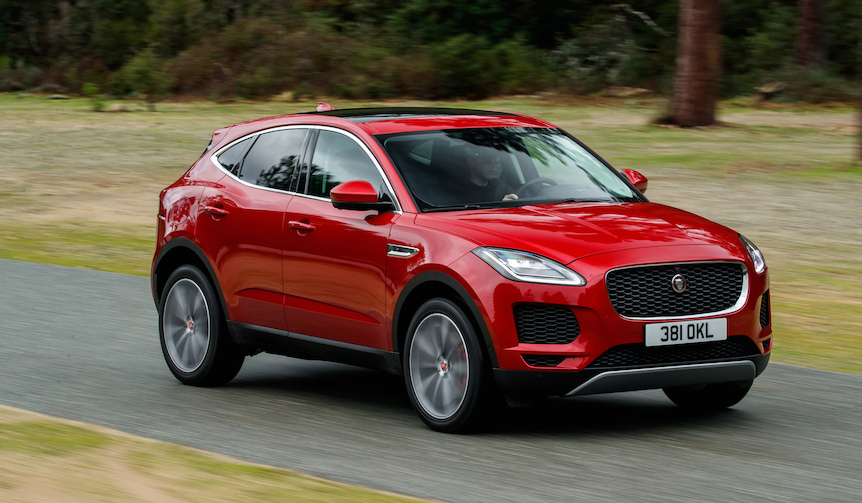
Test Drive of Jaguar's First Compact SUV, the "E-Pace" | Jaguar
Jaguar E-Pace | Jaguar E Pace
Test Drive of Jaguar's First Compact SUV, the "E-Pace"
Announced in the autumn of 2017, Jaguar's compact SUV, the "E-Pace," shares a design language with the brand's SUV "F-Pace," while featuring a sporty, coupe-like style with a sharply sloped rear end. Although its introduction to Japan is planned, Fumio Ogawa test drove it on the island of Corsica before its official announcement.
Text by OGAWA Fumio
A Brand-New Model with a Dynamic Style That Catches the Eye
Jaguar's compact SUV,E-PACEa test drive event for the "E-Pace" was held in Corsica in January 2017. This car is characterized by its high-quality build and driving dynamics despite its 4.4-meter length.
The E-Pace, which Jaguar Cars claims is designed to "acquire new fans" while retaining the styling and fun-to-drive characteristics expected of a Jaguar, is a new offering.
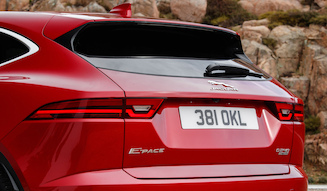
The front fascia, with its large grille and distinctive headlamps, feels similar to that of theF-PACE. The rear fenders are emphasized for presence, and the rear combination lamps feature a (subtle) semicircular motif.
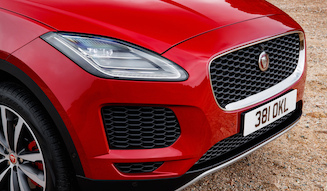
Jaguar E-Pace S D240
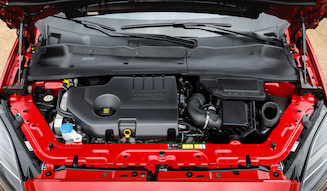
In short, it's instantly recognizable as a Jaguar, but more youthful than ever before. It's a model with a dynamic style that captures the eye.
To explain its origins, roughly speaking, it shares much of its chassis with theRange Rover Evoque. The engine is a 2-liter 4-cylinder, available in gasoline and diesel. Drivetrain options include front-wheel drive and full-time four-wheel drive.
Models for Japan are already set (official debut in late February 2018). The gasoline engines offer 250ps and 300ps, while the diesel engine is 180ps. The transmission is a 9-speed automatic, and all models are AWD (4WD).
In Japan, models are further divided into the "E-PACE" and "R-DYNAMIC," with slightly different characters, such as suspension settings. This is Jaguar Cars' unique marketing approach.
Below these, grades include the standard model, "S," "SE," and the top model, "HSE," differing in equipment. Driving assistance systems, comfort features, and tire sizes also vary.
The permutations are quite numerous. This offers users a wide range of choices, which is likely a positive point.
Jaguar E-Pace | Jaguar E Pace
Test Drive of Jaguar's First Compact SUV, the "E-Pace" (2)
Sporty Handling
At the test drive venue near the northern tip of Corsica, reached by charter flight from Paris, were the 300ps gasoline "P300" and the 240ps diesel "D240" models.
Corsica is largely mountainous with some plains, but mostly consists of coastal edges. In this regard, it's somewhat similar to Japan. The chosen route was a winding road through the mountains.
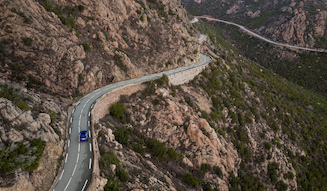
Jaguar E-Pace R-Dynamic S P300
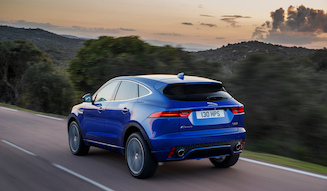
Its rivals are considered to be the Mercedes-BenzGLA, and the BMWX1. From a design perspective, the AudiQ2and the VolvoXC40, which will soon be released in Japan.
Compact SUVs are practical in urban environments and represent a rapidly growing market in Japan. Therefore, the E-Pace faces fierce competition.
In this context, the two models I drove this time impressed me as being exceptionally well-executed. Firstly, their power. Secondly, the sportiness of their handling.
The P300's 1,995cc "Ingenium" unit produces a maximum output of 221kW (300ps) and a peak torque of 400Nm.
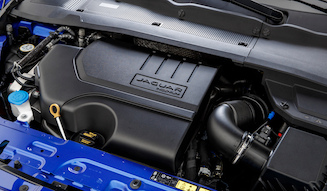
With peak torque available from 1,500rpm, it offers excellent initial acceleration. Furthermore, the engine smoothly revs to higher RPMs, providing a linear surge of power that is truly impressive.
The test car was equipped with 20-inch wheels. The steering response was sharper than expected when turning, yet not overly sensitive.
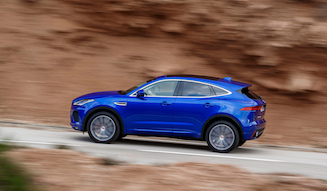
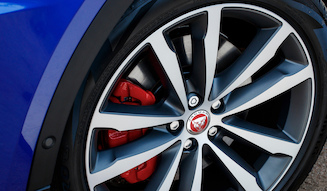
While not purely an off-road vehicle, its off-road capabilities are a selling point, it strikes a good balance with its on-road enjoyment.
The ride comfort was also better than anticipated. Perhaps this is due to the chassis being designed from the outset for SUVs. The suspension arms also seemed to move with ample travel.
The diesel D240 produces 177kW (240ps) and 500Nm. It's an engine with a smooth running character that belies its diesel nature. The optimal operating range is from 1,500rpm to just under 2,000rpm. Simply pressing the accelerator lightly is sufficient.
Jaguar E-Pace | Jaguar E Pace
Test Drive of Jaguar's First Compact SUV, the "E-Pace" (3)
Beauty, Fun to Drive, and Connectivity
What impresses about the E-PACE is its quality. Interior noise is also well-controlled. The diesel noise in the D240 is remarkably suppressed, making it difficult to tell what kind of engine the car has at first glance.
While diesel cars are becoming more common in Japan, the quality in this regard feels far superior to that of the E-PACE.
Personally, if asked which I prefer, I would choose the gasoline engine for the enjoyment of revving it, especially on roads without traffic lights like those in Corsica. The situation might be slightly different in Japan.
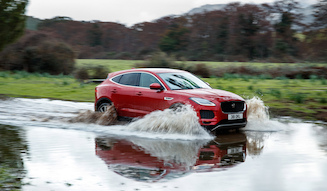
Jaguar E-Pace S D240
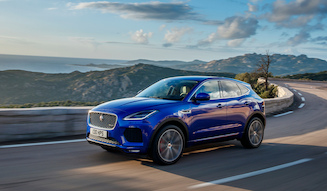
Jaguar E-Pace R-Dynamic S P300
I did not have the opportunity to drive the D180, which has a slightly lower output of 132kW (180ps) and 430Nm of peak torque compared to the D240. Based on my experience with the same engine in the "Range Rover Velar," it was more than powerful enough, so I doubt you would be disappointed.
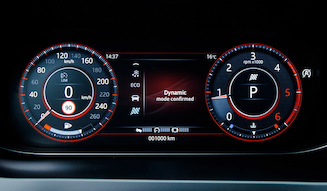
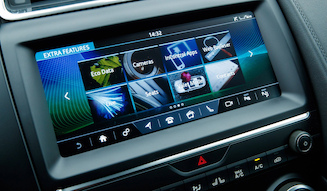
In addition to beauty and fun-to-drive, Jaguar highlights "connected" as a key feature of the E-PACE. This refers to the infotainment system, including its communication functions.
The system, named "InControl," allows remote control of the air conditioning and checking of the car's status via a smartphone. Numerous USB ports are also provided.
The price starts at 4.51 million yen for the standard model (D180 E-PACE). For the "S" grade, which many people will likely choose, it's 5.19 million yen (P250 S is 5.43 million yen, P300 S is 6.05 million yen).
The Mercedes-Benz "GLA220 4MATIC" is 4.58 million yen. The BMW "X1 18d" is 4.70 million yen, and the "20i" is 4.95 million yen. The Audi "Q2" starts at 4.05 million yen for the 1.4 model. The E-PACE fits between the BMW X1 and theX3(starting from 6.39 million yen). This is a well-considered pricing strategy.

Jaguar E-Pace S D240 | Jaguar E Pace S D240
Body Dimensions | Length 4,395 x Width 1,984 x Height 1,649 mm (Width excludes mirrors)
Wheelbase | 2,681 mm
Weight (EU spec) | 1,926 kg
Engine | 1,999cc Inline 4-cylinder Turbo Diesel
Max Output | 240 ps / 4,000 rpm
Peak Torque | 500 Nm / 1,500 rpm
0-100km/h Acceleration | 7.4 seconds
Top Speed | 224 km/h
Transmission | 9-speed AT
Drivetrain | 4WD
Suspension (Front/Rear) | MacPherson Strut / Multi-link
Tires | 245/45R20
Fuel Economy (EU) | 6.2 L/100km (approx. 16.1 km/L)
CO2 Emissions | 162 g/km
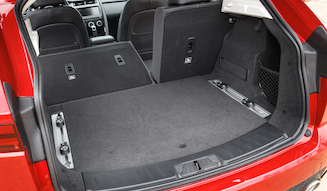
Trunk Capacity | 577 Liters
Jaguar E-Pace R-Dynamic S P300 | Jaguar E Pace R-Dynamic S P300
Body Dimensions | Length 4,395 x Width 1,984 x Height 1,649 mm (Width excludes mirrors)
Wheelbase | 2,681 mm
Weight (EU spec) | 1,894 kg
Engine | 1,998 cc Inline 4-cylinder Turbo Gasoline
Max Output | 300 ps / 5,500 rpm
Peak Torque | 400 Nm / 1,500 - 4,500 rpm
0-100km/h Acceleration | 6.4 seconds
Top Speed | 243 km/h
Transmission | 9-speed AT
Drivetrain | 4WD
Suspension (Front/Rear) | MacPherson Strut / Multi-link
Tires | 245/45R20
Fuel Economy (EU) | 8.0 L/100km (approx. 12.5 km/L)
CO2 Emissions | 181 g/km
Trunk Capacity | 577 Liters