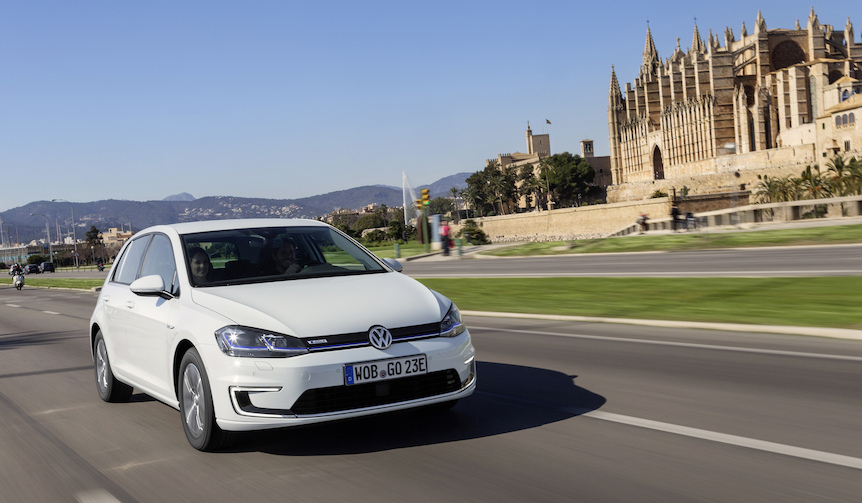
Test Drive the New e-Golf & Golf GTE | Volkswagen
Volkswagen Golf GTE | Volkswagen Golf GTE
Volkswagen e-Golf | Volkswagen e-Golf
Test Drive the New e-Golf & Golf GTE
The 7th-generation Volkswagen Golf received a minor facelift in November 2016.We've already reported onIn addition to gasoline and diesel engines, the EV model "e-Golf" and the plug-in hybrid model "Golf GTE" have also been updated simultaneously. Hirohisa Kaneko reports on these latest electrified models.
Text by HIROHISA KANEKO
Advancing Autonomous Driving
The Volkswagen Golf has undergone a significant minor change. We report from the media test drive event held on the island of Mallorca, Spain.
First, the exterior. The front and rear bumper designs have been renewed, and upon closer inspection, LED lights have been adopted for the headlights. Furthermore, the top-grade model features full LED taillights with dynamic turn signals. It has a presence comparable to higher-segment vehicles.
The base model is now equipped with the new 1.5 TSI engine (96kW/110kW), and improvements to the 7-speed DSG have enhanced fuel efficiency.
Inside the cabin, the "Discover Pro" infotainment system with gesture control and a larger touchscreen have also been introduced.
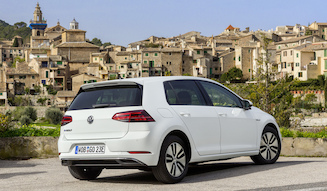
Volkswagen e-Golf
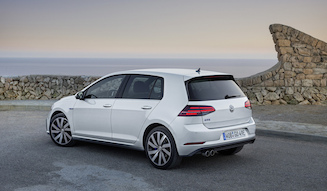
Volkswagen Golf GTE
The "Guide & Inform" service, which connects to the internet, is now available via an onboard SIM card, expanding connectivity. Of course, access is also possible via tethering by connecting a smartphone.
Furthermore, the "Traffic Jam Assist," which supports stop-and-go driving in traffic jams, has been adopted, enhancing semi-autonomous driving (driver assistance) capabilities.
This system maintains a set distance from the vehicle ahead while driving at speeds below 60 km/h, repeating stops and starts. It also assists in keeping the vehicle centered within its lane. It's surprising that it can even adapt to a driver's tendency to drift to the right or left.
In essence, the new Golf can now control its movement both longitudinally and laterally, further advancing automated driving (driver assistance). This technology significantly contributes to accident prevention, energy saving, and reducing driver burden.
Volkswagen Golf GTE | Volkswagen Golf GTE
Volkswagen e-Golf | Volkswagen e-Golf
Test Drive the New e-Golf & Golf GTE (2)
Electrified Models Also Updated
Alongside advancements in autonomous driving and expanded connectivity, powertrain electrification is one of the key challenges that current vehicles must address.
Regarding powertrain electrification, the Golf already featuresthe plug-in hybrid version, the "Golf GTE"which has been introduced in Japan. The author has highly praised its excellent drivability and unique driving feel.
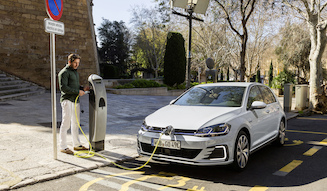
Volkswagen Golf GTE
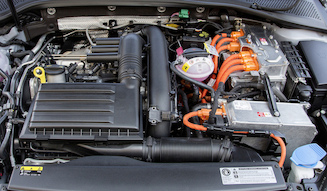
Volkswagen Golf GTE
This time, improvements have been made to the software and mechatronics. Dr. Philipp, the developer, states that it's "just a series of small improvements," but we were able to confirm on the roads of Mallorca that these have yielded truly significant results.
The transitions between the engine and motor, and the power control, have become more refined, resulting in exceptionally smooth, powerful, and quiet driving at all speed ranges. It is undeniably refined and supremely comfortable. It's safe to say it's on a different level compared to gasoline-only Golf models.
Additionally, the GTE features a GTE button on the center console. Pressing this button dramatically alters the power characteristics of the engine, motor, and transmission, allowing for quick and maximum power output in response to accelerator input.
While not easily noticeable on flat, ordinary roads, this difference becomes apparent on winding roads with inclines and declines. It allows for sporty driving and makes the car feel more alive. It's an excellent example of skillfully utilizing the motor not just for eco-driving, but also for performance.
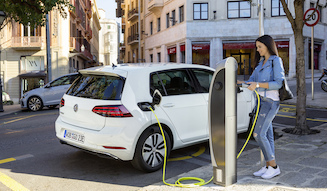
Volkswagen e-Golf
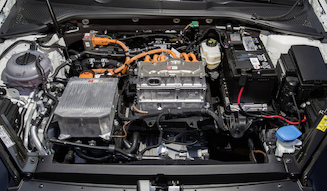
Volkswagen e-Golf
The original Golf GTI, introduced in 1976, created the hot hatch genre itself. The Golf GTE is its "21st-century Golf GTI," completely innovating upon it.
If the hot hatch genre is to survive, perhaps effectively utilizing the motor, as in the GTE, is the best approach. Its level of refinement makes one think so deeply.
Volkswagen Golf GTE | Volkswagen Golf GTE
Volkswagen e-Golf | Volkswagen e-Golf
Test Drive the New e-Golf & Golf GTE (3)
A Leap Forward Compared to Rivals
The pure EV "e-Golf" will be introduced to Japan for the first time this autumn. Its catalog range is approximately 300 km, and engineers state it can realistically travel about 200 km on the road. Its CHAdeMO-compatible rapid charging makes it convenient to use. Like the GTE, it drives smoothly and quietly thanks to its electric motor. Its practicality, with the same excellent comfort and versatility as other Golf models, is highly realistic.
The "Golf R" and "Golf R Variant" have been upgraded to 310 ps. While their finish is impeccable, when compared to the contemporary relevance of the GTE, their presence and methodology can only be described as "20th-century."
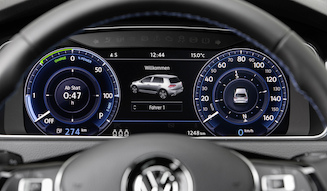
Volkswagen e-Golf
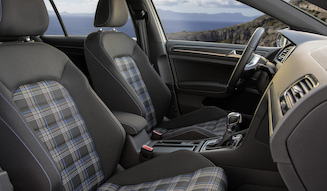
Volkswagen Golf GTE
With this minor change, the Golf has achieved high levels in three key areas: powertrain electrification, automated driving (driver assistance), and expanded connectivity. Its advancements are significantly ahead of its rivals. This is characteristic of the Golf, which has been the benchmark for automobiles worldwide since its debut in 1974, by pioneering the adoption of new technologies. It surpasses even vehicles in higher segments, setting a benchmark across categories. The maturity of the GTE was particularly impressive.

Volkswagen Golf GTE | Volkswagen Golf GTE
Body Dimensions | Length 4,276-4,370 x Width 1,799 x Height 1,484 mm
Wheelbase | 2,630 mm
Tread Front/Rear | 1,533-1,549 / 1,503-1,521 mm
Minimum Ground Clearance | 140 mm
Minimum Turning Radius | 5.45 meters
Weight | 1,615 kg
Engine | 1,395 cc Inline 4-cylinder Turbo
Maximum Engine Output | 110 kW (150 ps) / 5,000-6,000 rpm
Maximum Engine Torque | 250 Nm / 1,500-3,500 rpm
Maximum Motor Output | 75 kW (102 ps) / 2,500 rpm
Integrated System Maximum Output | 150 kW (204 ps) / 2,500 rpm
Integrated System Maximum Torque (Boost) | 350 Nm
Transmission | 6-speed Automatic (6DSG)
Drivetrain | FF
0-100 km/h Acceleration | 7.6 seconds
Maximum Speed | 222 km/h
Fuel Consumption (NEDC) | 1.8-1.6 L/100km (55.6-62.5 km/L)
CO2 Emissions | 40-36 g/km
Trunk Capacity | 272 - 1,162 liters
*European specifications
Volkswagen e-Golf | Volkswagen e-Golf
Body Dimensions | Length 4,270 x Width 1,799 x Height 1,482 mm
Wheelbase | 2,629 mm
Tread Front/Rear | 1,533-1,549 / 1,503-1,521 mm
Minimum Ground Clearance | 143 mm
Minimum Turning Radius | 5.45 meters
Weight | 1,615 kg
Maximum Output | 100 kW (136 ps) / 3,000-12,000 rpm
Maximum Torque | 290 Nm (25.5 kgm) / 0-3,000 rpm
Drivetrain | FF
Battery | Lithium-ion 35.8 kWh
0-100 km/h Acceleration | 9.6 seconds
Maximum Speed | 150 km/h
Energy Consumption | 12.7 kWh/100km (7.9 km/kWh)
Maximum Range | 300 km
CO2 Emissions | 0 g/km
Trunk Capacity | 341-1,231 liters
*European specifications