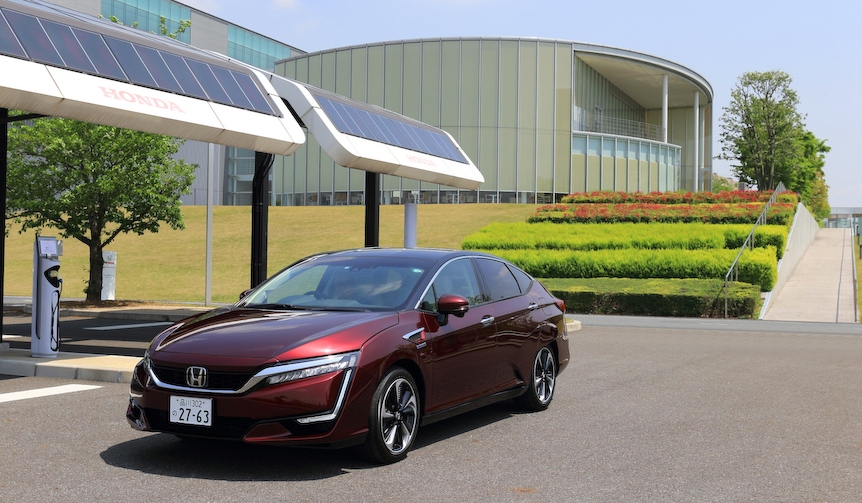
Test drive of Honda's 5-seater FCV, the Clarity Fuel Cell | Honda
Honda Clarity Fuel Cell
Test Drive of Honda's 5-Seater FCV, the Clarity Fuel Cell
Astonishingly Well-Executed
Honda has finally released its 5-seater FCV sedan, theClarity Fuel Cell. We had the chance to test drive the model, which went on sale March 10th.
Text by OGAWA FumioPhotographs by ARAKAWA Masayuki
A Powertrain the Size of a V6 Engine
Honda Motor Co., Ltd. launched the fuel cell vehicle "Clarity Fuel Cell" in March 2016. A test drive event was held in April. A fuel cell vehicle (FCV) generates electricity by splitting hydrogen fuel. The model is advertised in its press materials as pursuing "practicality, a universal value of automobiles, aiming for widespread adoption." The substantial body, measuring 4,915mm in length, offers seating for five. The initial year will focus on leases to local governments and corporations, with plans for individual sales after a monitoring period.
To get straight to the point, the execution was astonishingly good. As an electric motor vehicle running on hydrogen, it possesses all the advantages of plug-in hybrids and electric cars. Beyond the smooth driving feel unique to motors, which deliver instant maximum torque, the quiet cabin, with barely audible auxiliary systems, exudes a premium quality. Furthermore, its agile handling and comfortable ride were particularly noteworthy. This model truly showcases Honda's commitment, evident in its newly designed platform.
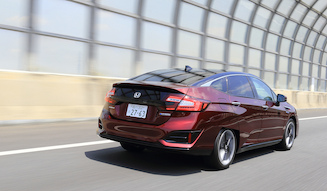
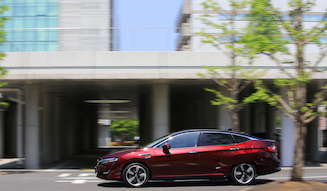
Honda has actually been involved with FCVs since the 20th century. The company has been actively developing them, providing models named "FCX" to government offices and private companies since 2003. At one point, they even researched a project to produce hydrogen using hydroelectric power from Yakushima Island. In 2006, miniaturization of the power source, including the battery, led to a significant redesign of the packaging, transforming the styling from the previous two-box "FCX" into a sleek, stylish form. In November 2007, they announced theFCX Clarity, which also left an impression of being smooth, quiet, and well-engineered. The "FCV Concept" was unveiled in November 2013.
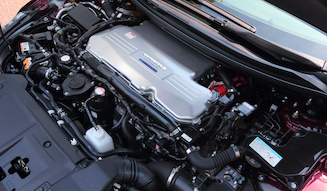
The Clarity Fuel Cell (¥7.66 million) features a miniaturized fuel cell powertrain, including the fuel cell stack, housed within the front bonnet – a world first, according to Honda. The motor's height has been reduced by 34% through a revised mounting method. By increasing the power generation capacity of the fuel cell stack by 1.5 times, its size has been reduced. The powertrain, comprising the boost converter, hydrogen supply system, air supply system, electric turbocharger-type air conditioner, and the fuel cell stack and drive unit, is said to be the same size as a conventional V6 engine.
The operating pressure of the hydrogen tanks has been increased from the previous 35 MPa (megapascals) to 70 MPa. Although the tank capacity is smaller, the storage volume has increased from 4kg to 5kg. This extends the driving range per fill-up to approximately 750km, which is a notable improvement. Honda states, "From daily use to long drives, the practicality as an everyday car has been significantly enhanced." Indeed, driving the Clarity Fuel Cell is, as we've touched upon, a pleasure.
Honda Clarity Fuel Cell
Test Drive of Honda's 5-Seater FCV, the Clarity Fuel Cell
Astonishingly Well-Executed (2)
Surprisingly Quick Handling
The gear selection in the Clarity Fuel Cell is done via buttons. The design of the selector for drive, park, etc., is unique. For example, pressing the reverse button involves pulling it towards you, a design philosophy that aligns the operation with the sensation of reversing. Pressing the D button and setting off, the instant delivery of 300Nm of maximum torque means the car accelerates briskly, without any sense of its 1,890kg weight.
Mid-range acceleration is also sharp. The advantages of the electric motor are fully utilized, responding sensitively to even slight pressure on the accelerator pedal. The acceleration feels different from internal combustion engine cars, with no perceptible delay. The accelerator pedal offers precise speed control, making it easy to maintain a desired speed with pinpoint accuracy, down to the kilometer per hour, as indicated on the digital speedometer. The engineers noted, "This was also a point we focused on."
The car's movement during lane changes is precise. Even for a large sedan, the handling through corners is by no means sluggish. On the contrary, it's surprisingly quick and allows for steering that faithfully follows the driver's intentions. Overall, while it shares some characteristics with German plug-in hybrids (in their electric motor modes), its agile performance can be considered a unique strength of a vehicle without an internal combustion engine. Selecting the sport mode via the drive mode selector further enhances acceleration, offering a distinctly sporty drive. This is a new generation of large sedan.
The ride comfort is excellent. There is virtually no sense of impact or vibration from minor road imperfections. At the same time, there is no lack of damping, highlighting the meticulous tuning. According to the engineers, the use of a subframe also contributes to the ride comfort. While it will initially be used by government agencies (for chauffeuring, etc.), the long wheelbase of 2,750mm ensures that rear passengers will feel as comfortable as if they were in a well-appointed limousine.
It's so comfortable that you might not want to get out.
Honda Clarity Fuel Cell
Test Drive of Honda's 5-Seater FCV, the Clarity Fuel Cell
Astonishingly Well-Executed (3)
A Unique Design
Stepping into the Clarity Fuel Cell, there's virtually no sense of unfamiliarity. As the interior designer stated, "We intentionally designed it to be similar to conventional passenger cars." The only difference is the display on the LCD meter, which includes a power charge meter and a fuel cell generation monitor, features not found in gasoline cars.
What's impressive in terms of comfort is the suppression of noise from the high-pressure fuel pump. The high-pitched whine is barely audible inside the cabin. As explained by the developers, the noise transmitted from the motor to the cabin has been reduced by 25% compared to the previous model, indicating that enhancing cabin quietness was a key development objective. The development team explained at the test drive venue that considerable effort was made to suppress not only auxiliary system noise but also tire noise from the road surface and even wind noise from the windshield. The result is remarkable quietness.
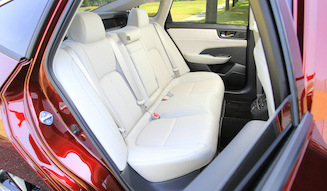
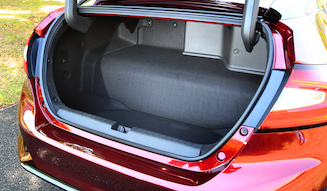
The interior features perforated leather seats, exuding a high level of quality. Stylistically, it might have been more interesting if the advanced nature was deliberately emphasized, like in BMW's 'i' series. However, given its intended use by government agencies and corporations, this might be the limit. While we shouldn't underestimate the user, perhaps for individual sales, more sophisticated materials could be incorporated, akin to European luxury sedans. While it's modern in terms of infotainment, supporting Apple CarPlay, it's questionable whether government officials would use Apple CarPlay. The technical accumulation is likely the primary goal for its eventual mass-market release.
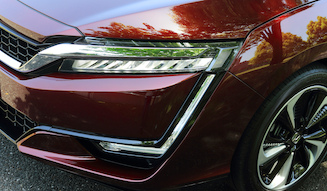
The styling is distinctive. In profile, the front and rear overhangs appear quite long. From the front grille, which combines large bumpers with slim headlights, to the roofline and rear wheel arches, the design elements are unique. The rear has a fastback-like style, but it's a separate trunk. It bears some resemblance to Citroëns from a bygone era. While it may initially feel unconventional, as you become accustomed to it, its unique character starts to appeal. If issues such as the number of hydrogen stations and the cost of hydrogen production are resolved, its widespread adoption could be rapid. The future is closer than we think.

Honda Clarity Fuel Cell
Body Dimensions | Length 4,915 x Width 1,875 x Height 1,480 mm
Wheelbase | 2,750 mm
Tread Front/Rear | 1,580 / 1,585 mm
Vehicle Weight | 1,890 kg
Motor | AC Synchronous Electric Motor
Maximum Output | 130 kW (177 ps) / 4,501-9,028 rpm
Maximum Torque | 300 Nm (30.6 kgm) / 0-3,500 rpm
Fuel Cell Stack Type | Polymer Electrolyte Membrane (PEM)
Fuel Cell Stack Maximum Output | 103 kW (140 ps)
Fuel Type | Compressed Hydrogen
Operating Pressure | 70 MPa
Fuel Tank Capacity | (Front) 24 L (Rear) 117 L
Tires Front/Rear | 235/45R18
Suspension Front | MacPherson Strut
Suspension Rear | Multi-link
Battery | Lithium-ion Battery
Minimum Turning Radius | 5.7 meters
Minimum Ground Clearance | 135 mm
Price | ¥7.66 million
Honda Customer Relations Center
0120-112010
http://www.honda.co.jp/