Test Drive the New Audi Q7, Arriving in Japan | Audi
Audi Q7 | The Audi Q7
Test Drive: The New Audi Q7 Lands in Japan
An SUV Leading the Way in Safety
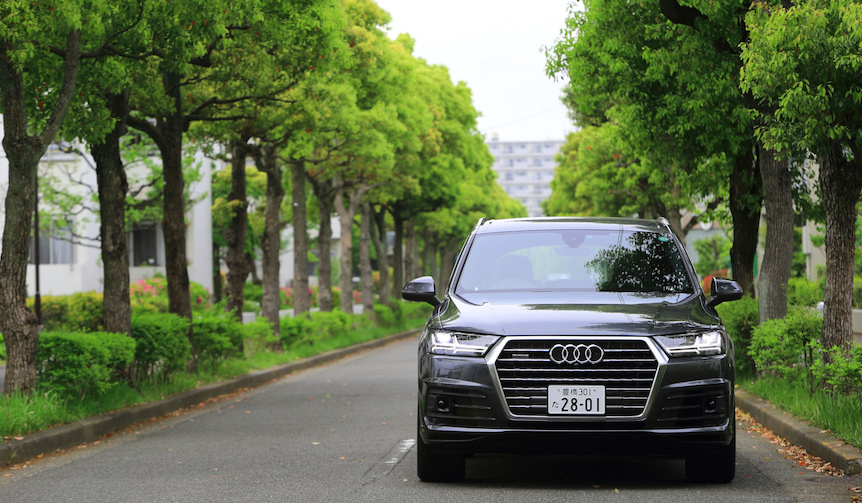
The new Audi "Q7" has begun sales in Japan.Q7". We test-drove the model equipped with a 2-liter engine, the first four-cylinder for the Q7 (photos primarily show the Q7 3.0 TFSI quattro).
Text by OGAWA FumioPhotographs by ARAKAWA Masayuki
Shedding Weight Equivalent to a Grand Piano
The Audi Q7 has undergone a full model change to its second generation, launching in Japan in April 2016. Its debut was at the January 2015 Detroit Auto Show, and since then, it has garnered significant attention from automakers worldwide at every exhibition. When asked why, one engineer from a Japanese manufacturer responded, "Its superior craftsmanship."
The Q7 lineup introduced in Japan is broadly divided into two models. The top-tier is the Q7 3.0 TFSI quattro (¥8.04 million) equipped with a 3-liter V6 engine (245kW, 440Nm). Joining it is the 2.0 TFSI quattro (¥9.29 million) with a 2-liter four-cylinder engine (185kW, 370Nm). Both are available with an optional air suspension. The full-time quattro all-wheel-drive system typically distributes torque with 40 percent to the front and 60 percent to the rear. The transmission is an 8-speed automatic.
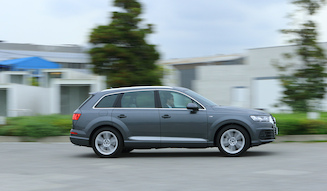
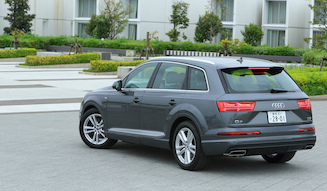
The new Q7 measures 5070mm in length, 35mm shorter than its predecessor. Its width is 1970mm, 15mm narrower, while the height remains nearly the same at 1735mm. A seven-seater configuration with a third row of seats is available as an option. Audi Japan's PR representative stated that they have retained the best aspects of the previous model while pursuing improved fuel efficiency. The use of lightweight materials such as aluminum has resulted in a weight reduction of up to 300kg compared to the previous model. The phrase "equivalent to a grand piano" was used, indicating a significant weight decrease – roughly equivalent to three adults.
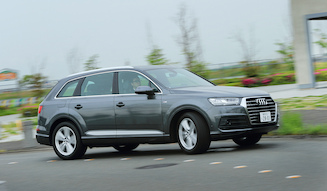
The slightly coupe-like profile, a hallmark of the Q7, has been retained. The cabin height has been slightly lowered, and the window graphics show the upper line descending towards the rear, creating a sense of dynamism. The wrap-around design of the tailgate from the previous model continues, but the emphasis on curves has been somewhat subdued, resulting in a modern, sharp styling that leaves a lasting visual impression.
It runs surprisingly well, even with the 2-liter engine.
Audi Q7 | The Audi Q7
Test Drive: The New Audi Q7 Lands in Japan
An SUV Leading the Way in Safety (2)
Surprisingly Abundant Torque
We test-drove the Q7 2.0 TFSI quattro (¥8,040,000). It is equipped with a 1984cc 4-cylinder engine, producing a maximum output of 252ps (185kW) at 5000-6000rpm and a maximum torque of 370Nm at 1600-4500rpm. With a vehicle weight of 2000kg, I was indeed concerned about its performance. However, this worry proved to be unfounded.
The 2-liter engine, a first for the Q7, offers surprisingly ample torque (starting from 1600rpm, 370Nm is available), providing no dissatisfaction from the moment you start driving. It responds linearly to accelerator pedal input for acceleration, and when you push the engine beyond 3000rpm, the turbocharger kicks in, delivering powerful acceleration. Those seeking ultra-smooth acceleration might prefer the 3-liter V6, but the 2-liter version is more than adequate.
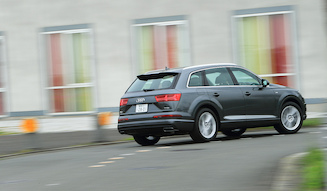
The "Audi Drive Select" system, standard equipment, aids in the acceleration feel. You can switch modes using the dashboard controls, with options like "Comfort," "Allroad," and "Offroad." Selecting "Dynamic" utilizes higher RPMs, providing a more powerful impression. This 2-liter engine pairs well with the "Dynamic" mode, which encourages driving at higher revs.
Audi Drive Select also works in conjunction with the optional "Adaptive Air Suspension Package" (¥460,000). The test car was equipped with this option, and it is highly recommended. It effectively suppresses excessive vehicle movement, providing a smooth ride at high speeds. It also allows for adjustable ride height in off-road conditions and includes the new Q7's significant feature, "All-Wheel Steering."
All-Wheel Steering is an electric rear-wheel steering system. At low speeds, the rear wheels steer in the opposite phase to the front wheels, reducing the turning radius. For vehicles with conventional springs, the turning radius is 5.7 meters; this system achieves 5.3 meters, significantly improving maneuverability. In practice, on narrow roads, it made maneuvering surprisingly easy. At high speeds, the rear wheels steer in the same phase, enabling quicker and more confident lane changes.
Another appeal is the interior.
Audi Q7 | The Audi Q7
Test Drive: The New Audi Q7 Lands in Japan
An SUV Leading the Way in Safety (3)
A Space to Enjoy the Sound of Silence
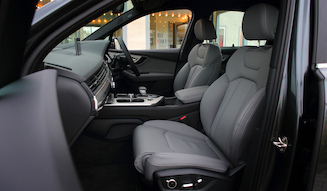
What impressed me about the new Audi Q7 was the comfort of the cabin. As the Audi Japan PR representative explained, "The new model emphasizes spaciousness with a horizontal dashboard design," and indeed, the interior feels generously proportioned and pleasant. When seated, the placement of controls and the usability of switches are logical and well-thought-out. The tactile feedback when operating them, the feel of the shift lever, and its movement through the gate all exude a premium quality, a hallmark of Audi.
Further enhancing the cabin's comfort is its exceptional quietness. To put it extremely, it's almost silent. This is the result of meticulous refinement in every aspect, including the windshield, sound insulation, and aerodynamic design. Road noise, wind noise on the roof, and sounds from the engine bay and exhaust are suppressed to extremely low levels. It truly is a "sound of silence," a space to savor the quiet. This is undoubtedly a major strength of the new Q7.
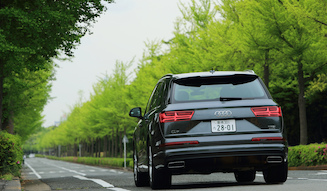
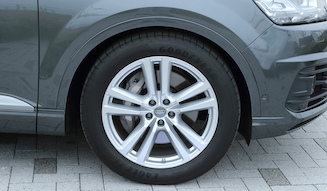
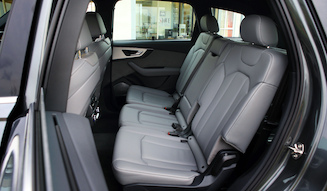
The interior is spacious. As mentioned earlier, although the overall length has decreased and the width has slimmed down, the interior space has expanded. The distance between the front and rear seats has increased by 21mm, and there is more headroom, with an additional 41mm for the front seats and 23mm for the second row. The second row is genuinely comfortable for both legroom and headroom. The three individual seats in the second row can slide fore and aft by 110mm and their backrests can be reclined, offering flexibility. Combined with the high level of quietness, it provides a luxurious limousine-like experience. Functionality is also well-considered; when the third-row seats are installed, a single lever allows the backrest to fold down, creating a large opening for easy access.
The abundance of safety features is another significant characteristic of the new Q7.
Audi Q7 | The Audi Q7
Test Drive: The New Audi Q7 Lands in Japan
An SUV Leading the Way in Safety (3)
Comprehensive Safety Equipment
The enhanced safety equipment is another noteworthy aspect of the new Q7. Conveniently, the adaptive cruise control follows the vehicle ahead, adjusting speed for acceleration, deceleration, and even stopping. Furthermore, in line with the latest Audi models, the Q7 is equipped with "Traffic Jam Assist," which effectively utilizes the adaptive cruise control functions. This is an automated driving system invaluable in traffic jams up to 60 km/h, as it also handles steering during slow-speed crawling.
"Audi pre sense city" detects vehicles and pedestrians, and can automatically apply the brakes if necessary. Audi Japan states it is effective in preventing right-turn accidents at intersections by detecting oncoming straight-moving vehicles from blind spots and activating automatic braking. Automatic braking also engages when a vehicle approaches from a blind spot while reversing.
"Active Lane Assist" is a system that automatically steers to prevent lane departure while driving. The automatic steering system, combined with ultrasonic sensors, also contributes to the convenience of the "Park Assist" automated parking system. The coordinated operation of systems utilizing cameras and radar sensors represents the cutting edge of automotive technology.
Optional safety features further expand the offerings. The "Advanced Optics Package" (¥500,000) includes "Night Vision," which detects heat signatures of living beings in the dark using infrared. Additionally, "Matrix LED headlights" (¥310,000) are available, which avoid dazzling oncoming or preceding vehicles. There is also the "Rear Assistance Package" (¥140,000), which bundles Audi side assist, Audi pre sense rear, and rear side airbags.
The Audi Q7 is an SUV that leads the way in the pursuit of safety.

Audi Q7 2.0 TFSI quattro | Audi Q7 2.0 TFSI quattro
Body Dimensions | Length 5,070 × Width 1,970 × Height 1,735 mm
Engine | 1,984cc Inline 4-cylinder DOHC Turbo
Max. Output | 185 kW (252 ps) / 5,000-6,000 rpm
Max. Torque | 370 Nm / 1,600-4,500 rpm
Transmission | 8-speed Tiptronic
Drivetrain | Full-time 4WD
Steering | Right
Price | ¥8.04 million
Audi Q7 3.0 TFSI quattro | Audi Q7 3.0 TFSI quattro
Body Dimensions | Length 5,070 × Width 1,970 × Height 1,735 mm
Engine | 2,994cc V-type 6-cylinder DOHC Turbo
Max. Output | 245 kW (333 ps) / 5,500-6,500 rpm
Max. Torque | 440 Nm / 2,900-5,300 rpm
Transmission | 8-speed Tiptronic
Drivetrain | Full-time 4WD
Steering | Right
Price | ¥9.29 million
Audi Communication Center
0120-598-106
http://www.audi.co.jp