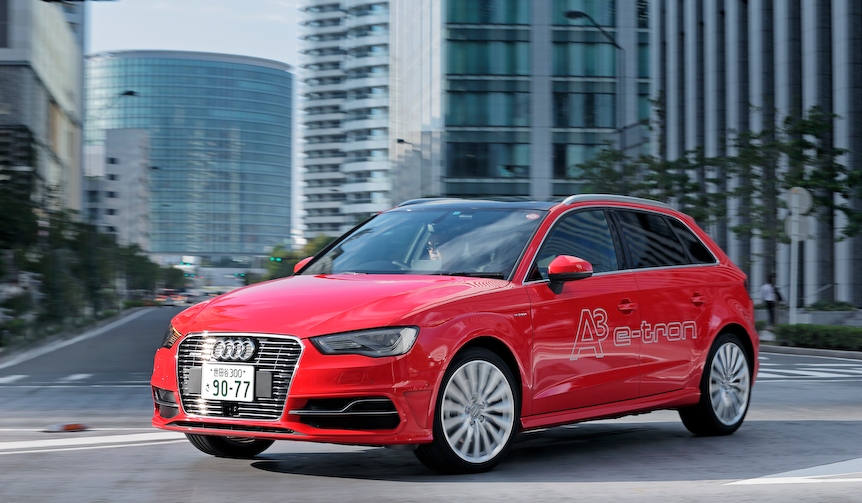
Test Drive: The Audi A3 Sportback e-tron Plug-in Hybrid | Audi
Audi A3 Sportback e-tron
Test Drive: Audi's PHEV A3 Sportback e-tron
Finally, it has arrived in Japan: the A3 Sportback e-tron, Audi's first plug-in hybrid. Equipped with a large-capacity battery that can be charged externally, it's an eco-car that can function almost entirely as an EV for daily commutes and handle long distances by combining with its gasoline engine for trips. How has the Audi brand refined this PHEV? Fumio Ogawa reports after a test drive.
Text by OGAWA FumioPhotographs by HANAMURA Hidenori
A Notable Pioneer in Audi's Eco-Friendly Strategy
The word "finally" is hard to avoid. The AudiA3 Sportback e-tron (e-tron) has landed. The firstprototypewas revealed several years ago. This plug-in hybrid (PHEV), a project close to Audi's heart, has finally hit the public roads. It will make its debut on Japanese streets within 2015.
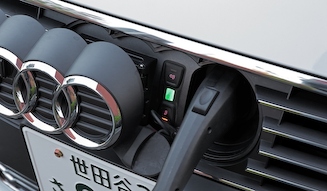
The A3 Sportback e-tron is a hybrid vehicle that can be charged externally (plug-in) and offers a long driving range in EV mode. It combines a 1.4-liter turbo engine producing a maximum output of 110kW and a maximum torque of 250Nm with a motor that delivers 330Nm of maximum torque. It is equipped with a 6-speed S tronic (dual-clutch) transmission. The battery is a lightweight, compact lithium-ion unit.
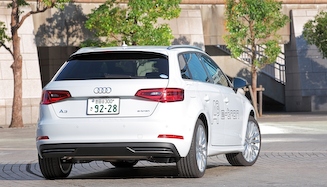
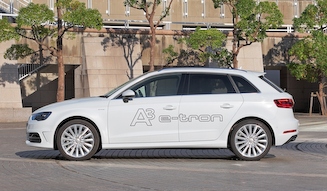
Externally, the grille, front and rear bumpers, and side skirts are unique, but there are no striking differences. The innovation lies within. In Japan, the price is 5.64 million yen, and according to the importer, Audi Japan, "subsidies of up to 610,000 yen for the introduction of clean energy vehicles, etc., are applicable."
Audi is currently focusing on plug-in hybrids. Not long ago, its parent company, Volkswagen, announced that the next-generation Phaeton, its top model, would be an electric vehicle, generating considerable buzz. Audi is following a similar path, currently announcing its near-future lineup which includes e-tron models combining gasoline engines with electric motors, g-tron models using natural gas as fuel, and h-tron fuel cell vehicles powered by hydrogen.
At the Frankfurt Motor Show in September 2015, it was also announced that the newly redesigned A4 would be offered in a g-tron variant.
Plug-in hybrids play a crucial role in meeting the European Commission's regulation to limit CO2 emissions per vehicle to below 95 grams per kilometer by 2020.
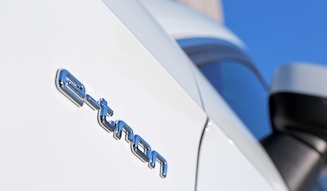
Returning to the A3 Sportback e-tron, its CO2 emissions are rated at 37 grams per kilometer based on European measurements, which is remarkably low. Its fuel efficiency under Japan's JC08 mode is 23.3 km/liter, making it a truly "eco-car." With the expectation of numerous new e-tron models to follow, the A3 Sportback e-tron, now available in Japan, is a model that deserves significant attention as a pioneer in Audi's environmental strategy.
Audi A3 Sportback e-tron
Test Drive: Audi's PHEV A3 Sportback e-tron (2)
What Sets It Apart is Its Quality
What are the charms of the A3 Sportback e-tron? To jump to a conclusion, it's the balance between quality and price. Previously, plug-in hybrids in Japan were represented by the Toyota Prius PHV (approx. 3.21 million yen) and the Mitsubishi Outlander PHEV (approx. 3.59 million yen). Internationally, models include the Mercedes-Benz S 550e Long (16.22 million yen), Porsche Panamera S E-Hybrid (14.98 million yen), and the same company'sPanamera S-E Hybrid(11.67 million yen).Cayenne S E HybridThe lineup was limited.
While Japanese models had limited equipment, German models were very expensive. Until now, these two categories were far apart. The A3 Sportback e-tron, along with the Golf GTE (4.99 million yen), which was released earlier as a PHEV,Golf GTEeffectively targets a niche by offering high quality at a reasonable price.
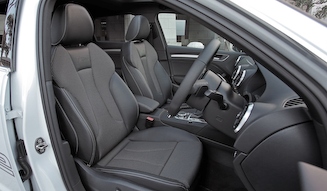
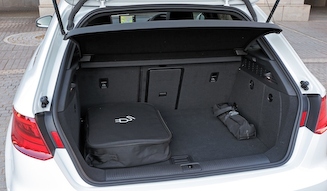
Driving the A3 Sportback e-tron, it is quiet, the ride is powerful, and the fuel efficiency is good (as advertised). The build quality and interior finish are high. Whether in EV mode or with the engine running, external noise is meticulously shut out, remaining remarkably quiet regardless of speed. In recent years, car manufacturers have been focusing on improving quietness through measures such as vibration damping in chassis components, enhanced sealing in areas where noise enters, and improved glass quality. The A3 Sportback e-tron is no exception.
The interior space, built on a 2,635mm wheelbase, is comfortable. The dashboard, including the center console, has a simple basic structure, but the surface treatment using curves creates a sense of quality. Audi's signature four circular air vents add an exciting mechanical feel. The chrome accents on various controls contribute to the premium ambiance.
Audi A3 Sportback e-tron
Test Drive: Audi's PHEV A3 Sportback e-tron (3)
The Ride Quality Was Surprisingly Refined
The A3 Sportback e-tron features four drive modes: "Hybrid Auto" for general hybrid driving, "Hybrid Hold" to maintain battery charge while driving, "Hybrid Charge" to actively charge the battery, and "EV" for electric-only driving.
Additionally, it incorporates control via the S tronic transmission. In D mode, when the accelerator is released, the clutch disengages from the powertrain and drivetrain, entering a coasting mode to save fuel. In S mode, however, energy regeneration occurs when the accelerator is released, providing a braking effect.
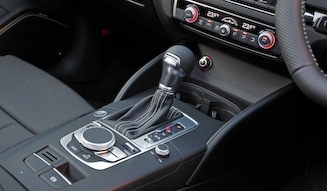
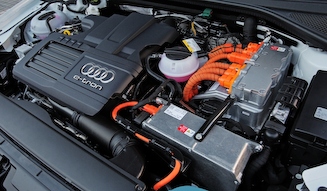
The driving performance can be summarized as surprisingly powerful. When the battery is fully charged, the car is set to run on electric power for the first 52.8 km. German cars often favor starting in EV mode, which is related to their fuel consumption measurement methods. However, even in Japan, the benefit of EV driving with the motor's ample 330Nm of torque is significant. Acceleration is smooth and silent from a standstill.
"You can enjoy quite sporty acceleration in S mode," advised an Audi Japan PR representative. Trying it out, the acceleration was indeed more than expected. I was surprised to glance at the speedometer and find myself traveling at a much higher speed than I realized. In D mode with Hybrid Auto, the transitions between engine and electric power are so smooth that the driver barely notices them, earning high marks for a comfortable drive.
The ride comfort of the A3 Sportback e-tron was also impressive. Road imperfections are not felt, and even significant vertical movements are carefully controlled.
The model I test drove was equipped with the optional S line Sport package (180,000 yen), which made the suspension feel slightly firmer. Those prioritizing comfort might prefer the standard specification. On the other hand, the S line Sport package offers sharp steering response, making it ideal for those who prioritize sportiness.
When considering rivals for the A3 Sportback e-tron, finding direct competitors among plug-in hybrids is challenging. In terms of fuel efficiency, premium diesel sedans or station wagons like the Mercedes-Benz C 220 d (5.59 million yen) or BMW 320d (5.06 million yen) might be considered rivals. While clean diesels, which achieve both emission control and power through urea SCR catalysts, are attractive, the A3 Sportback e-tron, with its more modern impression, is likely to hold its own against strong competitors.

Audi A3 Sportback e-tron
Body Dimensions: Length 4,330 x Width 1,785 x Height 1,465 mm
Wheelbase: 2,635 mm
Tread Front/Rear: 1,525 / 1,495 mm
Vehicle Weight: 1,570 kg
Engine: 1,394 cc Inline 4-cylinder Turbocharged
Engine Max Output: 110 kW (150 ps) / 5,000-6,000 rpm
Engine Max Torque: 250 Nm (25.5 kgm) / 1,500-3,500 rpm
Motor: AC Synchronous Motor Rated Output: 55 kW (75 ps)
Motor Max Output: 80 kW (109 ps)
Motor Max Torque: 330 Nm (33.7 kgm)
System Integrated Max Output: 150 kW (204 ps)
System Integrated Max Torque: 350 Nm
Battery: Lithium-ion Battery (96 cells)
Battery Capacity: 8.7 kWh
Transmission: 6-speed Dual-Clutch (S tronic)
Drivetrain: FF
Trunk Space: 280 ℓ
Minimum Turning Radius: 5.1 m
Suspension Front/Rear: MacPherson Strut / 4-Link
Brakes Front/Rear: Ventilated Disc / Disc
Tires Front/Rear: 225/45R17
Minimum Ground Clearance: 145 mm
Fuel Economy (JC08 Mode): 23.3 km/ℓ
CO2 Emissions: 100 g/km
Steering Position: Right
Price: 5.64 million yen
Audi Communication Center
0120-598-106(9:00-19:00, open daily)