February 24, 2015
A Whirlwind in the 2012 Imported Car Market – Test Drive of the New BMW 3 Series
BMW 3 Series | BMW 3 Series
A Game Changer in the 2012 Import Car Market──Test Drive: The New 3 Series (1)
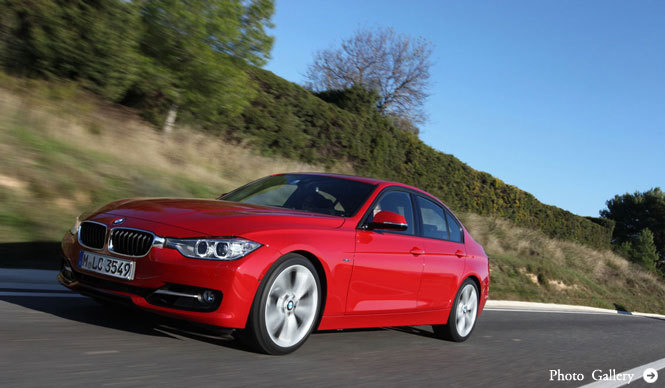
The sixth-generation BMW 3 Series was unveiled in October 2011 via a live stream on Facebook. Its environmental performance has been significantly improved through downsizing and the incorporation of various devices. The body size has been enlarged to enhance comfort and accommodate the hybrid system to be announced later. While meticulously adhering to BMW's design language, the new generation features a sharper front end. This sixth generation offers numerous talking points. We present an impression of the car by automotive journalist Toshifumi Watanabe.
Text by WATANABE Toshifumi
The Spiritual Pillar of BMW
In the Japanese market, the BMW 3 Series is a major name, rivaling the Volkswagen Golf in popularity. In fact, during periods between Golf model changes, it has topped import car sales figures, indicating how well it has integrated into the Japanese market.
BMW's growth into a universally recognized mass-market car manufacturer began in the early 1960s. The BMW 1500, slightly larger and more substantial than the popular compact cars of the time but not as expensive as luxury cars, targeted a market gap and became a hit, widely popularizing the code name 'Neue Klasse,' meaning 'new class' in German.
The 2002 series, affectionately known as 'Maruni' in Japan, is also a descendant of this Neue Klasse.
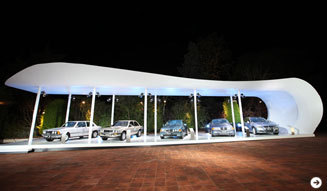
A lineup of previous 3 Series models
The first-generation 3 Series, named to carry on that success, was launched in 1975 with a full model change. Since then, the total number of units sold across its past five generations is said to exceed 12 million. Considering BMW's business scale, this figure is undoubtedly exceptional. It can be considered more than just the backbone of the company; it is its spiritual pillar. Therefore, its success in the Japanese market might be considered only natural.
BMW 3 Series | BMW 3 Series
A Game Changer in the 2012 Import Car Market──Test Drive: The New 3 Series (2)
328i Also Features a 2.0-Liter Inline-4 Engine
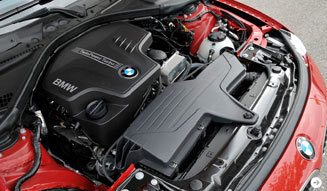
Looking at the overview of the new 3 Series, the biggest theme appears to be the thorough implementation of their product policy, 'Efficient Dynamics.' A prime example of this is the decision to limit inline-6 engines to higher-end models, with both the mainstream 320i and the 328i adopting inline-4 engines. The trend of 'downsizing' is evident at BMW, with similar 4-cylinder units being actively deployed in the 5 Series from the 2012 model year. Incidentally, the inline-6 is scheduled for the later-released 335i and the also-announced ActiveHybrid 3.
Achieves Environmental Performance Unmatched by Rivals
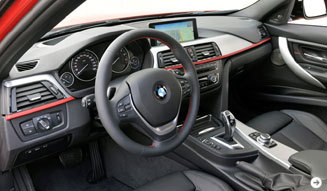
The 4-cylinder unit in the test car, the 328i, has a displacement of 2 liters but features direct injection and a twin-scroll turbocharger, producing a maximum output of 245 ps. The Dynamic Drive Control, which integrates engine and transmission management, throttle opening, and power steering assist levels with a single button on the center console, includes an Eco Pro mode, similar to the 1 Series, that effectively saves power consumption and air conditioning to maximize fuel efficiency. Combined with the start-stop system, the CO2 emissions for the 8-speed automatic transmission version are 147g/km. This figure, alongside performance metrics like a top speed of 250 km/h and 0-100 km/h acceleration in 6.1 seconds, can be considered exceptional even when compared to direct rivals.
Not only for collision safety requirements and appearance, but also to secure space for later installation of hybrid lithium-ion batteries and urea SCR systems for Euro 6 compliant diesel engines, the new 3 Series has had its overall length extended by 95mm and its wheelbase by 50mm compared to the previous generation. The tread has also been significantly widened, by 37mm at the front and 47mm at the rear. Seeing it in person gives a considerably more substantial impression, largely due to the design that encompasses the wider tread. In fact, the actual overall width remains the same as the previous generation at 1,811mm, and for the Japanese market, it will be introduced at 1,800mm with dedicated settings for door handles and other components, thus retaining its compact size that can accommodate infrastructure like tower parking.
BMW 3 Series | BMW 3 Series
A Game Changer in the 2012 Import Car Market──Test Drive: The New 3 Series (3)
Ride Comfort and Quietness Significantly Improved
The new 3 Series also offers a personalization system, similar to the 1 Series, allowing customers to choose from three interior and exterior trim lines – 'Sport,' 'Luxury,' and 'Modern' – tailored to their preferences. The 328i, which was primarily test-driven, was the 'Sport' trim with staggered 19-inch front and rear tires.
Upon starting to drive, the first thing that surprises is the significant improvement in ride comfort and quietness compared to the previous model. The sensation of rolling smoothly over road imperfections is so refined it could be described as 'hissing,' and the flat ride is impeccable. Even when cruising through winding roads at a pleasant speed, it exhibits stable behavior, adeptly handling bumps with a comfortable amount of roll. This aspect remains largely unchanged even with the 18-inch tires on the 'Modern' trim, clearly indicating that the chassis provides ample damping.

So, what happened to BMW's signature sharp handling, comparable to that of sports cars? This test drive included full-throttle runs on the main course of the Catalunya Circuit. Furthermore, the fact that it was conducted with the same vehicles used for public road testing hints at their intention to showcase the new 3 Series' dynamic performance and robustness.
Even when the Dynamic Drive Control is set to 'Sport Plus' mode, which maximizes agility, the car's response to steering inputs on the track is noticeably more refined and composed compared to the previous model's almost racing-car-like sharpness. The approach to body roll has clearly shifted towards greater tolerance, allowing the tires to maintain consistent contact with the road while tenaciously gripping corners. The rear suspension's stability, crucial for cornering, is also impressive, with the car's posture remaining uncompromised. While the previous model was already commendable for its effort to maintain neutral handling, the new generation adds a significant degree of suppleness to its movements. This is conveyed to the driver not just through steering inputs but also through a certain rawness, as if the car is cornering using all four limbs.
BMW 3 Series | BMW 3 Series
A Game Changer in the 2012 Import Car Market──Test Drive: The New 3 Series (4)
Scheduled for Introduction to Japan Next Spring
That said, the turn-in response is by no means sluggish. On the contrary, after a tenacious grip through a corner, the quick transitions for the next turn possess a nimbleness akin to a judo practitioner's pivot. This remarkable agility is likely aided by the weight reduction, including the adoption of the 4-cylinder engine.
The feel of the 4-cylinder engine also proved that any concerns were unfounded.

Generating maximum torque from just 1,250 rpm, and aided by the wide gear ratios of the 8-speed automatic transmission, it delivers powerful acceleration from very low engine speeds, making gear position almost irrelevant. On the other hand, the power continues to build towards the peak without faltering and smoothly revs up to the 7,400 rpm redline, making its tuning sufficiently sporty even when compared to numerous other 4-cylinder turbo engines. While it doesn't produce the pleasing sound of a 6-cylinder, as mentioned earlier, if we consider the agile and refined handling, facilitated by the lighter front end, as BMW's new sensory appeal, then the result is more than satisfactory.
The new 3 Series is scheduled for an surprisingly early introduction to Japan, planned for early next spring. It is undoubtedly set to become a game changer not only in the premium D-segment but also in the import car market of 2012.

BMW 328i
Body Dimensions | Length 4,624 x Width 1,811 x Height 1,429mm
Wheelbase | 2,810mm
Engine | 2.0-liter inline-4
Maximum Output | 245 ps (180 kW) / 5,000-6,500 rpm
Maximum Torque | 350 Nm / 1,250-4,800 rpm
Fuel Consumption | 6.4 ℓ/100km
CO2 Emissions | 149 g/km