March 16, 2015
The Joy of Driving an FR Sports Car, Made Accessible: Test Drive of the Toyota 86 | TOYOTA
TOYOTA 86 | Toyota 86
Test Drive: The 21st Century Toyota 86 (1)
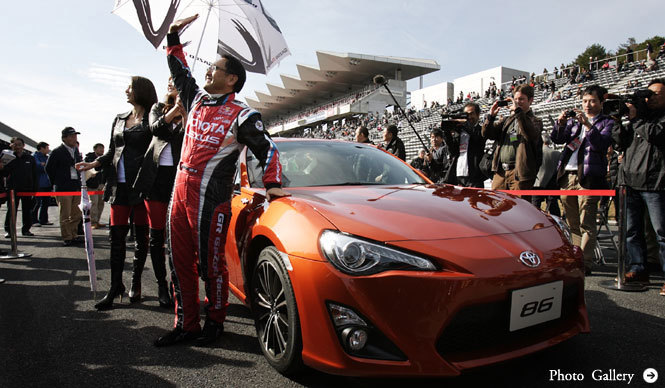
The 21st-century "Hachi-Roku" finally made its debut as a production model at Fuji Speedway recently. Developed under the name "FT-86" as a concept, the car will be simply called "86" and is slated for release in spring 2012. We offer our driving impressions of this car, designed to let you enjoy FR sports driving more casually, with the concept of "Intuitive Handling FR."
Text by Tadayuki AokiPhotos by Masayuki Arakawa
Price Around 2 Million Yen?!
As I headed towards the designated parking area within Fuji Speedway, a line of small sports cars approached from the front. These were Toyota Sports 800s, affectionately known as "Yotahachi," with their cute, round headlights. In a large parking lot nearby, a Toyota 2000GT gleamed elegantly in the morning sun. Behind it, forming a particularly large group, were the AE86 models of the Corolla Levin and Sprinter Trueno. The sight of so many simple hatchback and notchback bodies lined up conveyed the car's immense popularity.
On November 27, 2011, the Toyota 86, the "Hachi-Roku" of the 21st century, was unveiled at the "Toyota GAZOO Racing Festival 2011." This compact FR sports car is touted as reviving the spirit of the "Yotahachi" with its "boxer engine + rear-wheel drive" concept, the sleek style of the 2000GT, and the community spirit that surrounded the original Hachi-Roku. Positioned as an accessible sports car, whispers suggest a price tag around 2 million yen upon its release next spring.
On this day, members of the press were given a brief opportunity to test drive the car.
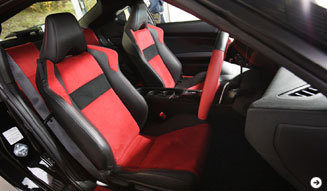
I opened the door and settled into the driver's seat of the Toyota 86. The red and black combination seats featured side bolsters on both the backrest and seat base. The cushioning felt soft. When I pressed the starter, the boxer engine's beat was palpable for just a moment upon ignition.
Added an in-car movie of the drive by automotive writer Tadayuki Aoki, who wrote this test drive review!
TOYOTA 86 | Toyota 86
Enjoying FR Sports Driving with Ease
Test Drive: The 21st Century Toyota 86 (2)
The Joy of Driving an FR Sports Car, Easily Accessible
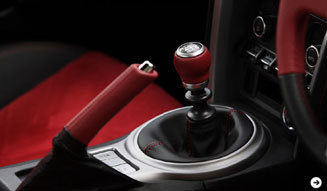
The test car was a 6-speed manual. I engaged the clutch and started driving. The 2-liter boxer engine responded nimbly to throttle inputs, linearly accelerating the 86 as expected from a naturally aspirated unit. The gear ratios were modest, perhaps even sensible: around 60 km/h in first and exceeding 100 km/h in second. Meanwhile, at 100 km/h in sixth gear, the engine spun at 2,750 rpm, indicating the top gear isn't solely for fuel economy. On a high-speed race circuit, the finely spaced gearbox would likely prove rewarding.
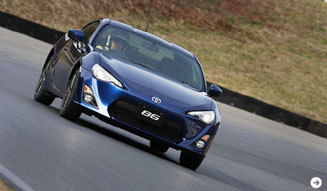
True to its "Intuitive Handling FR" concept, the Toyota 86's handling is straightforward and approachable. When you turn the steering wheel, the nose responds quickly, but the movement isn't overly sensitive, so the driver doesn't feel anxious with every turn. Furthermore, the moderate body roll and tires that don't offer extreme grip make the car's limits easy to discern. On a slightly tight corner, a playful application of throttle causes the rear to slide smoothly, making the driver feel confident. Every time I gripped the steering wheel of the nimble Toyota 86, whether at the Japan Cycle Sports Center or the short circuit at Fuji Speedway, I found myself thinking, "I can't wait to drive it on a mountain pass!"
For those seeking absolute speed on the circuit, the new Hachi-Roku might feel slightly lacking in its stock form. However, for drivers who want to enjoy a "spirited drive" with a comfortable margin in their daily commute or on familiar mountain roads, it's the perfect companion. It allows you to easily experience the joy of driving an FR sports car.
TOYOTA 86 | Toyota 86
Enjoying FR Sports Driving with Ease
Test Drive: The 21st Century Toyota 86 (3)
A Fierce Front Face with Eyes Like a Predator
The Toyota 86's form, with its long nose and compact cabin, immediately conveys its FR drivetrain to the observer. The body, measuring 4,240mm long, 1,775mm wide, and 1,300mm high, with a wheelbase of 2,570mm, is close in size to the former Nissan FR sports car, the Silvia. This might make it easy for former Silvia drivers (S13, 14, 15) to switch to a Toyota?
Jokes aside, potential customers for the new 86 could include not only loyal fans of the original Hachi-Roku but also those who admire the Honda Integra but want to try rear-wheel drive next, are interested in the Mazda Roadster but can't get past the two-seater limitation, or aspire to own an FR sports car but find imported models prohibitively expensive.
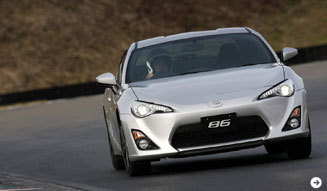
The Toyota 86 enters the market at a time when the coupe and sports car segment has become quite sparse. Its aggressive front face, dubbed the "Keen Look," is described as having "eyes like a predator." While one might imagine a connection to the Lexus LFA supercar, the overall design feels somewhat busy compared to the clear lines of the rest of the body. In line with Toyota's slogan, "FUN TO DRIVE, AGAIN.," one wonders how older drivers, whose hearts might be stirred by the thought of "driving a Hachi-Roku again," will perceive the new 86's face. It's a slight concern, but ultimately a matter of personal taste.
TOYOTA 86 | Toyota 86
Enjoying FR Sports Driving with Ease
Test Drive: The 21st Century Toyota 86 (4)
Powered by a Subaru-sourced 2-liter Boxer engine with D-4S
Unsurprisingly, the Toyota 86 was developed in collaboration with Subaru Corporation. The front-mounted engine is a 2-liter boxer unit from Subaru. However, the bore and stroke have been changed to a square configuration (86mm x 86mm), described as "a tradition for Toyota sports models." It produces a maximum output of 147 kW (200 ps) at 7,000 rpm and a peak torque of 205 Nm at 6,600 rpm. The high compression ratio of 12.5:1 suggests good efficiency as an internal combustion engine. Toyota's proprietary D-4S technology is employed in the cylinder head, featuring twin injectors that switch between direct injection and port injection depending on driving conditions, reportedly achieving "high environmental performance."
Two transmission options are available: a conventional 6-speed manual with a three-pedal setup and a 6-speed automatic with a torque converter. To offer "Intuitive FR Handling" at an affordable price, automated manual transmissions or dual-clutch gearboxes were not utilized.
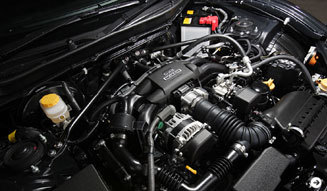
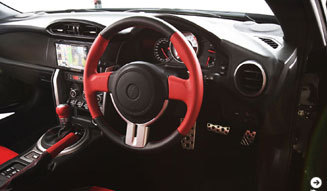
The suspension features MacPherson struts at the front and a multi-link setup based on double wishbones at the rear. Tire sizes are either "215/55R16" or "215/45R17," depending on the grade. While these are modest specifications for a modern sports model, readily available tire sizes are a welcome consideration for users who truly enjoy driving, minimizing the impact on their wallets. Those prioritizing looks can, of course, opt for aftermarket solutions.
The Toyota 86 is slated for export to North America, Asia, and Europe, in addition to Japan. The question remains whether it can capture the hearts of not only domestic fans who feel affection and nostalgia for the "Hachi-Roku" name, and the "young at heart," but also younger individuals, both domestically and internationally, who might actually fold down the rear seats (which are split-folding) and load four tires for track days. The success of the Toyota 86 hinges on this.

TOYOTA 86 | Toyota 86
Body Dimensions | Length 4,240 x Width 1,775 x Height 1,300mm
Wheelbase | 2,570mm
Engine | 2-liter horizontally opposed 4-cylinder
Max Output | 200 ps / 7,000 rpm
Max Torque | 205 Nm / 6,600 rpm
Transmission | 6-speed MT, AT