Test Drive: Toyota MIRAI Fuel Cell Vehicle | Toyota
Toyota Mirai
A Pioneer for the Next Generation of Powerplants
Test Drive: Toyota Mirai Fuel Cell Vehicle
Toyota has launched the Mirai, a mass-produced fuel cell vehicle (FCV) that uses hydrogen as its energy source. Toyota has beaten the world to market with this next-generation automobile, which was once thought to be far in the future, and it is now running on our roads. Tatsuya Otani, who test drove the Mirai in the city, explores the background of its creation.
Text by OTANI TatsuyaPhotographs by ARAKAWA Masayuki
Impressive Handling
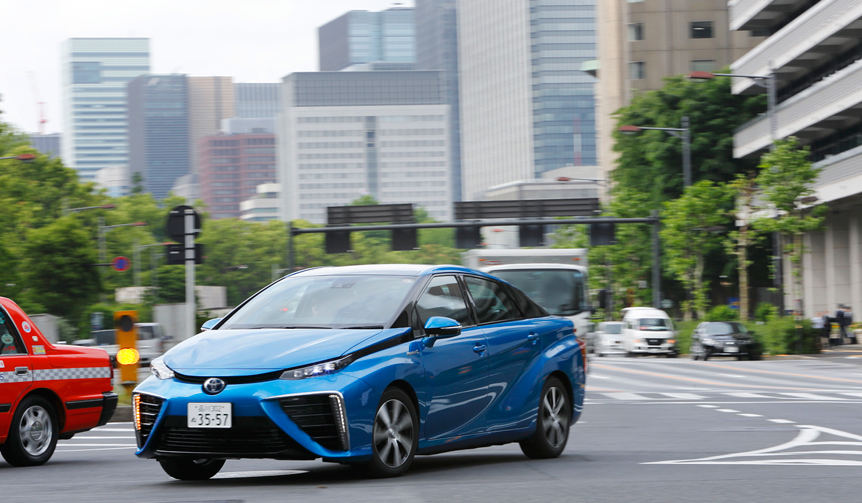
In April of this year, I had the opportunity to drive the Toyota Mirai on public roads for the first time. I had previously taken a short test drive on a closed course and was favorably impressed by its comfortable ride and precise handling. After driving the Mirai for over an hour on public roads this time, that impression was only strengthened.
Firstly, the rigid body provides a reassuring sense of stability, as if it can shrug off impacts from the road. Furthermore, the suspension strokes smoothly and supplely, making for a comfortable ride. And because the car's center of gravity is low, the suspension can be relatively soft without excessive body roll, allowing for surprisingly agile cornering.
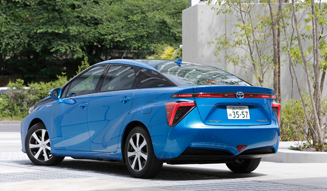
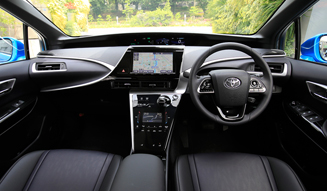
Frankly, many of Toyota's eco-cars up to now have prioritized "eco" to such an extent that their bodies felt flimsy, their suspensions didn't move smoothly, or their handling felt elusive. In other words, there was often a sense of dissatisfaction with the driving experience.
But the Mirai is different. Its ride quality is on par with well-crafted European compact cars, and its handling suggests meticulous development. There's no need to make compromises. In fact, I even find myself wanting to drive the Mirai enthusiastically. As far as I know, no other Toyota car offers such profound satisfaction when driving.
The Mirai's appeal doesn't end there.
Toyota Mirai
A Pioneer for the Next Generation of Powerplants
Test Drive: Toyota Mirai Fuel Cell Vehicle (2)
Power That Defies Eco Preconceptions
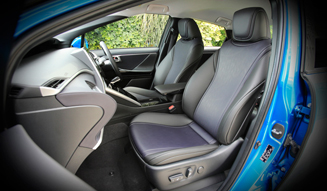
Fuel cell vehicles are characterized by their electric motors as the power source, with electricity supplied to these motors generated by an onboard "fuel cell" power generator. In this sense, FCVs can be considered a type of electric vehicle. As a result, they are very quiet.
On some prototype fuel cell vehicles I drove previously, the electric fan that draws in large amounts of oxygen from the air made an unpleasantly loud noise when the throttle pedal was pressed deeply. However, in the Mirai, the cabin remains quiet at all times.
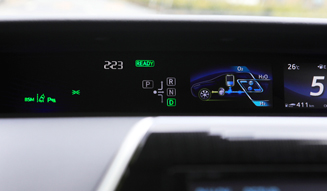
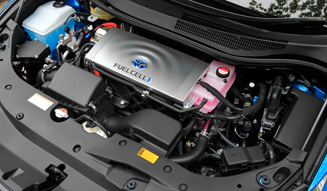
Another aspect I found pleasing about the Mirai is its power characteristics. The Mirai's fuel cell stack has a maximum output of 114 kW (155 ps). Considering it propels a 1,850 kg body, it's not exceptionally powerful by ordinary standards.
However, these specifications are typical of many prototype fuel cell vehicles tested so far. Yet, the Mirai possesses a strength that surpasses its specifications. When you press the throttle pedal firmly, it accelerates smoothly with a level of power that doesn't disappoint. Moreover, the time lag between pressing the throttle and the acceleration actually beginning is short. This allows for truly stress-free driving.
Therefore, when it comes to the Mirai, I find myself praising it without reservation. However, this is akin to evaluating a mobile phone by saying, "This device is truly excellent." But a mobile phone is only complete with the network provider that offers the service, not just the device itself.
In other words, no matter how excellent the device, it's useless without a network to connect to – like giving pearls to swine.
With gasoline cars, gas stations have traditionally been ubiquitous across the country (though their numbers are declining), so there was no need to worry about the number of refueling stations, which would be analogous to the phone companies for mobile phones. However, with fuel cell vehicles, a completely new type of transportation, one must first consider the availability of hydrogen stations.
Toyota Mirai
A Pioneer for the Next Generation of Powerplants
Test Drive: Toyota Mirai Fuel Cell Vehicle (3)
The ZEV Mandate: Prioritizing Infrastructure?
As of early July, Toyota's website lists 81 operational hydrogen stations nationwide. For comparison, statistics from 2013 show approximately 35,000 gas stations in Japan. Even charging spots for electric vehicles (EVs), which have also been criticized for lagging infrastructure, now exceed 14,000 (according to Nissan Leaf's website). The number of hydrogen stations is orders of magnitude smaller.
Partly for this reason, Toyota initially produced the Mirai at a pace of about two cars per day. Even in 2017, two years later, production was only just over four times that, at 3,000 units annually. Compared to the company's scale of selling 10 million cars a year, this is a negligible number.

Iwatani Hydrogen Station in Shiba Park, Tokyo.
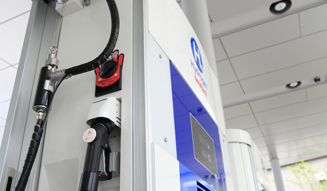
Hydrogen station supply system
Despite this, why did Toyota rush to launch the Mirai? While the desire to establish their technology as a global standard by being the first to mass-produce it was certainly a factor, another crucial reason is said to be the need to comply with the ZEV mandate implemented in states like California.
The ZEV mandate requires major automakers to sell a certain percentage of ZEVs (Zero Emission Vehicles). The law applies to six major manufacturers (GM, Toyota, Ford, Honda, Nissan, Chrysler) selling over 60,000 vehicles annually in California. The ZEV sales ratio, which started at 10 percent in 2005, is set to gradually increase to over 16 percent from 2018 onwards.
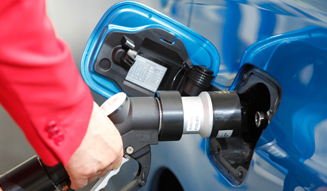
Refueling with "hydrogen" at the Iwatani Hydrogen Station in Shiba, Tokyo. Due to the high-pressure gas, general drivers are not permitted to fill up with hydrogen themselves, unlike at self-service gas stations.

A receipt like this is provided, similar to a gas station. The fill-up amount this time was 0.32 kg. The price per kg is 1,100 yen. Based on the national average price of premium gasoline on July 13th, this is equivalent to the price of approximately 7 liters of gasoline per kg.
However, at present, the only practical ZEVs are either electric vehicles (EVs) or fuel cell vehicles (FCVs). To assist automakers who sell neither or only a very small number, various exceptions have been implemented. In extreme cases, hybrid vehicles (HVs) and plug-in hybrid vehicles (PHVs) could previously be counted as ZEVs.
But from 2018 onwards, not only will HVs and PHVs no longer be recognized as ZEVs, but even EVs, which are inherently ZEVs, will have their credit reduced, creating a disadvantage for automakers trying to meet the ZEV mandate's requirements.
Toyota Mirai
A Pioneer for the Next Generation of Powerplants
Test Drive: Toyota Mirai Fuel Cell Vehicle (4)
The Next Wave of Powerplants
Furthermore, this ZEV mandate applies not only to California but also to a total of 10 states that cooperate with California, making its impact extremely significant. And if automakers fail to meet the ZEV mandate's conditions, they face hefty fines.
Moreover, from 2018, Volkswagen, BMW, Mercedes, Hyundai, Mazda, Kia, and others will also be included in the regulations. This means that automakers who have been trying to skirt the regulations with HVs and PHVs will be at a loss. They will be forced within three years to sell either fuel cell vehicles or, at the very least, a certain number of EVs.
Given the insufficient hydrogen infrastructure, this appears to be the primary reason Toyota decided to launch the Mirai. Of course, as mentioned earlier, the fuel cell vehicle developed by Toyota demonstrates remarkable completeness. All that remains is for hydrogen stations to be built nationwide and for methods of hydrogen production and transportation to be established, though these are, naturally, not simple tasks.
However, the influence of California, a major market within the United States, a major automotive consumer nation, is immense. The Muskie Act, the first emissions regulation in history, was also enacted in California. As you know, this triggered the introduction of emissions regulations worldwide. Therefore, it would not be surprising if the ZEV mandate ultimately dictates the trend for next-generation powerplants.
Japanese and American automakers are trying to gain the upper hand in fuel cell vehicle development by leveraging the ZEV mandate, while European automakers wish to overcome the challenges with PHVs and EVs as before. The tug-of-war between these two sides is likely to continue for some time.

Toyota Mirai
Body Dimensions | Length 4,890 x Width 1,815 x Height 1,535 mm
Wheelbase | 2,780 mm
Tread Front/Rear | 1,535 / 1,545 mm
Weight | 1,850 kg
Fuel Cell System | Toyota FC Stack (Fuel Cell) + Motor
Fuel Cell | Polymer Electrolyte Membrane
Maximum Output | 114 kW (155 ps)
Motor | AC Synchronous Electric Motor (Permanent Magnet Synchronous Motor)
Maximum Output | 113 kW (154 ps)
Maximum Torque | 335 Nm (34.2 kgm)
Drive Battery | Nickel-Metal Hydride Battery
Capacity | 6.5 Ah
Drivetrain | FF
Suspension Front | Strut
Suspension Rear | Torsion Beam
Brakes Front | Ventilated Discs
Brakes Rear | Discs
Tires Front/Rear | 215/55R17
Maximum Speed | 175 km/h
Cruising Range per Fill (Reference) | Approx. 650 km
Price | 7,236,000 yen
Toyota Motor Corporation Customer Relations Center
0800-700-7700
Open daily 9:00 - 18:00