February 25, 2015
Mercedes-Benz S400 HYBRID: A Test Drive Review
Mercedes-Benz S400 HYBRID
The True Value of a Hybrid for Owner-Drivers (1)
Mercedes-Benz offers a hybrid model in its large S-Class sedan lineup. A significant feature is the 100% exemption from automobile acquisition tax and weight tax.
By Fumio Ogawa
Torque Equivalent to a Large-Displacement Engine Achieved
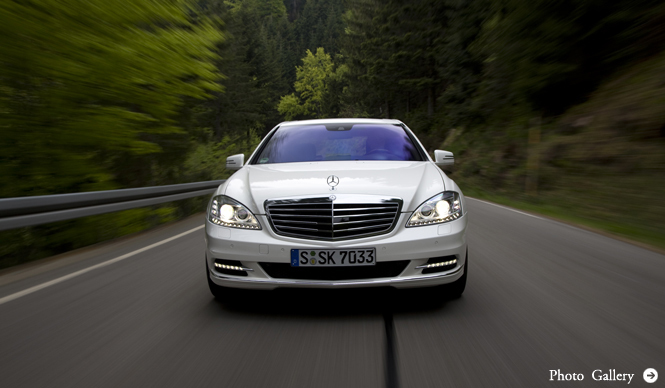
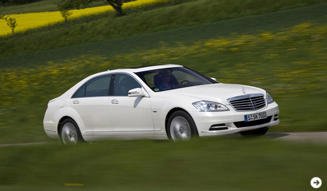
The Mercedes-Benz S-Class HYBRID with standard wheelbase (12.7 million yen) shares the hybrid system combining a 3.5-liter V8 engine with an electric motor, the same as the S-Class HYBRID Long which went on sale in September 2008. However, it is characterized as being for owners who drive themselves, with a body that is 13 cm shorter and a minimum turning radius that is 20 cm smaller.
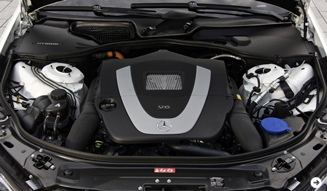
The S-Class HYBRID features a body with a total length of 5,100 mm and a wheelbase of 3,035 mm (the HYBRID Long has a wheelbase of 3,165 mm and a total length of 5,230 mm). Even with the "standard wheelbase," it offers ample space. Mercedes' hybrid system incorporates a thin electric motor between the engine and the transmission. This electric motor acts as a power booster during startup and acceleration, when more torque is needed. The manufacturer's goal is to achieve torque equivalent to a large-displacement engine while also improving fuel efficiency, even with a smaller engine displacement.
An Extremely Natural Driving Sensation
Although it's a hybrid, it's not a system that relies heavily on the electric motor, as exemplified by Toyota's THS-II. Therefore, the driving feel is the same as a gasoline car. There's no unnatural sensation from the regenerative braking system, and one might not even realize it's a hybrid if they weren't told. There are currently two main types of hybrids popular in Europe, and in both cases, the motor is small, suggesting that this approach is more readily accepted by the market.
Additionally, it comes with hybrid-specific features such as the "ECO Start-Stop function," which stops the engine when the vehicle speed drops below 15 km/h. The manufacturer claims a total fuel economy improvement of approximately 30% over the S 350. This model is suited for owners who need a large luxury sedan but also want to project an environmentally conscious image.
Mercedes-Benz S400 HYBRID
The True Value of a Hybrid for Owner-Drivers (2)
The High Ride Comfort That is the Hallmark of the S-Class
Acceleration doesn't betray its 1.9-ton weight. Starting is smooth, and the benefits of the electric motor are felt when exiting corners. It feels as though even more torque is applied to the drive wheels, and despite its large body, the handling is by no means poor. Observing the "Energy Flow" display in the instrument cluster, one can see the electric motor engaging when the accelerator pedal is pressed firmly. However, the sensation is natural. It functions like a supercharger, but it gently adds torque to the engine. In essence, it skillfully utilizes the hybrid system.
In Europe and North America, where high-speed driving is common, systems where the engine is primary and the electric motor is secondary are considered more practical. The German hybrid models that have recently arrived in Japan all adopt a similar philosophy. The S-Class HYBRID is no exception. Mercedes currently employs two hybrid systems, but only this "mild hybrid" version of the S-Class HYBRID has been introduced in Japan. While its fuel efficiency may not be dramatically better than that of Toyota/Lexus, it might be a suitable compromise for drivers who don't want to be inconvenienced. The adoption of a compact and lightweight lithium-ion battery adds only 75 kg to the weight. There's no sense of unnecessary heft when maneuvering, including during cornering.
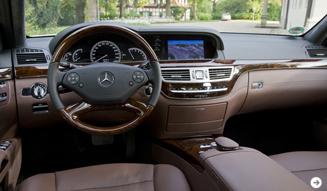
The S-Class HYBRID truly shines on long drives, proving it is undoubtedly a member of the S-Class family. During cruising, the electric motor disengages, and the car runs solely on the gasoline engine. The exquisite combination of handling that reduces fatigue and a comfortable ride, along with the supple feel imparted by its substantial body, are unique to the S-Class. Furthermore, as a characteristic of hybrid vehicles, charging of the battery begins when the accelerator pedal is released. Observing this process on the monitor is also quite interesting.

Mercedes-Benz S400 HYBRID
Body | Length 5,100 x Width 1,870 x Height 1,485 mm
Wheelbase | 3,035 mm
Engine | 3.5-liter V6 DOHC engine
Max. Output (Engine) | 205 kW (279 ps) / 6,000 rpm
Max. Torque (Engine) | 350 Nm (35.7 kgm) / 5,500 rpm
Max. Output (Motor) | 15 kW
Max. Torque (Motor) | 160 Nm
Fuel Economy (10-15 mode) | 11.2 km/ℓ
CO2 Emissions | 186-189 g/km
Transmission | Electronically controlled 7-speed AT
Drivetrain | FR
Steering | Left
Price | 12.7 million yen
*CO2 emissions are based on domestic data.