March 16, 2015
TOYOTA FJ CRUISER | A Test Drive Review of the Toyota FJ Cruiser
TOYOTA FJ CRUISER | TOYOTA FJ CRUISER
A Design-Conscious 4WD Aimed at Younger Customers (1)
The Toyota FJ Cruiser, a design-conscious 4WD that was popular primarily in the United States, was launched in Japan on December 4, 2010. It features a playful body design with a variety of body colors and a large 4-liter engine.
By Fumio Ogawa
The Right-Hand Drive Japanese Model Arrives After Careful Preparation
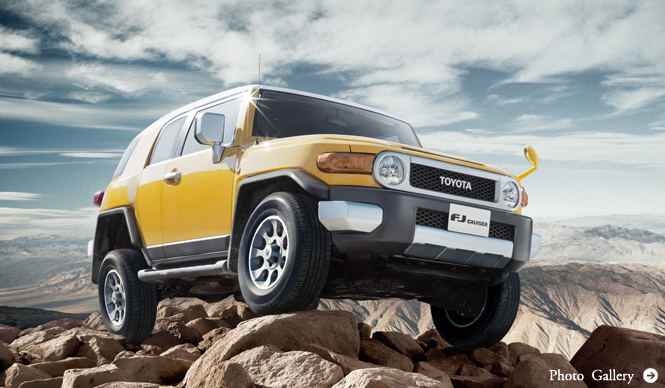
The "FJ Cruiser" (¥3.14 million) has been sold in North America since 2006. It had already garnered fans in Japan, with parallel imported units being sold. The reason for its eventual launch in Japan, according to a vehicle development representative, was the desire to "offer a car that makes young Japanese users, who are said to be drifting away from cars, feel excitement and thrill."
Its distinctive front-end design is reminiscent of the Land Cruiser, known as the "FJ40," which was released in the 1960s.
This was a vehicle that was exported overseas and active everywhere. It's understandable, then, that the FJ Cruiser, embodying that image, has achieved popularity in North America, including Canada, countries from Mexico to South America, the Middle East, China, and Africa.
"Initially, there were no plans to build a right-hand drive version, but we determined it had the potential to be a car that young people would be willing to spend money on, so we decided to proceed with the right-hand drive conversion. As the Land Cruiser became more luxurious and moved upmarket, this model fits into the resulting niche. It uses the Prado's chassis as a base, and by cleverly positioning the fuel tank, it offers sufficient performance even off-road, making it a versatile vehicle," said a vehicle development representative.
Models Equipped with "X-REAS" Available
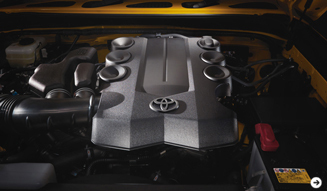
The FJ Cruiser has a frame chassis and is powered by a 4-liter V6 gasoline engine. This engine features variable valve timing, producing a maximum output of 203 kW (276 ps) and a maximum torque of 380 Nm. The drivetrain is a part-time system with manual switching between 2WD and 4WD. The 4WD system also includes a low mode for steep inclines and muddy terrain. Additionally, an active traction control system, which automatically controls power distribution to all four wheels in low mode, is available as an option. The transmission is a 5-speed automatic.
"While it boasts high off-road capability, comfort on paved roads is also important for those who use it in the city. Especially in Japan, it will likely be used primarily on-road, so we've tuned the settings with on-road comfort in mind," says the vehicle development representative. The Japanese lineup also includes models with Toyota's unique "X-REAS" system, which connects the dampers to suppress body roll and provide sportier handling.
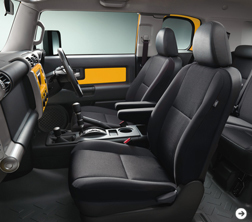
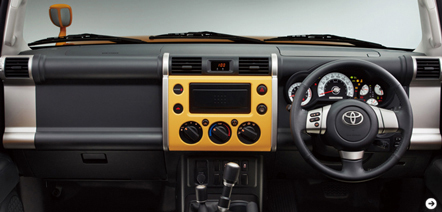
Once inside, the seating position is high, as expected of a large 4WD. The center panel is the same color as the body, and the controls are large and easy to operate, as Toyota explains, "so they can be operated even with gloves on." However, the slightly plasticky feel is a minor concern.
Most striking is the windshield, which is short in length and almost perfectly vertical. Along with the thick A-pillars, this is a key design feature of the FJ Cruiser. One might wonder about wind noise. However, when driving on the highway, it's surprisingly quiet. This is apparently because the upright windshield positions the top edge further from the occupants' ears.
TOYOTA FJ CRUISER | TOYOTA FJ CRUISER
A Design-Conscious 4WD Aimed at Younger Customers (2)
A Chassis with Responsive Handling for a Sporty Feel
Let's move on to the driving impressions. From the start, it feels more "4WD-like" than expected, with a slight delay in the vehicle's response when turning the steering wheel. It truly has the Land Cruiser's DNA. Although the engine's peak torque is set at a relatively high 4,400 rpm, you can feel ample power even at lower revs. Conversely, it doesn't seem eager to rev high.
I mentioned a "4WD feel," but as you drive, that initial impression fades, and a sporty feel becomes more prominent. This is likely due to the chassis's excellent responsiveness. Perhaps because the suspension has been tuned for the Japanese market, where "on-road use is overwhelmingly dominant," the way the car corners when you turn the wheel feels closer to a passenger car than one would expect from a vehicle advertised for its off-road prowess.Range RoverIt felt sportier than a Range Rover, but softer than a Range Rover Sport.
Initially, I test-drove the most basic grade equipped with 17-inch tires. Afterward, I tried the sporty version with 20-inch tires and the X-REAS system to reduce roll. Naturally, the latter offers sharper handling, but the basic grade is packed with the FJ Cruiser's inherent qualities, so I believe it's equally impressive.
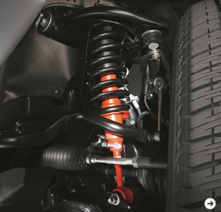
X-REAS Shock Absorbers
Initially, I test-drove the most basic grade equipped with 17-inch tires. Afterward, I tried the sporty version with 20-inch tires and the X-REAS system to reduce roll. Naturally, the latter offers sharper handling, but the basic grade is packed with the FJ Cruiser's inherent qualities, so I believe it's equally impressive.
The interior has a high ceiling, and the front seats feel very spacious. The steering wheel grip and shift lever grip are made of a unique rubber that feels pleasant to the touch. The seats were satisfactory during the short test drive. However, their simple design is a bit disappointing, not quite matching the FJ Cruiser's vibrant image.
Access to the rear seats is through the rear-hinged doors, known as "suicide doors" in the US. Pulling the rugged handle inside, which resembles a large, square piano key, reinforces the impression of its lineage from the Land Cruiser. Perhaps excessive design wasn't the original intention of the vehicle's developers. The rear seatback is too short, but legroom is sufficient even for adults. In the US, there's a "tradition" of not using the rear seats much. In Japan, people quickly tend to ask, "What about rear seat comfort?" For a manufacturer selling the same car in countries with such different automotive cultures, this must be a point of consideration.
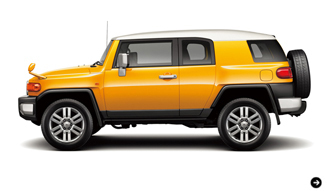
There are seven body colors, including yellow, a vivid blue, a bright beige, and a subdued brick red, all of which are combined with a white roof. They all seem to suit the body design. With competitive pricing, enjoying the world of off-road 4WD occasionally with the FJ Cruiser might be a good idea.

TOYOTA FJ CRUISER | TOYOTA FJ CRUISER
Body | Length 4,635 x Width 1,905 x Height 1,840mm
Engine | 4.0-liter V6
Maximum Output | 203 kW (276 ps) / 5,600 rpm
Maximum Torque | 380 Nm (38.8 kgm) / 4,400 rpm
Drivetrain | Part-time 4WD
Transmission | 5-speed AT
Fuel Economy | 8.4 km/ℓ
CO2 Emissions | 115 g/100km
Price | ¥3.14 million