Journey to Maranello, the Holy Land of Ferrari Vol. 2 | Ferrari
Ferrari
Pilgrimage to Maranello, the Holy Land of Ferrari Vol. 2
Passing Down Skills, Sharing Passion
Ferrari is headquartered in Maranello, in the province of Modena, Italy.Previous ArticleIn the first installment, we gave you a peek inside the factory, the very heart of Ferrari. This time, we'd like to guide you through "Ferrari Classiche," the special department that manages historic cars, and " Corse Clienti," which handles F1 machines for private owners and special models.
Back to "Pilgrimage to Maranello, the Holy Land of Ferrari Vol. 1"
Text by Akio Lorenzo OYAPhotographs by Fabrizio Gremo
Ferrari Classiche: The Service Department for Historic Ferraris
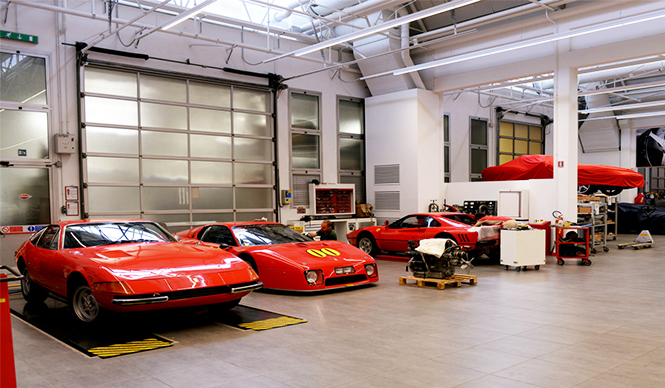
Ferrari Classiche, Ferrari's historic car service, was established in 2006. The moment the door opened, we were enveloped in the distinct aroma of old cars, a scent that was even more pronounced after the new car factory tour. According to Marco Allegri, Commercial & Marketing Director of the department, their current operations encompass three main areas.
Issuance of Original Certification
Restoration
Production of parts for historic Ferraris
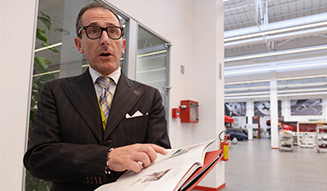
Marco Allegri, Commercial & Marketing Director at Ferrari Classiche, Ferrari's historic car service department.
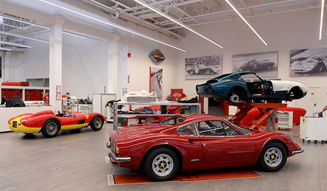
During our visit, restorations were underway on models such as the "Dino 246 GT" (front), unveiled in 1969, and the "275 GTB" (middle), which debuted in 1966.
The Original Certification confirms that a historic vehicle was indeed manufactured by Ferrari. Allegri explains that chassis inspection typically requires the car to be brought in physically. However, for models from specific eras like the "F40," "Daytona," or "Dino," certification is possible with just photographs of designated areas, usually taking about three months. Owners in Japan and the U.S. can also apply through their respective Ferrari official networks.
A vast archive of historical production data is also housed within the department for reference. To date, they have undertaken restoration work on 85 historic Ferraris since the department's inception. They also provide maintenance for enthusiasts participating in races and rallies with their historic Ferraris. The spring, leading up to the Mille Miglia, is particularly busy. "Some clients even bring their cars all the way from New Zealand to Maranello for service," Allegri shared.
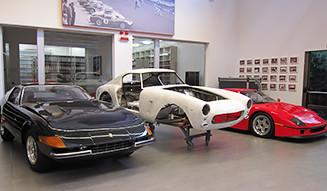
Lined up in the foreground are "365 GTB/4 Daytonas." Early models featured fixed headlamps, but this is a later model adapted to U.S. regulations with retractable headlamps.
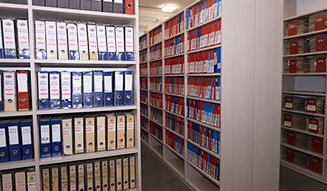
The extensive archive of historical production data within the Classiche factory. Records for every car manufactured by Ferrari are kept here.
Allegri himself joined the company in 1978. An expert's expert, he recalls, "My first job was on the 308 GTB." However, he notes that not all staff members are seasoned veterans like himself. They also employ younger technicians to ensure the transmission of skills.
It's fascinating to see the restoration techniques being passed down, much like a medieval master craftsman and his apprentice, while the modern quality control systems, as detailed in our previous report on the new car factory, are also in place.
Ferrari
Pilgrimage to Maranello, the Holy Land of Ferrari Vol. 2
Passing Down Skills, Sharing Passion (Part 2)
Corse Clienti: Supporting Historic F1 Cars
Our next visit was to the department known as "Corse Clienti," located near the Fiorano test track, a name familiar to any Ferrari enthusiast. Their primary responsibilities are as follows:
Support for private racing teams
Organizing events such as Ferrari Racing Days
Sales and maintenance of historic F1 cars (machines at least two years since their debut)
Federica Santoro, in charge of marketing, proudly stated, "We provide comprehensive support for private teams, from technical assistance and guidance on team management to hotel arrangements." Former Ferrari F1 pilots, including Marc Gené, also contribute to the operations.
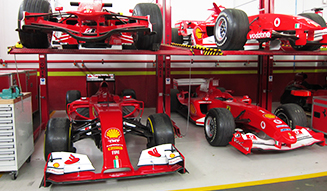
At Corse Clienti, F1 cars are stored in a multi-story car park – a sight that initially made me question my own eyes.
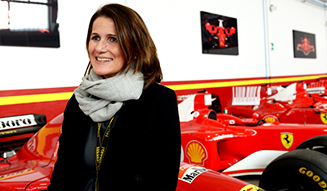
Federica Santoro, Marketing Manager
We then spoke with Giacomo De Bia, Technical Director of the sports department. He joined the company in 1989 and served as the electrical engineer for F1 from 1991 until 2003, the year Ferrari won the Constructors' Championship. "My last circuit was Suzuka," he recalled fondly, before moving to Corse Clienti.
Corse Clienti also supports discerning private clients who purchase historic Ferrari F1 cars. De Bia described the challenges of instructing them: "F1 cars have 800 horsepower engines in a chassis weighing just 600 kg. One wrong move, and they can spin away as easily as a bar of soap." As fans know, the acceleration forces during starts and cornering are immense.
Nevertheless, after several days of training at Fiorano, clients can achieve a certain level of control. I was once again convinced that enthusiasts with the means to acquire an F1 car also possess a bold spirit of challenge and physical stamina.
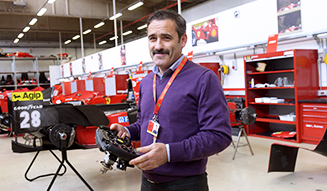
Giacomo De Bia, Technical Director of the Sports Department
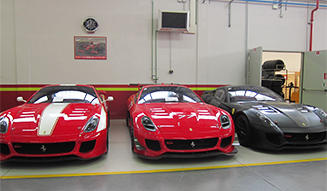
In addition to F1 cars, the Corse Clienti facility also housed special models for private owners, such as the "599XX EVO."
Behind his desk, De Bia showed us a securely locked case containing several F1 steering wheels. "F1 steering wheels can be easily detached by releasing a lock. To prevent theft at circuits or events, most clients entrust us with the original steering wheels used by F1 pilots in races."
It's like a "steering wheel keep," akin to bottle keep at a bar. Finally, when asked about the joy of his work, De Bia replied, "Sharing passion with clients." His mustachioed face beamed.