Journey to Maranello, the Holy Land of Ferrari Vol. 1 | Ferrari
Ferrari
Pilgrimage to Maranello, the Holy Land of Ferrari Vol.1
The Ferrari Factory Where 'Romeo and Juliet' Work
Founded in 1947 by Enzo Ferrari, the company is one of the world's leading automakers. With its 'Prancing Horse' emblem, Ferrari has produced countless masterpieces and etched its history with numerous legends. Why has Ferrari captivated people across all eras? OPENERS takes you inside the Ferrari headquarters in Maranello, Italy, to reveal its full story over six installments.
Text by Akio Lorenzo OYAPhotographs by Fabrizio Gremo
Through the Same Main Gate as Enzo
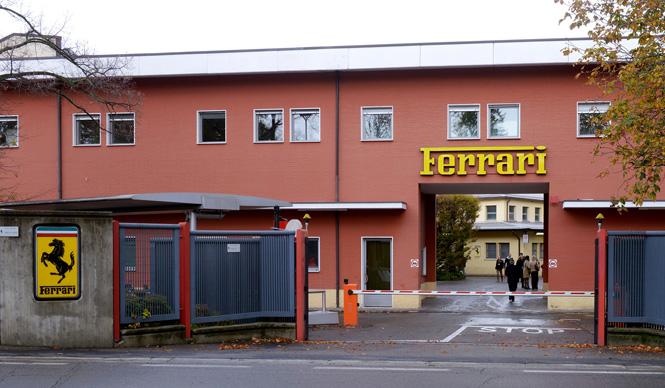
About 22 kilometers south of Modena, every time I visit the Ferrari Maranello headquarters factory, I'm struck by how it resembles an Italian historic old town. Many historic towns feature buildings from various eras like the Renaissance and Baroque, all enclosed by even older medieval walls.
Ferrari S.p.A. is no different. It boasts a variety of buildings, including modern factory and research facilities constructed since 1997, where approximately 3,000 employees work.
Yet, the main gate, the face of the company, welcomes visitors today just as it did in the era of founder Enzo and legendary engineer Gioachino Colombo.
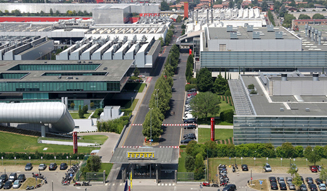
Ferrari's headquarters are located in Maranello, in the province of Modena, Italy. This is a panoramic view of the headquarters from the factory's main gate.
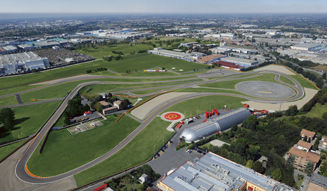
Adjacent to the headquarters is Ferrari's test track, the Fiorano Circuit.
Incidentally, Ferrari was named the 'World's Most Powerful Brand' for two consecutive years, 2012 and 2013, by the British firm Brand Finance. It's quite remarkable that despite such global recognition, they maintain their traditional gate.
This time, we invite you, our readers, to experience a part of the factory tour.
For reference, factory tours at Ferrari headquarters are generally limited to customers who have purchased a vehicle through an official dealer in their respective countries, or to corporate sponsors of motorsports and other events.
Ferrari
Pilgrimage to Maranello, the Holy Land of Ferrari Vol.1
The Ferrari Factory Where 'Romeo and Juliet' Work (Part 2)
Assembling Engines While Overlooking a 'Museum'
First, we visit the engine assembly building. Inside the meticulously organized factory, not only Ferrari's V8 and V12 engines but also Maserati's V6 engines are assembled. Furthermore, the casting of the engine blocks, the preceding step, is carried out within Ferrari's own factory on-site, the only one of its kind among Italian automotive plants.
Automation has been progressively implemented in various processes within the factory for the past 15 years. In the process of assembling valve seats and fitting them to the cylinder head using liquid nitrogen, two industrial robots work in perfect coordination.
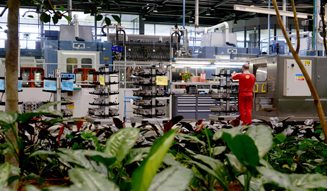
Real plants are grown throughout the factory, creating an atmosphere far from the image of a noisy, sterile facility.
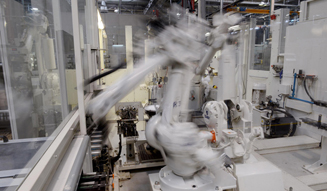
Two industrial robots lined up in the engine assembly building. Their affectionate nicknames are 'Romeo and Juliet'.
Here in the factory, these two workmates are affectionately called 'Romeo and Juliet.' While it's not uncommon for industrial robots to have nicknames, this one is particularly charming, isn't it?
A program akin to Japan's QC (Quality Control) circles is also in practice. However, even here, Ferrari's unique sense shines through. It's named 'Pole Position,' and each team is assigned a name of a legendary Ferrari driver, such as 'Schumacher' or 'Barrichello.' For the Italian employees, many of whom are F1 fans, this undoubtedly boosts their motivation.
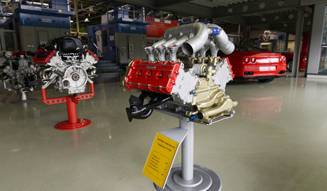
In a corner of the engine assembly building, a display of historical V8 and V12 engines is arranged to foster pride and a sense of responsibility among employees.
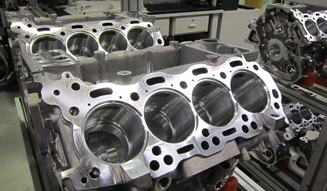
Numerous V8 engine blocks await assembly.
In one corner, despite being an engine assembly plant, actual Ferrari cars and engines from various eras are displayed as if in a museum. This is based on the policy: 'So that factory employees can always feel a sense of responsibility and pride by viewing the final products.'
Ferrari
Pilgrimage to Maranello, the Holy Land of Ferrari Vol.1
The Ferrari Factory Where 'Romeo and Juliet' Work (Part 3)
Resembling a 'Theater'
Next, we tour the assembly line. Bodies crafted at the affiliated carrozzeria 'Scaglietti' in Modena are transported to Maranello, where they undergo painting within the factory.
Assembly of V8 models takes place on the first floor, and V12 models on the third. Manual labor is still integral. A prime example is the interior production process, a part of the V12 assembly line, where 75% of the work is done by hand. Furthermore, 40% of the staff working there are women, based on the understanding that 'many women excel at delicate tasks.'
With countless threads, bundles of textile leather, and sewing machines, if it weren't for the staff in their Maranello Red uniforms, one might mistake it for a sartoria (tailor's shop).
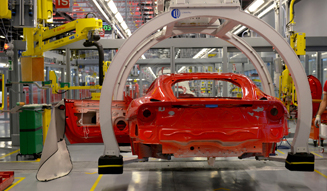
Bodies, having completed painting in a separate building, are brought over. They are lifted by hoists as assembly work progresses.
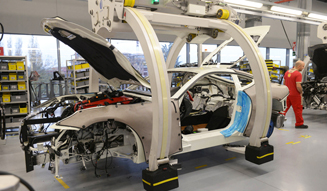
V12 model assembly line.
The temperature and humidity are maintained at optimal levels for the factory employees. The presence of real plants in various locations also contributes to a botanical garden-like atmosphere, a distinctive feature of Maranello. Another notable aspect is the quietness; the only sound audible on the assembly line is the gentle hum of motors. According to the public relations representative, the factory is designed to keep noise levels below 75 decibels.
You won't hear the melodies of alarm sounds from transport vehicles, common in factories. Unlike Japan, where unnecessary background music blares from speakers day and night in streets and stores, Italy is a place where only the occasional church bells ring. This reflects a respect for sound and a tranquil environment.
In Italy, when job openings for 'Ferrari factory employees' are advertised, applications flood in. While many are driven by the hope of potentially working for Ferrari, it's also true that some applicants are aware of this exceptional working environment.
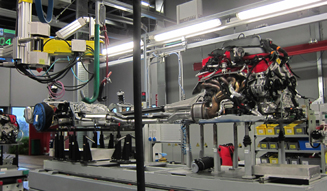
In Italian terms, the powertrain awaits its 'matrimonio' (marriage) with the body.
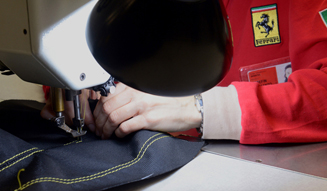
Sewing of interior textile materials takes place right next to the assembly line.
A Scene Unlike Typical Automotive Factories
A relatively new female PR staff member confided in me, 'When I first saw this factory, I thought it was fake.' She assumed it was an attraction built separately from the 'real' factory.
Thus, beautiful Ferraris are crafted in this beautiful, theater-like factory.
To be continued in 'Pilgrimage to Maranello, the Holy Land of Ferrari Vol.2'