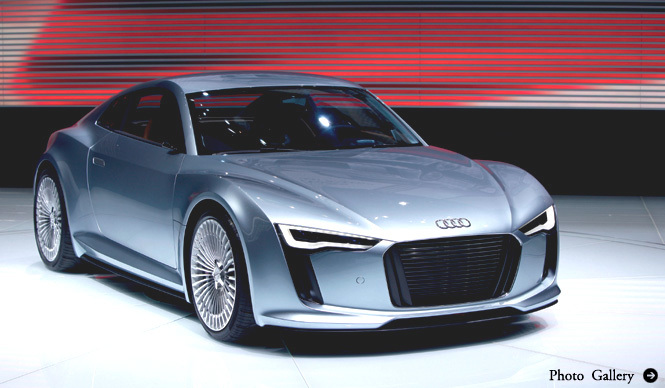
Audi e-tron | The Second Generation EV Sport, Made Smaller
AUDI e-Tron
The Second-Generation EV Sports Car, Now Smaller
Audi unveiled the evolved version of its EV concept sports car, the "e-tron," for the first time at the Detroit Motor Show.
By Giraffe
Slightly Smaller Than the TT
The e-tron, announced at last September's Frankfurt Motor Show, was an EV sports car developed based on the "R8." However, this evolved version has appeared with a more compact size than the previous iteration.
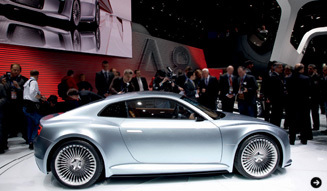
Its dimensions are 3930mm in length, 1780mm in width, and 1220mm in height, with a wheelbase of 2430mm. The wheelbase is 220mm shorter than the "R8," indicating that the overall size is slightly smaller than the "TT."
Furthermore, the previous model, based on the "R8," was equipped with a total of four motors, two on each axle, delivering a maximum output of 313 ps and a peak torque of 459 kgm. It achieved 0-100 km/h in 4.8 seconds and a top speed of 200 km/h (electronically limited). This evolved version, however, features more modest specifications.
Planned for Production by 2012
Upon closer inspection, the number of motors has been halved to two on the rear axle, with maximum output reduced to 204 ps and peak torque to 270 kgm. Additionally, the drivetrain has been changed from full-time 4WD "quattro" to rear-wheel drive, incorporating new "torque vectoring" for differential torque distribution between the left and right rear wheels.
However, this change has also reduced the vehicle's weight by 250kg to 1350kg compared to the previous model. Consequently, it achieves 0-100 km/h in 5.9 seconds and a top speed of 200 km/h (electronically limited).
The maximum cruising range, a key concern for EVs, remains 250km, thanks to the adoption of a 45kWh lithium-ion battery. Charging can be completed in approximately 11 hours using a standard 16A, 230V household outlet, or in about 2 hours with a rapid charger.
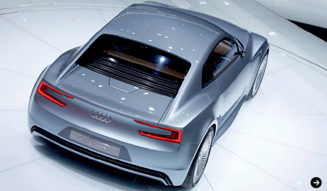
Audi plans to bring this EV sports car, with its distinct body, to market by the end of 2012.
BRAND HISTORY
Audi's emblem is the "Four Rings." As you may know, each ring represents one of the automotive manufacturers: Audi, DKW, Horch, and Wanderer. All were based in Saxony and were pioneers of the German automotive industry in the early 20th century. However, the four companies, hit hard by the global depression following World War I, formed Auto Union in 1932 to survive. DKW focused on motorcycles and small cars, Wanderer on mid-size cars, Audi on premium mid-size cars, and Horch on luxury vehicles.
However, after World War II, Saxony in East Germany fell under Soviet occupation, and Auto Union dissolved. Anticipating this, the new Auto Union was established in Ingolstadt, Bavaria, in West Germany. Unlike BMW and Mercedes-Benz, Auto Union faced a challenging start without existing factories, but gradually gained strength through the production of vehicles like the DKW delivery van.
In late 1964, Auto Union came under the umbrella of Volkswagen and soon introduced new models bearing the Audi name. In 1969, it merged with NSU, based in Neckarsulm (known for its development of the Wankel engine), becoming Audi NSU Auto Union. From 1985 onwards, it has continued as Audi. Technology such as quattro, dynamic performance backed by motorsport activities, elegant design, and high-quality finishes are driving Audi's popularity.