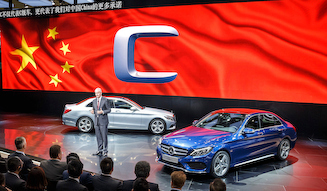
Beijing Motor Show Live Report (1) | Auto China 2014
Beijing Motor Show 2014: On-Site Report (1)
No Longer a "Copycat Paradise"
China's automotive market has grown to become the second largest in the world, trailing only North America, and is now a market that demands attention from every brand. The Auto China 2014, the country's largest auto show, was held in this crucial market. Akio Lorenzo Oya, an automotive journalist based in Italy who previously worked for a Japanese car magazine, visited the show. What did he see and feel, with his unique perspective from both Europe and Japan?—.
Read the second part here
Text and Event Photographs by Akio Lorenzo OYA
Changes Brought by the "One-Child Policy"
Under the theme "Cars Contribute to a Better Future," the Beijing International Automotive Exhibition was held from April 20-29, 2014.The Beijing Showisthe Shanghai Showand is held in alternate years. This year marked the 13th iteration, making it the largest automotive exhibition in China.The Tokyo Motor Show 2014was held across a venue of approximately 230,000 square meters, about six times the size of the Tokyo show. It featured 1,134 vehicles on display, including 118 world premieres and 71 concept cars.
One of the key topics this year was the focus on environmental measures, such as hybrid and electric vehicles. This initiative is undoubtedly driven by the air pollution issues prevalent in various parts of China.
In Europe, for instance, environmentally friendly vehicles are likely to be exempt from urban traffic restrictions, such as those based on odd or even license plate numbers. On April 19th, the day before the press preview, newspapers reported that the Chinese government was considering purchase subsidies. Amidst this context, a wider array of environmentally conscious vehicles were presented by European and domestic manufacturers than at the 2013 Shanghai Show.
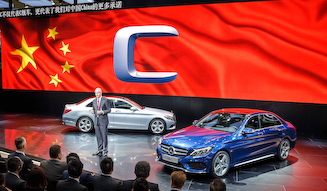
Mercedes-Benz C-Class L
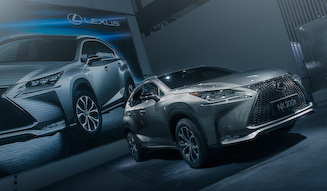
Lexus NX
Another significant trend was the surge of new SUVs and crossover models and concepts. Historically, China's market favored long-wheelbase (LWB) vehicles, prioritizing rear-seat comfort. German manufacturers, in particular, had been producing LWB versions specifically for the Chinese market through joint ventures.
This trend continues, with Mercedes-Benz unveiling an LWB version of the "E-Class"—minorly updated at last year's Shanghai show—and this year in Beijing, debuting a long-wheelbase variant based on the "C-Class" which was first shown in Detroit in January.
To establish a new trend beyond LWB sedans, manufacturers are now focusing heavily on SUVs and crossovers.
Mr. Hiroshi Ueda, Vice President of LEXUS China, explained to this reporter that the core demographic is "individuals in their early to late thirties, born under the one-child policy." He analyzed, "They have a greater sense of financial freedom and are no longer satisfied with conventional sedans." Furthermore, he noted, "Three-row seating is particularly important for accommodating and sometimes caring for parents and grandparents." This suggests that China's unique family dynamics and lifestyle are expected to fuel this burgeoning trend.
Beijing Motor Show 2014: On-Site Report (1)
No Longer a "Copycat Paradise" (2)
Refining Design
The quality of vehicles produced by Chinese manufacturers is steadily improving.
Six to seven years ago, the interiors of Chinese cars exhibited at European motor shows were far from international standards. Switchgear felt stiff, and the interiors carried a scent reminiscent of cheap toys. Today, the quality and finish of their interiors have improved remarkably. The pace of this progress surpasses that of Korean cars in their earlier development phase. If placed inside blindfolded, most people would likely not realize it was a Chinese car.
Equally astonishing is the advancement in exterior design. In the past, Chinese auto shows were often dominated by models that blatantly copied the designs of Japanese and European cars, leading to lawsuits over design rights involving companies like Fiat, BMW, and Chevrolet.
In contrast, many concept cars unveiled by Chinese manufacturers at this year's Beijing show demonstrated a greater degree of originality compared to those at last year's Shanghai show.
This progress is partly due to the active recruitment of foreign design directors. Chery, which previously faced issues for producing the "QQ," a car strikingly similar to the Fiat-GM joint venture's Chevrolet Matiz, has now appointed James Hope, a former Opel designer, as its head of design. At this year's Beijing show, they displayed a stylish sedan and a sharp-looking crossover.
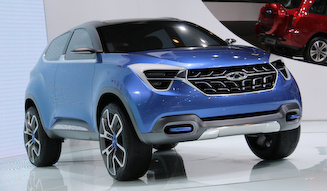
Chery Concept Beta
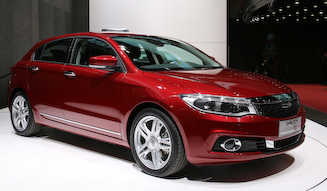
Qoros 3 hatchback
The same can be said for Qoros, a premium brand from Shanghai backed by Chery. They have appointed Gert V. Hildebrand, the designer who led the first generation of the BMW "MINI," as their Executive Director of Design. Design development is managed through a tripartite system involving Munich, Shanghai, and Graz, Austria.
Qoros has chosen Geneva as its debut venue since 2013. Their staff explains their strategy: "Gaining recognition in Europe will help us appeal to premium customers in China." At this year's Beijing show, they exhibited the five-door hatchback version that was unveiled in Geneva in March.
While the presence of foreign designers is not explicitly stated, BAIC's (Beijing Automotive Industry Holding Co., Ltd.) "BJ100 Concept" is also a remarkable creation. It presents a muscular, full-size SUV with an urban, modern flair. Although the front grille shows influences from Jeep and Hummer, the overall design exhibits a high degree of originality.
BAIC, having previously produced Jeeps under license from American Motors Corporation, has the longest history among Chinese manufacturers in the off-road vehicle segment. In this regard, they possess substantial historical backing. Even more surprisingly, this model is slated for production in 2017. It remains to be seen how much of the concept car's appeal will be retained in the production version.
The vehicles displayed exude a power that commands them to no longer be called a "copycat paradise." The day may soon come when Chinese cars, alongside works from renowned Italian coachbuilders, are entered in the concept car categories at prestigious European concours d'elegance. This was the feeling I took away from this year's Beijing show.