BMW's First EV - The Making of the BMW i3 | BMW
BMW i3 | BMW i3
BMW's First EV
The Making of the BMW i3
BMWThe first mass-produced electric vehicle from BMW, the "BMW i3," is finally nearing its release. Why is BMW building this car, and how? A report from BMW's i factory in Leipzig by Toshifumi Watanabe.
Text by WATANABE Toshifumi
On the Theory of Other Industries Building Cars in the EV Era
Many of you have likely heard the argument that as we enter the EV era, the number of parts will drastically decrease, eliminating the need for existing heavy, large-scale production technology, thereby making it easier for companies from other industries to enter the automotive business.
If this refers to the comprehensive work of development and production for finished vehicles, then this argument is entirely off the mark.
The enormous social risks borne by this industry, coupled with its low profit margins... even a simple calculation reveals how inefficient an investment it is. Unless there is a tremendous demand in the local market, it is unnatural to consider betting on such an industry now, which requires immense effort for little return. Most people on the ground likely feel the same way.
On the other hand, there is no doubt that the era since the 21st century has been changing at an unprecedented pace. It is also true that automobile manufacturers are reaching the limits of maintaining their purity, both financially and in terms of development, to adapt to these changes.
The automotive business, which, due to the number of people involved and the scale of money moving, might appear to outsiders as vested interests, is beginning to explore a direction of aiming for synergistic development through collaboration with other industries.
In other words, the current situation is that car manufacturers themselves are actively seeking contact with unfamiliar worlds as business partners.
How can the self-identity and responsibility that their products should embody be reconciled with the flexibility that is now required? I believe that BMW's "i" project offers the most realistic and dynamic insight into this question today.
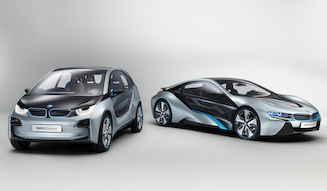
BMW i3 & BMW i8
BMW i3 | BMW i3
BMW's First EV
The Making of the BMW i3 (2)
M and i
BMWWhile "M" offers products that pursue sportiness under BMW's direct control, "i" aims to provide products that pursue sustainability in a similar position.
For the two seemingly opposite entities to be connected under the BMW umbrella, the prerequisite is that they must fulfill the company motto of "Sheer Driving Pleasure." In simpler terms, what brings pleasure to the "i," which anticipates the widespread adoption of electric powertrains?
The full-scale rollout of the "i" brand will likely begin with the "BMW i3," which will premiere at this year's Frankfurt Motor Show. In a technical workshop held prior to this, various answers were prepared in different forms.
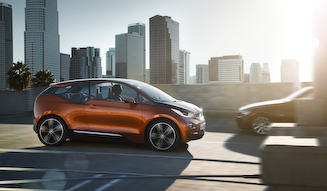
BMW i3 Concept Coupe
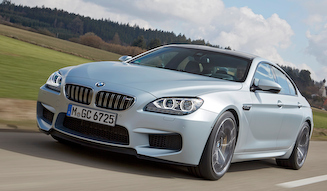
BMW M6 Gran Coupe
A Car Born from the Wind
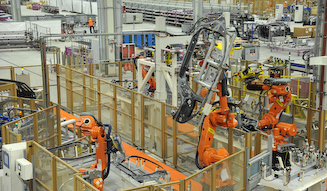
The venue was the Leipzig plant. Equipped with the latest facilities built after German reunification, BMW's large plant is rapidly preparing for the full-scale production of the i3.
The large wind turbines installed on the premises will eventually number four in total and are expected to become a symbolic presence visible from the Autobahn. Of course, for the i3, they are not just landmarks but also function as a part of its philosophy.
The production process for the i3, developed as BMW's first purpose-built EV, includes plans for remarkable energy reduction to further enhance its environmental performance.
It is astonishing that the four symbolic wind turbines are expected to cover 100% of the electricity required for i3 production under ideal conditions.
While there is, of course, a buffer of the conventional power supply network behind this, there has never been an automotive manufacturing line that relies so boldly on renewable energy.
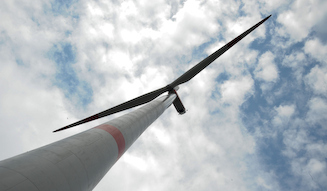
BMW i3 | BMW i3
BMW's First EV
The Making of the BMW i3 (3)
A Different Approach to Car Manufacturing
Naturally, this is also a result of the contribution from the vehicles being manufactured.
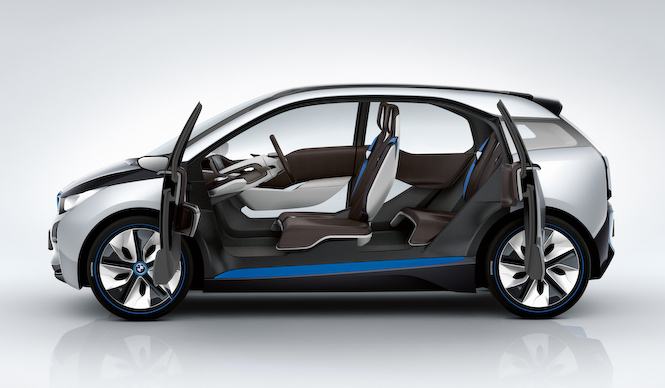
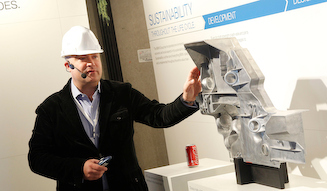
BMWThe i3 is constructed with a design philosophy that clearly separates the chassis and body into "drive module" and "life module" respectively, with the former composed almost entirely of aluminum and the latter of carbon.
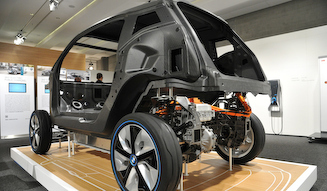
The upper part is the life module, the lower part is the drive module.
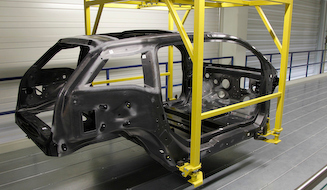
CFRP Life Module
This means that from the material stage, the engineering is designed to incorporate CO2 reduction with a completely different approach than conventional cars.
For example, in the case of the i3, 50% of the aluminum used in the drive module is made from recycled materials such as aluminum cans.
Aluminum requires a large amount of electricity for purification from bauxite, but it offers the advantage of achieving lightweight and high rigidity for automobiles. By increasing the recycling rate, the CO2 emissions from the initial electricity consumption can be significantly reduced.
A key feature of sustainability, which is BMW's primary theme for the "i" brand, is that it is not limited to the environmental performance of the product itself but is assessed holistically based on life cycle assessment.
BMW i3 | BMW i3
BMW's First EV
The Making of the BMW i3 (4)
Carbon That Travels Halfway Around the World
Furthermore, the upper structure, called the "life module," is constructed as a monocoque using carbon material, which has eliminated the need for conventional processes in the production plant.
The body panels are made of polypropylene with directly colored outer panels, reducing water usage in the painting process to almost zero. Additionally, the carbon body, achieved through unique hot molding to attain rigidity and weight comparable to dry carbon while dramatically increasing productivity, eliminates the energy-intensive welding process.
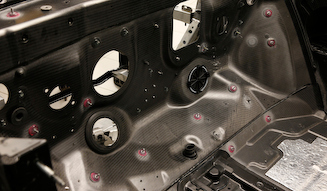
The life module is bonded, so welding is not required. It is connected to the aluminum drive module with bolts.
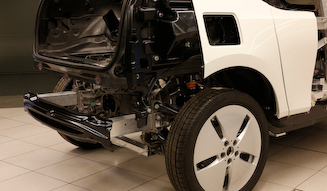
The body panels are made of colored lightweight plastic, eliminating the need for rust prevention and painting.
For the i3, being an EV, lightness is an especially crucial point for extending its range.
BMW has long focused on carbon, considered the leading next-generation material for automobiles,BMWand has accumulated know-how in production and quality by using it in the roof panels of some models.
The carbon body production process for the i3, which fully utilizes this expertise, is shaped through a journey that spans more than halfway around the globe.
The carbon fiber yarn supplied by Mitsubishi Rayon of Japan to BMW first travels to the United States.
In Moses Lake, Washington, there is a factory owned by a joint venture established by SGL, a German company specializing in carbon molding, and BMW.
There, the raw yarn is sintered and processed into fibers. These fibers cross the Atlantic and land in Germany. They are then transported to BMW's Landshut plant, where they are molded into panels before being delivered to the Leipzig plant for assembly.
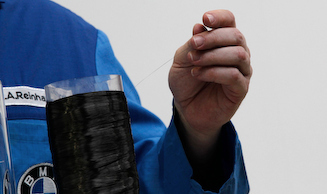
The reason for this complex mileage traces back to the Landshut plant, which is a hub for BMW's casting technology and has staff and facilities with expertise in molding, making it the core of BMW's carbon processing.
And the fiber processing in the United States has the advantage of being able to cover the vast amount of electricity required for carbon sintering 100% through hydropower from the lake.
Furthermore, the lightness of the material offers the benefit of reduced CO2 emissions associated with transportation. The advanced nature of carbon materials in automotive applications may lie in the fact that even across such long distances, the benefits of hydropower can be fully realized.
BMW i3 | BMW i3
BMW's First EV
The Making of the BMW i3 (5)
The Paradigm Shift Caused by the BMW i3
BMW, whose very name means "Bayerische Motoren Werke" (Bavarian Motor Works), is, needless to say, a manufacturer that has earned global acclaim for the power, efficiency, and sensory appeal of its internal combustion engines.
Looking at the details of the i3, which features an electric motor, it is evident that the company's internal technological development is deeply involved.
On the other hand, it is also clear that for areas such as low-voltage electronics and materials, which are far removed from traditional automotive manufacturers, they have unhesitatingly engaged in technological exchange with external industries.
In any case, it is impossible to move forward without formulating strategies based on completely different concepts than before and inviting knowledge from the right doors. The true difficulty of EVs is likely understood better by automobile manufacturers, who have struggled with them for so long, than by irresponsible outsiders.
The quietness and coolness are unlike anything one would expect in a car factory. The scent that hangs in the air is very similar to that of opening a new computer box.
Standing on the production line at the Leipzig plant, where prototypes are steadily being produced for full-scale manufacturing, one can truly feel the paradigm shift occurring in automotive production.
The BMW i3, containing various implications, is scheduled for announcement this September at the Frankfurt Motor Show.