LA Auto Show Playback: Part 2 | L.A. Auto Show
L.A. Auto Show 2018 | Los Angeles Auto Show 2018
LA Auto Show Playback: Part 2
Mainstreamers, Including Japanese Cars
Increasingly Premium-Oriented
A wrap-up by Kazuhiro Nanyo, who visited the 2018 Los Angeles Auto Show held at the end of 2018. In the latter half, we focus on compact mainstreamers, particularly Japanese cars.
Text & Photographs by Kazuhiro Nanyo
The Stars of the "Mainstream"—
In the automotive industry, where brands increasingly position themselves as premium or semi-premium, the term "mainstream" is often used to describe models that form the core volume within the basic car segment, chosen not for economic reasons but for their fundamental utility. This typically refers to the mass-market models from comprehensive automakers, excluding manufacturers like the "big three" German brands, Range Rover, or Jaguar, which do not prioritize sales volume.
Incidentally,Volkswagen GolfandPeugeot 308are two best-sellers in the European C-segment, but they are arguably transitioning from mainstream to premium.
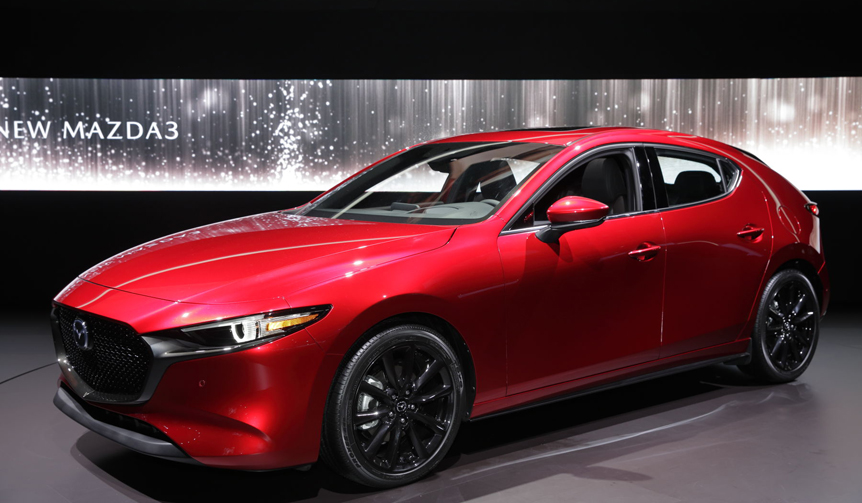
At this year's LA Auto Show, the Mazda 3, the fourth generation of the "Axela," was a standout, boldly declaring its shift towards premium with an ambitious full model change. While currently considered a mainstreamer, its hatchback version, in particular, captured attention with a design that faithfully translated the "Kai" concept unveiled at the 2017 Tokyo Motor Show into a production model.the "Kai" conceptinto a production model.
Mazda 3
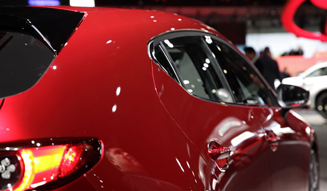
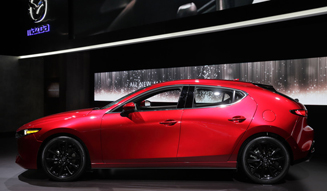
Its most striking feature is undoubtedly the smooth side view, devoid of character lines, a stark contrast to German cars that favor sharp creases. Upon closer inspection, however, a subtle, sword-like curve flows from the headlights to the C-pillar, appearing to float above the gently tapered body. The interplay of surfaces from the thick C-pillar to the rear fender, and the precise fit of the rear doors, showcase a delicate craftsmanship characteristic of Japanese manufacturing.
Overseas reactions have been interestingly divided. While some praise it as "Mazda has achieved what the current Alfa Romeo cannot" or "a hatchback revolution akin to Range Rover's with the Evoque," others express dissatisfaction, finding the side body "too plain and uninspired."
Mazda 3
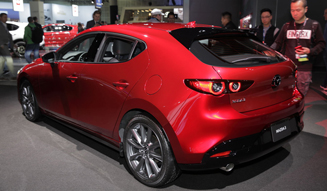
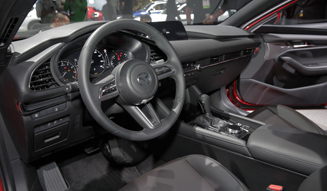
Looking at the interior, the dashboard's shape, with its somewhat awkwardly scooped-out sections around the meter panel and display, has generally not been well-received. However, such criticism also indicates the car's ability to attract attention, suggesting its design has been recognized as noteworthy.
With a length of 4,459mm for the 5-door hatchback and 4,662mm for the 4-door sedan, the dimensions might seem substantial, but this translates into a near-cubic cargo space for the hatchback. The "Skyactiv-X" powertrain, which achieves compression ignition in a gasoline engine, appears to be combined with a mild hybrid system. While the new platform, sharing the "Skyactiv-X Vehicle Architecture" name, was less prominent, an AWD system with G-Vectoring Control is also available. The latest generation of the Mazda 3, which earned global acclaim in its previous iteration, is set to appear at the Tokyo Auto Salon and in Geneva before rolling out worldwide throughout 2019.
L.A. Auto Show 2018 | Los Angeles Auto Show 2018
LA Auto Show Playback: Part 2
Mainstreamers, Including Japanese Cars
Increasingly Premium-Oriented (2)
Asian Automakers Focus on Design with Electrification as a Given
Meanwhile, among the Japanese manufacturers, the faceliftedToyota Priusreceived generally positive reviews. While its design, now closer to the PHV version, is somewhat more subdued, this is not necessarily a negative when considering its relative improvement from the initial phase. The technical decision to use a nickel-hydrogen battery for the AWD version, challenging the trend towards lithium-ion batteries, was particularly praised. Another highlight at the Toyota booth was the "Camry TRD." Retaining the 305ps 3.5-liter V6 engine, it features a body lowered by 1.5cm, a more rigid suspension, and upgraded brakes with 328mm front discs.
Honda, which has a unique presence in the American market, revived the "Passport" name for a full-fledged SUV positioned between the "CR-V" and "Pilot."PassportThis name was previously used in the early 1990s for Honda's first SUV model in North America, a sibling to the Isuzu Rodeo. While the Pilot is a 7-seater, the Passport is a 5-seater with a more off-road-oriented stance than the CR-V, competing with models like the Jeep Cherokee.
In a more compact class, South Korea's Kia has fully redesigned its third-generation "Soul," a hit in the North American market. With its elongated nose and a nearly vertical rear hatch, this generation places a particular emphasis on its electric vehicle variants.
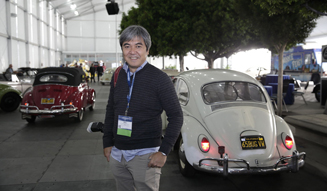
Shinsuke Watanabe, editor-in-chief of the American magazine "hot VWs"
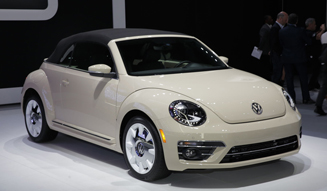
Volkswagen The Beetle Cabriolet
California, uniquely among American states, has historically been receptive to imported compact cars, from Hondas of yesteryear to Volkswagens. In fact, on the opening day of the LA Auto Show, a gathering of classic Volkswagens, including the "Type I," created a distinctly LA scene near the main gate. This was the "Beetles Breakfast" meeting, organized by the American magazine "hot VWs," where owners gathered at the invitation of editor-in-chief Shinsuke Watanabe.
Although Volkswagen's image in America suffered greatly due to the diesel emissions scandal, the connection between the brand and California remains strong. Inside the auto show, Volkswagen even displayed a final edition of the "New Beetle Cabriolet" as a tribute to California. Whether the Volkswagen Group can overcome the stigma of scandal hinges on its success in California and its ability to lead the trend towards electrification and EVs.