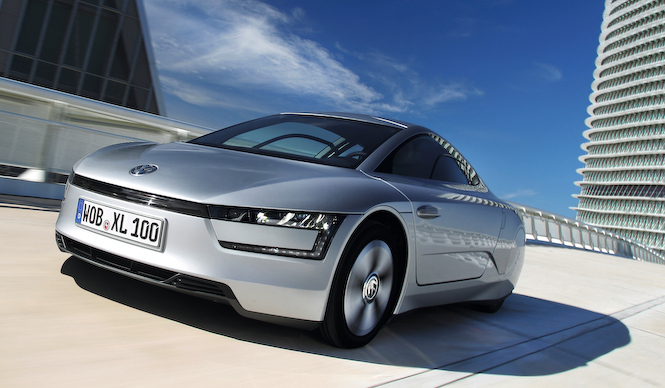
Volkswagen Unveils the XL1: 100 Kilometers Per Liter | Volkswagen
Volkswagen XL1 | Volkswagen XL1
Volkswagen's Production Model Achieves Over 100km Per Liter
Volkswagen AG has finally unveiled the production model of the "XL1," an ultra-fuel-efficient car that has been under development as the car of the 21st century.
Text by HORIGUCHI Yoshihiro (OPENERS)
The Car of the 21st Century
At the dawn of the 21st century, Ferdinand Piëch, then Chairman of Volkswagen, set forth a vision to commercialize a "liter car" – a two-seater with everyday utility that could travel 100 km on less than one liter of fuel.
To realize this, the first concept car, utilizing the latest materials and aerodynamic design of the time, appeared as early as 2002. It became a topic of conversation when Chairman Piëch himself drove it over 200 km on public roads for testing. While this evolved into the "L1" with more advanced technology in 2007, due to aerodynamic considerations, it was a tandem seating arrangement (front and back) and a car whose daily usability was questionable.
And this year, 2013, the "XL1" has arrived. Although it was already unveiled at last year's Qatar Motor Show, this time it was announced as a production model.
The announced fuel consumption is 0.9 L/100 km. In Japanese notation, this translates to 111 km/L. CO2 emissions are kept to 21 g/km.
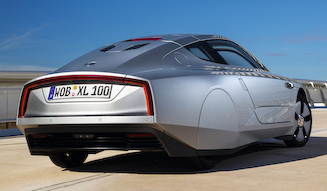
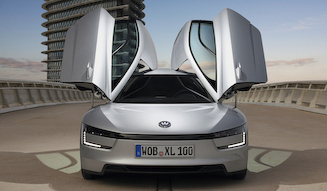
The compact body measures 3,888 mm in length, 1,665 mm in width, and 1,153 mm in height. This is shorter than the Polo (3,970 mm) and lower than the Boxster (1,282 mm). It seats two occupants, with the seats slightly offset front-to-back to maximize space, a technique also used in the Smart and Toyota iQ. The luggage compartment offers 120 liters of space.
The vehicle weighs a mere 795 kg. Of this, the carbon monocoque body alone accounts for just 230 kg. Other major weight components include the battery and engine at 227 kg, gears at 153 kg, and electrical equipment at 105 kg.
The powertrain is a hybrid system combining a 0.8-liter inline 2-cylinder turbo diesel engine producing a maximum output of 35 kW (48 ps) and 120 Nm of torque, with an electric motor delivering 20 kW (27 ps) and 140 Nm of torque. The 0.8-liter TDI engine is derived from the 1.6-liter inline 4-cylinder TDI found in models like the Golf. This is paired with a 7-speed dual-clutch transmission (DSG) and positioned on the rear axle, which drives the wheels.
Meanwhile, the front houses a 5.5 kWh lithium-ion battery, making it a plug-in hybrid capable of charging from a standard household outlet.
In boost mode, where the electric motor assists the diesel engine, the system delivers a maximum output of 51 kW and 140 Nm of torque, achieving 0-100 km/h in 12.7 seconds. The top speed is electronically limited to 160 km/h. Naturally, it also features an EV mode operating solely on the electric motor, offering a range of 50 km on a full charge. At a constant speed of 100 km/h, only 6.5 kW (8.4 ps) is required, and in electric mode, it consumes just 0.1 kWh per kilometer.
This means it's designed for a scenario where you charge at home and drive emission-free through the city, then utilize the highly efficient diesel engine in the suburbs.
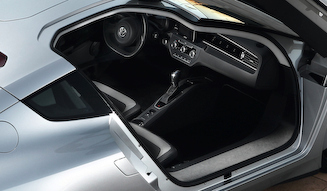
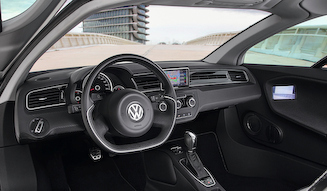
Development of Affordable Carbon Manufacturing Technology
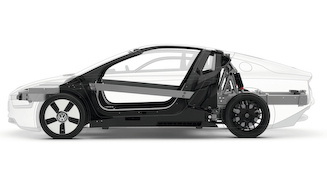
To achieve its lightweight design, the XL1 extensively uses carbon fiber reinforced plastic (CFRP) for its interior and exterior materials, including the body shell. This accounts for 22.5% of the total weight, or 169 kg. Other material compositions include light alloys like aluminum at 22.5%, iron and stainless steel at 23.2%, and the remainder being fibers and plastics, indicating a significant use of lightweight materials.
Looking at individual components, the front double-wishbone and rear semi-trailing arm suspension, dampers, and brake calipers are made of aluminum. The anti-roll bars are CFRP, the wheels are magnesium, and carbon-ceramic brakes are used, demonstrating a thorough commitment to lightweight materials.
The front windshield is a thin, laminated glass measuring 3.2 mm, while the side windows use polycarbonate. The upper half of the side windows are fixed, with only the lower half, divided by a frame, able to open slightly.
The doors are supported by two hinges near the A-pillar and the top of the windshield, opening diagonally forward in a wing-door style.
The CFRP (carbon fiber reinforced plastic) used extensively for weight reduction in the XL1 is produced using a new manufacturing method called RTM (Resin Transfer Moulding). Traditional CFRP involved a complex process of layering carbon and resin materials, then injecting heated resin under vacuum at high temperatures, which required manual labor and made cost reduction difficult. The RTM method involves placing layered carbon fiber into a mold, creating a vacuum within the mold, and then injecting heated resin to permeate the fibers. This process allows for automation, making carbon fiber materials more affordable than before.
The carbon monocoque body shell possesses the robustness to ensure a survival space in the event of an accident, similar to racing machines. Furthermore, the XL1 is equipped with aluminum frames at the front and rear, which significantly absorb impact energy during collisions. For side impacts, aluminum impact beams are integrated within the doors, ensuring safety.
Body Shaped with Aerodynamics as Top Priority
Achieving low fuel consumption is not solely due to weight reduction. Visually, the covered rear wheels are striking, and the body shape, when viewed from above, tapers from front to rear in a streamlined form that Volkswagen describes as a "dolphin body form." To minimize air resistance, door mirrors, which would create protrusions, have been eliminated; instead, cameras mounted on the body sides serve this function. The underside of the car is covered flat for aerodynamics, with diffusers integrated around the rear wheels. As a result, the overall drag coefficient (Cd) achieved is 0.189.
The tires are Michelin eco-tires with high rolling resistance. The front tires are an extremely narrow size of 115/80R15, and the rear drive wheels are size 145/55R16.
The exterior features a front design that follows Volkswagen's current design language, with a horizontal grille flowing into LED headlights. However, in the XL1's case, this is purely aesthetic; actual air intake for cooling occurs from the lower front section. This area is equipped with electric louvers that open and close only as needed to the minimum extent required, ensuring they do not affect aerodynamics.
The XL1 is manufactured at Volkswagen's Osnabrück GmbH facility. This was formerly Karmann's factory, and it currently produces theGolf Cabrioletand the newBoxstermodels. Within this factory, the XL1 is not built on an assembly line but is placed on a frame and assembled individually, almost as if it were handcrafted.
Although this announcement is for a production model, specific details such as delivery dates and pricing, beyond information about the vehicle and production facilities, have not yet been disclosed.

Volkswagen XL1 | Volkswagen XL1
Body Dimensions | Length 3,888 x Width 1,665 x Height 1,153 mm
Wheelbase | 2,224 mm
Trunk Capacity (VDA) | 120 Liters
Weight | 795 kg
Engine | 800 cc Inline 2-cylinder Turbo Diesel
Bore x Stroke | 81 x 80.5 mm
Max. Output | 35 kW (48 ps)
Max. Torque | 120 Nm
Motor Output | 20 kW (27 ps)
Motor Torque | 140 Nm
System Max. Output | 51 kW
System Max. Torque | 140 Nm
Transmission | 7-speed Dual Clutch (7DSG)
Drivetrain | RR
Front Suspension | Double Wishbone with Anti-roll Bar
Rear Suspension | Semi-trailing Link
Tires Front/Rear | 115/80R18 / 145/55R16
Top Speed | 160 km/h (limited)
0-100 km/h Acceleration | 12.7 seconds
Fuel Consumption (NEDC) | 0.9 L/100 km
CO2 Emissions | 21 g/km
Fuel Tank Capacity | 10 L
Battery Capacity | 5.5 kWh