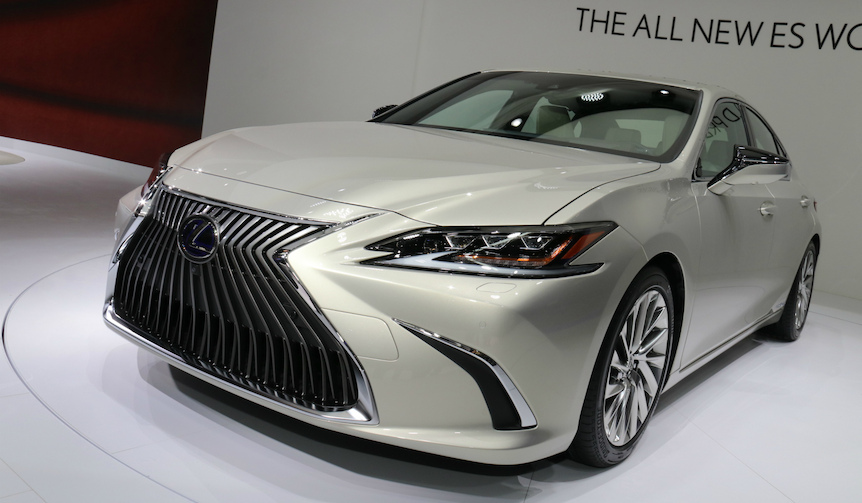
Beijing Motor Show 2018 Report: Production Cars | Auto China 2018
Beijing International Automotive Exhibition 2018 | Auto China 2018
Production Cars
No Visible Boundaries
The Beijing Motor Show, held for ten days from April 25th this year, took place in Beijing, a megacity undergoing rapid transformation. This dynamism was vividly reflected in the show itself. With globalization accelerating at an astonishing pace, the number of concept cars on display was among the highest in recent years. The production cars exhibited were equally sophisticated, appearing almost too refined for the market. It was as if the show's momentum had been distilled into the vehicles themselves.
Photographs by Akio Lorenzo OYA & BMWText by Akio Lorenzo OYA
Cities and Shows in Constant Flux
This report covers the production cars and production-intent concept cars from the Beijing Motor Show, held from April 25th to May 4th, 2018.
Forgive the personal reflection, but my first visit to China was in 2010 to cover the Shanghai Expo. Since then, I have visited China every year. During this time, the urban landscape of its major cities has changed relentlessly.
The streets of Beijing in April 2018, where I visited for the motor show, were no different. While the construction boom of yesteryear had subsided, passengers at subway stations now queued orderly for boarding.
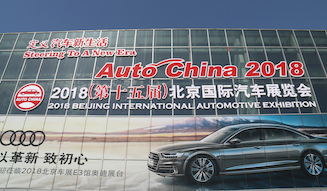
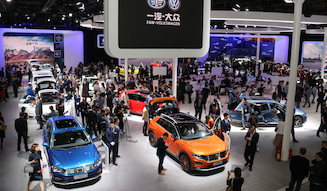
On the roads, the cacophony of car horns had significantly diminished. An overwhelming number of shared bicycles zipped through the streets, more so than in Japan. The fashion sense of men and women on the street had become as sophisticated as that in Tokyo, perhaps even more so, with the exception of hairstyles among young men.
The venue for the 15th Beijing Motor Show had also changed considerably. The large-scale dance performances, reminiscent of human wave tactics, and the giveaway bags resembling giant lucky draws exclusively for Chinese journalists, had become far less prominent.
Conversely, the presentations increasingly featured Chinese executives fluent in English, on par with their foreign counterparts. Some brands even opted for Chinese text solely as subtitles on video screens. Their globalization is progressing at a frightening speed.
Beijing International Automotive Exhibition 2018 | Auto China 2018
Production Cars
No Visible Boundaries (2)
The Advance of Electrification
As if to prove the event's theme, "Steering to a New Era," the Chinese automotive industry is undergoing significant shifts. One notable change is the relaxation of foreign ownership restrictions.
Previously, foreign manufacturers entering China were required to form joint ventures with local companies, with their equity capped at 50%. Just before the show, the Chinese government announced a phased abolition of these restrictions by 2022, allowing foreign companies greater freedom to invest.
However, foreign brands are currently adopting a wait-and-see approach.
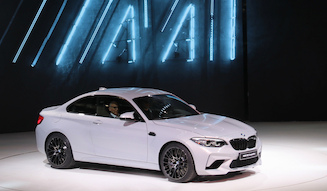
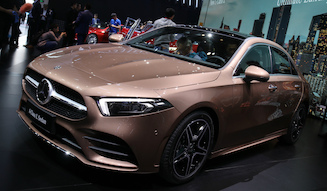
This sentiment is shared by BMW, which operates a joint venture with Brilliance Auto (Huachen Automotive Group). Peter Nota, the company's Board Member for Sales and Marketing, told me, "Our joint venture is successful, and we gain significant advantages through negotiations with local authorities. Therefore, there will be no changes in the short term."
For reference, BMW operates three factories in China and produces six models, including the "X3," which began production in June.
Turning to the exhibits, electrified vehicles, including plug-in hybrids (PHEVs), have become a major trend, driven by the Chinese government's mandate for manufacturers to produce a certain percentage of new energy vehicles starting in 2019.
Japanese automakers also showcased their efforts: Toyota displayed its first overseas-produced PHEV, while Honda presented an EV concept based on its China-exclusive brand, 'Everus'.
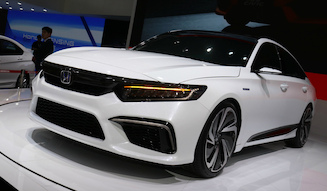
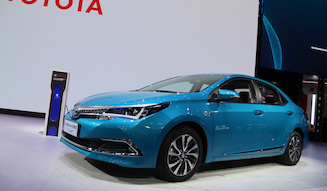
For context, a Nikkei report on May 20th, after the show's conclusion, stated that the Chinese government plans to build a city in the suburbs of Beijing by 2035 where all private cars will be autonomous. Xi Jinping's strong leadership is proving to be a powerful driving force towards becoming a technology-driven nation.
Returning to BMW, the company plans to launch 25 electrified models globally by 2025, including the "iX3" featured in the concept car section. As the era of EVs approaches, Chinese-funded premium pure EV brands like 'Byton' and 'Qiantu' are keenly eyeing market expansion. In this landscape, is BMW sufficiently competitive?
In response, Board Member Nota expressed confidence, stating, "BMW is making substantial investments in autonomous driving and digitalization. The same applies to connectivity; already, 1.3 million BMW ConnectedDrive vehicles are on the road in China. Our recently announced network collaboration with Alibaba will also be well-received by Chinese customers." He highlighted the various values accompanying electrification.
Beijing International Automotive Exhibition 2018 | Auto China 2018
Production Cars
No Visible Boundaries (3)
A Reminder of Tokyo
The Chinese pure EV brand 'Qiantu,' mentioned earlier, was established in February 2015, inheriting the legacy of its predecessor. Its first vehicle was unveiled at the Shanghai Motor Show in April of the same year. In essence, it is a three-year-old manufacturer.
Despite its youth, it showcased three concept cars in a spacious booth. Behind a partition, another model was on display.
Dubbed the "K50," it features a full carbon fiber body and is an AWD vehicle powered by two 160kW motors. Its top speed is approximately 200 km/h, it can charge to 80% in 45 minutes, and its range reaches nearly 300 km.
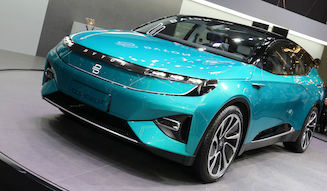
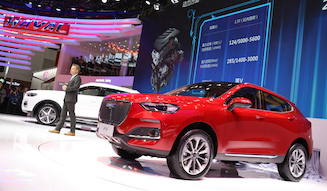
The company emphasized its high level of refinement, stating, "It's not just about overwhelming specs; the overall balance of driving dynamics is what truly matters."
This wasn't my first encounter with Qiantu at a Chinese auto show. I had assumed it was still in the concept stage, but according to staff, this was the final model ahead of its official launch in June. "It took time to get government approval (for production to begin)," a staff member recalled, hinting at the local circumstances.
Incidentally, some reports later indicated that the US market is also a target.
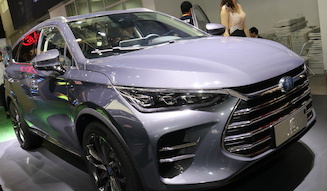
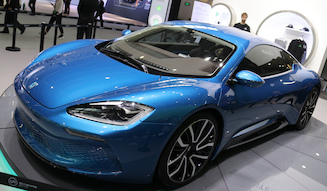
There were many other models where the line between concept and production car was blurred at first glance. Seeing such displays reminded me of the 1991 Tokyo Motor Show.
Foreign journalists who saw the Toyota Sera, released that same year, repeatedly asked the accompanying hostesses, "Is this a concept car?" They were likely puzzled that the Sera, with its eccentric gullwing doors, was placed on a flat display area, allowing free entry and exit, rather than on a turntable.
Production cars that resemble concept cars are a barometer of a motor show's vitality. The numerous Chinese auto shows are currently in the midst of a veritable boom.