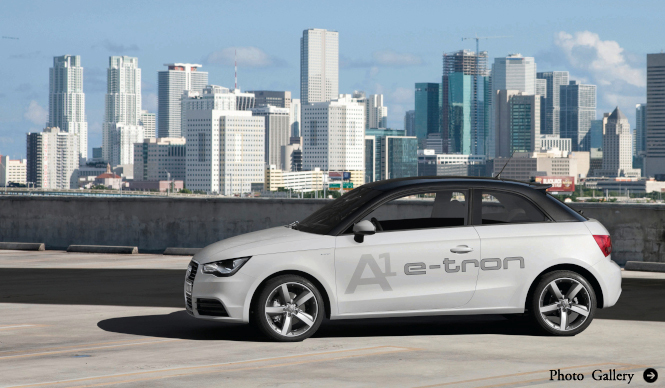
Audi's Future Engine | Audi
Audi Future Lab
Audi's Vision for the Future Society: Part 1
Audi Future Engine
What makes a premium brand truly premium? Is it not simply that its cars are luxurious, but that the car is positioned within the path toward the society the brand aims to realize in the future? If we aspire to cars from premium brands, is it not because the future they herald is one we find desirable? The "Audi future lab," which continues its research toward a sustainable society, encompassing not just cars but also infrastructure, makes one ponder such questions. In this two-part report, Tatsuya Otani covers the research outcomes from this Audi future lab. First, we look at the future of the engine.
Text by OTANI Tatsuya
The Cutting Edge of "Vorsprung durch Technik"
It was an incredibly comprehensive presentation.
AudiAudi's technology workshop, aptly named "Audi Future Lab," focused on "Mobility." This meant that not only cars, but anything related to human movement—from personal mobility like bicycles to urban transport, and even future energy sources—was covered, showcasing a wide array of Audi's current research initiatives. It's no wonder the topics were so extensive.
Given the sheer volume of information, it's physically impossible to cover everything. Therefore, we will focus on the themes that are most likely to pique the interest of OPENERS readers.
Hybrid Systems: Strengths and Weaknesses
The workshop not only featured presentations by engineers but also allowed attendees to test drive three experimental vehicles developed by Audi.
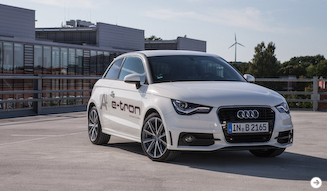
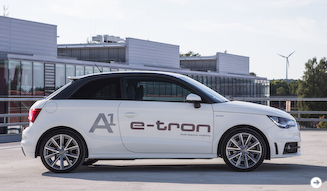
Among them, the most intriguing was the dual-mode hybrid system installed in the "A1."
What makes it "dual-mode" is its ability to seamlessly switch between series and parallel hybrid configurations.
In a series hybrid system, the engine is solely dedicated to generating electricity, which then powers an electric motor that drives the wheels. The engine and wheels are not mechanically connected. In contrast, a parallel hybrid system uses both the engine and the electric motor to drive the wheels, with a mechanical connection between the engine and the wheels.
While series hybrids allow for efficient engine operation, they can lack power as only the motor drives the wheels. Parallel hybrids, on the other hand, primarily use the engine for propulsion, making it difficult to optimize engine efficiency. Both approaches have their pros and cons.
Toyota's "Prius" employs a series-parallel hybrid system to address this dilemma. While it can operate in both series and parallel modes depending on the situation, its mechanism is somewhat complex. Chevrolet's "Volt" uses a similar concept.
Audi Future Lab
Audi's Vision for the Future Society: Part 1
Audi Future Engine (2)
Audi's Solution: "Dual Mode"
Meanwhile, Audi'sAudidual-mode hybrid system can switch between series and parallel modes with a surprisingly simple mechanism. Its core components include a 1.5-liter three-cylinder TFSI engine, a motor directly connected to it (EM1), a second motor (EM2) that drives the front wheels via the final drive, and a clutch positioned between EM1 and the final drive. Remarkably, it eliminates the need for a power split device, as seen in Toyota's system, and even a gearbox!
In fact, many electric vehicles (EVs) do not have a gearbox. This is because electric motors offer torque characteristics that are nearly ideal for automotive applications, providing strong torque at low speeds and diminishing torque at high speeds.
Thinking about it, a series hybrid system also drives the wheels using an electric motor, similar to an EV. The absence of a gearbox in the dual-mode hybrid can be understood through the same principle.
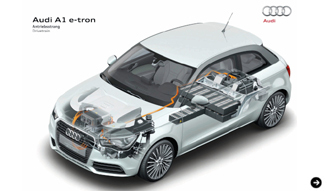
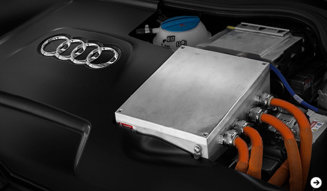
This dual-mode hybrid primarily functions as a series hybrid. When needed, the engine drives EM1 to generate electricity, which then charges the battery. EM2 receives power from the battery to drive the wheels. During this process, the aforementioned clutch is disengaged, meaning only EM2 is providing propulsion. Conversely, the engine and EM1 focus solely on power generation.
Incidentally, the engine in "series mode" only operates when the battery charge is low; otherwise, it remains off. Consequently, in terms of noise and vibration, it is indistinguishable from an EV.
So, how does it switch to "parallel mode"? By starting the engine and engaging the clutch.
This connects the engine, EM1, and EM2, allowing the engine's power to be transmitted to the wheels. While this might seem somewhat crude compared to Toyota's system, which carefully blends engine and motor power using a power split device, Audi's dual-mode hybrid operates remarkably smoothly.
Audi's High Expectations
During the test drive, the car started smoothly using only electric power. If driven gently, it could reach speeds of up to 130 km/h on electric power alone. However, when the accelerator pedal was pressed firmly, such as when merging onto a highway, the engine would quickly start, the clutch would engage, and the car would accelerate powerfully, something not possible on electric power alone. The system also allows for comfortable cruising at speeds above 130 km/h on the German Autobahn.
What's even more interesting is that Audi has developed this dual-mode hybrid into a plug-in hybrid. The large 17.4 kWh lithium-ion battery offers an impressive electric-only range of 90 km on a full charge. This means that as long as the battery is kept charged, daily commutes can be handled almost entirely on electric power. Consequently, the engine is only engaged when high power is required in parallel mode or when the battery is running low.
During our test drive, the battery was sufficiently charged, so the engine did not engage unless the accelerator was pressed deeply.
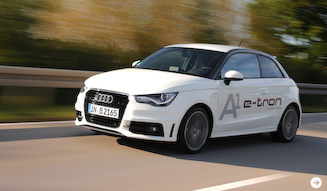
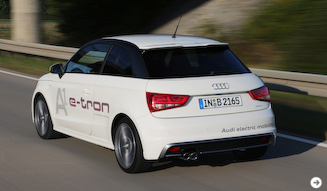
The limited range of EVs has long been considered their biggest drawback. However, Audi's dual-mode hybrid overcomes this by allowing the engine to recharge the battery, effectively solving the EV's Achilles' heel. Furthermore, by combining a simple mechanism with a 1.5-liter three-cylinder engine, Audi has achieved both excellent performance and a compact design that fits within the A1's engine bay. This system holds significant promise for the future.
At the recent Paris Motor Show, Audi unveiled the concept car "crosslane coupe" which featured this very dual-mode hybrid powertrain. This clearly indicates Audi's high expectations for this system.
Audi Future Lab
Audi's Vision for the Future Society: Part 1
Audi Future Engine (3)
Electric Boost That Tames Quattro
The second test vehicle was the "A6 3.0 TDI" equipped with an electric biturbo.
This is essentially an electric supercharger, driven by an electric motor. Its primary advantage is its rapid response. It effectively compensates for the turbocharger's drawback, which cannot generate boost pressure until the engine reaches a certain RPM.
Compared to conventional mechanical superchargers, electric superchargers allow for precise electronic control, enabling them to deliver boost pressure quickly only when needed. This is another significant advantage.
However, a weakness of electric superchargers is their high power consumption to drive the compressor. To address this, Audi utilizes the electric supercharger only during initial acceleration when a sharp response is crucial. Once the engine reaches higher RPMs, it switches to a turbocharger driven by exhaust gas energy, thus achieving both high responsiveness and efficiency.
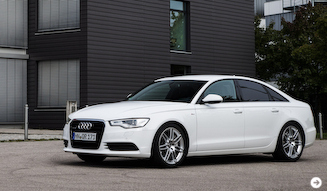

The effect is remarkable. Despite being based on the "A6 3.0 TDI quattro" with all-wheel drive, when the throttle was floored from a standstill, the immense torque caused the tires to spin with a "screech," overwhelming the grip of all four wheels.
According to the engineer accompanying us, this was because the tuning had not yet been optimized for the electric biturbo, and it is possible to eliminate the tire screech with further development. Nevertheless, the initial torque capable of overpowering the quattro system is astonishing. Its responsiveness is sure to change perceptions of diesel engines.
Incidentally, this prototype vehicle was equipped with only one conventional turbocharger. The primary objective of using a single turbocharger was likely to shorten the exhaust path and enhance catalytic converter efficiency. The initial concept was probably to compensate for the reduced responsiveness caused by using a single turbo instead of twin turbos with this electric supercharger. In any case, from the perspective of enhancing both performance and environmental efficiency, the potential of this system feels very high.
In principle, the electric biturbo can be applied to both diesel and gasoline engines. The reason for using a diesel engine in the test vehicle was likely the judgment that it would be more advantageous for demonstrating the improved responsiveness.
Audi Future Lab
Audi's Vision for the Future Society: Part 1
Audi Future Engine (4)
High Voltage Promotes High Efficiency
The final vehicle we test drove was the "A7 Sportback 3.0 TFSI" equipped with the "iHEV" system. In a nutshell, iHEV is an energy recovery system based on 48 volts. Standard passenger cars typically operate on a 12-volt electrical system. In contrast, the motors in full hybrid vehicles are driven by high voltages exceeding 200 volts. iHEV sits in between. Therefore, it is less expensive than a full hybrid system and offers more power than a standard passenger car's electrical system (iHEV also includes a 12-volt system in parallel).
What does this "slightly more powerful" electrical system achieve? It enables an idling stop function with an expanded operating range.
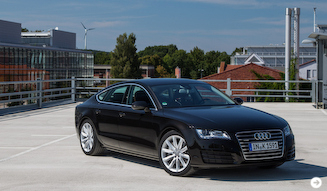
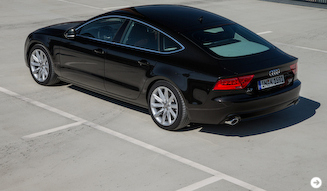
In conventional idling stop systems, the engine is restarted using the traditional starter motor. This starter is designed to ignite a completely stopped engine; it cannot restart an engine that is still in the process of stopping. Consequently, conventional idling stop systems only allow for restarts after the engine has completely halted.
This means that even if the driver thinks, "Ah, I really want to start the engine now...", they cannot restart an engine that is in the process of stopping. This inevitably leads to a waiting period. Alternatively, situations arise where the engine could be stopped but is intentionally kept running as a precaution. The former frustrates the driver, while the latter prevents the idling stop system from achieving its full efficiency benefits.
iHEV breaks through this dilemma. Instead of the conventional ring gear and pinion gear combination, it connects the motor and engine with a belt and incorporates a powerful 48-volt motor, enabling the restart of an engine that is still in the process of stopping. It also employs precise control that allows the engine to stop even at the slightest opportunity.
The effect... is unfortunately difficult to perceive. While the tachometer does show the engine frequently stopping,
the stopping and restarting are so smooth, akin to a hybrid vehicle, that one hardly realizes the idling stop system is active.
Nevertheless, it undoubtedly offers greater fuel efficiency improvements than vehicles with conventional idling stop systems.
Audi is considering integrating this system with its navigation system in the future. For example, when approaching the crest of an incline, the vehicle's speed barely decreases even if the throttle is released just before reaching the summit. By providing information to the driver through the display, such as "You can release the throttle now," the system encourages early throttle lift-off, thereby extending the idling stop duration and achieving fuel efficiency beyond the hardware's inherent potential.
While the 48-volt system performs energy regeneration, the recovered electricity is not directly used to drive the wheels. Furthermore, the 48-volt and 12-volt systems are connected via a DC-DC converter, allowing them to assist each other when necessary.
This concludes the first part of "Audi Future Lab." In the second part, we will report on Audi's vision for urban engineering and future energy.