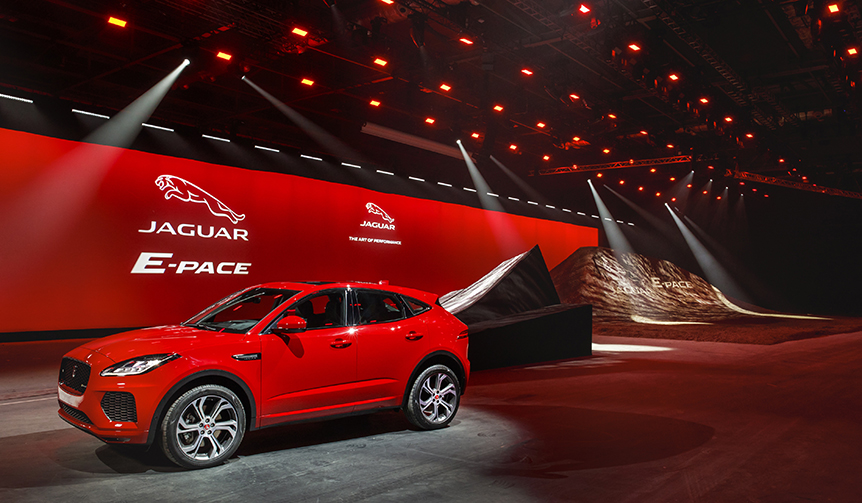
Introducing the Jaguar E-PACE, Jaguar's New Compact SUV | Jaguar
Jaguar E-Pace | Jaguar E-PACE
Introducing the Jaguar E-PACE, Jaguar's New Compact SUV
Jaguar has announced its new compact SUV,F-PACEthe "E-PACE," following its "F-PACE."E-PACEWhat kind of model is this second SUV from the British brand? Yasuhiko Kawaura reports after seeing it in person in its home country.
Text by KAWAURA Yasuhiko
Returning to its Roots as a Sports Car Brand
In Japan's automotive world, where German brands often dominate the import car market,—Jaguar's latest creations have been steadily gaining presence.
This brand once faced an existential crisis due to declining product appeal and quality issues. However, since being acquired by India's Tata Motors in the late 2000s, after parting ways with its former parent company Ford, this historic British brand has shown clear signs of recovery.
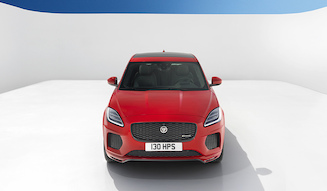
Jaguar E-Pace First Edition
The key to this success appears to lie in the products themselves. Freed from the constraints of sharing hardware with Ford vehicles, Jaguar's recent models are objectively compelling and should appeal to a wide audience.
Some may believe that the essence of Jaguar lies in its "gentle atmosphere, steeped in history and tradition." However, the brand recognizes that to secure its future, it must attract new customer segments, even if it means diverging somewhat from the desires of its long-time fans.—This unwavering determination seems to be reflected in the products Jaguar has been releasing lately.
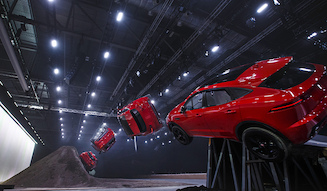
At its world premiere, the E-PACE performed a "barrel roll," jumping 15.3 meters while rotating 270 degrees.

The 15.3-meter barrel roll set a Guinness World Record.
Thus, the reborn Jaguar's initial strategy was to reassert itself as a "sports car brand," drawing on its history.
For example, the dramatic transformation of the flagship sedan, the "XJ," which underwent a full model change in 2010 to its current form,XJand the launch of the brand-new "F-TYPE" in 2012, reviving the two-seater pure sports car after a long hiatus,F-TYPEclearly demonstrate this stance.
Consequently, Jaguar's current lineup, developed under this new philosophy, is finally reaching its "harvest season."
Jaguar E-Pace | Jaguar E-PACE
Introducing the Jaguar E-PACE, Jaguar's New Compact SUV (2)
The Arrival of the E-PACE, the F-PACE's Younger Sibling
It's also noteworthy that this new Jaguar is actively expanding its SUV lineup.
SUVs have become a major focus for premium automotive brands worldwide. Porsche, which was quick to embrace this trend and achieve success as a former "sports car specialist," has been followed by Bentley, Maserati, Alfa Romeo, Lamborghini, and others. Brands that once seemed unlikely to venture into "tall 4WD models" are now actively developing them.
Jaguar, with engineers boldly stating "Our rival is Porsche!", is certainly not missing out on this trend.
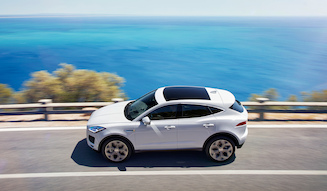
Jaguar E-Pace
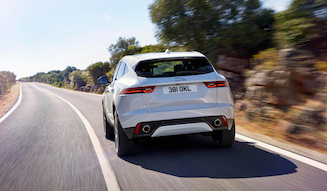
Among these, Jaguar first launched the "F-PACE," its first-ever SUV, followed by the all-electric "I-PACE," for which a specific market launch date of "early 2019" was announced. Most recently, they unveiled the E-PACE, which they themselves describe as a "compact performance SUV."I-PACEThe E-PACE, positioned as the successor to the globally acclaimed F-PACE, is easily imagined as its "younger sibling."
Indeed, its overall length and wheelbase are significantly shorter than the F-PACE's. The 4,395mm length is 351mm less than the F-PACE (domestic specification), and the 2,681mm wheelbase is 193mm shorter.
Jaguar E-Pace
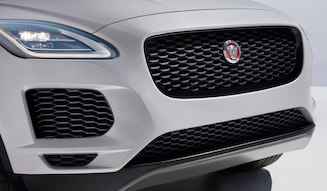
Jaguar E-Pace
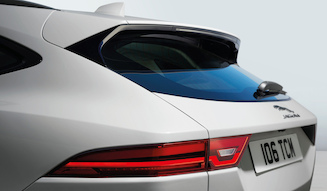
The height, however, is only 18mm lower, a deliberate choice to ensure ample cabin space for a full four-seater model. The width, with folded mirrors, is 1,984mm for the E-PACE, compared to 2,070mm for the F-PACE.
Currently, the width without mirrors—the standard measurement in Japan—is unannounced for the E-PACE, while the F-PACE measures 1,935mm. Ideally, for ease of use in Japan, it would be around 1.85 meters.
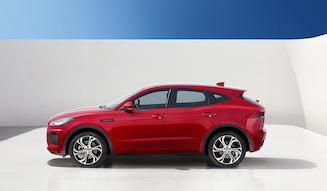
Nevertheless, seeing the E-PACE in person at its London launch event, the immediate impression is one of "remarkable sleekness and sportiness." The prominent lower body, clad in large wheels, certainly conveys the robustness expected of an SUV. Yet, the cabin's side window graphic, reminiscent of a coupe, and the tapering upper body at the rear exude the dynamic flair characteristic of recent Jaguar models.
Jaguar E-Pace | Jaguar E-PACE
Introducing the Jaguar E-PACE, Jaguar's New Compact SUV (3)
The Only Model in the Lineup Based on an FF Layout
The swept-back headlight housings that wrap around the front fenders and the taillight design, combining thin horizontal lines with a chicane-like indentation, evoke a connection to the pure sports car, the F-TYPE. This visual kinship with the F-TYPE is even more pronounced in the interior design.
For instance, the cockpit-like feel is emphasized by the grip bar-like structure that separates the passenger side, descending from the upper dashboard to the center console. The three rotary dials for climate control on the center panel, which the designer stated were inspired by "Leica camera lenses," are also a clear nod to the F-TYPE. Similarly, the shift lever, designed as a stick rather than the rising mechanism found in many Jaguars when the ignition is turned on, further reinforces this connection.
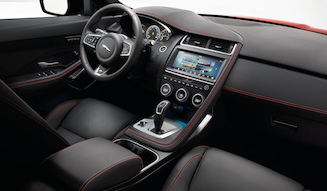
Jaguar E-Pace First Edition
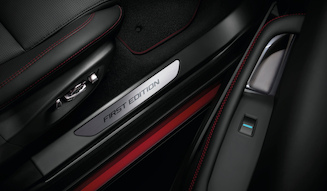
In terms of its resemblance to the F-TYPE, the E-PACE actually emphasizes this connection more strongly than the F-PACE itself. This clearly indicates the intention to design it as a "sports car for the SUV segment."
The running components adopted for the E-PACE, excluding the latest "Ingenium" engines, are distinctly different from those of its larger sibling, the F-PACE, and indeed any existing Jaguar model.
This is because the powertrain, consisting of five turbocharged 2.0-liter four-cylinder engines (two gasoline, three diesel) paired with either a 6-speed manual or a 9-speed automatic transmission, is mounted transversely—a first for the Jaguar lineup. In the 2WD variants, power is sent to the front wheels, making it the "only model in the lineup based on an FF layout."
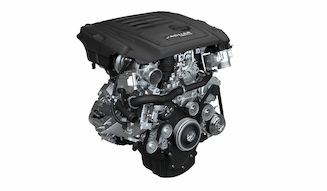
Inline 4-cylinder DOHC 2.0-liter diesel turbo engine
However, in the 4WD versions with high-output engines, a wet multi-plate clutch actively distributes torque to the rear wheels, enabling controlled drifts even on low-grip surfaces. This tuning, aimed at providing a "rear-wheel-drive-like" handling feel, is a characteristic touch for a Jaguar product.
Similarly, the body, constructed from a combination of high-strength steel, aluminum, and lightweight composite materials, with efforts made to "lower the center of gravity by aluminumizing components in higher positions, such as the roof, tailgate, and hood," further reinforces its identity as a product from a "sports car manufacturer."
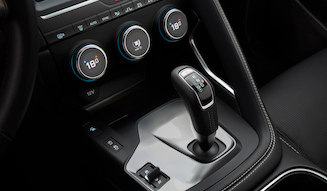
Jaguar E-Pace
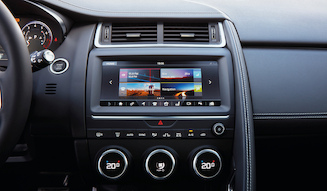
Furthermore, this model is equipped with numerous features befitting a new model, including the latest multimedia system, driver assistance systems utilizing stereo cameras, and a color head-up display.
Jaguar itself describes the E-PACE as "achieving the design and performance of a sports car in a compact SUV." Sales in its home market were slated to begin in the winter of 2017.